

Declaring famine in Gaza…a human tragedy that threatens development and exceeds the limits of food security
Declaring famine in Gaza…a human tragedy that threatens development and exceeds the limits of food security
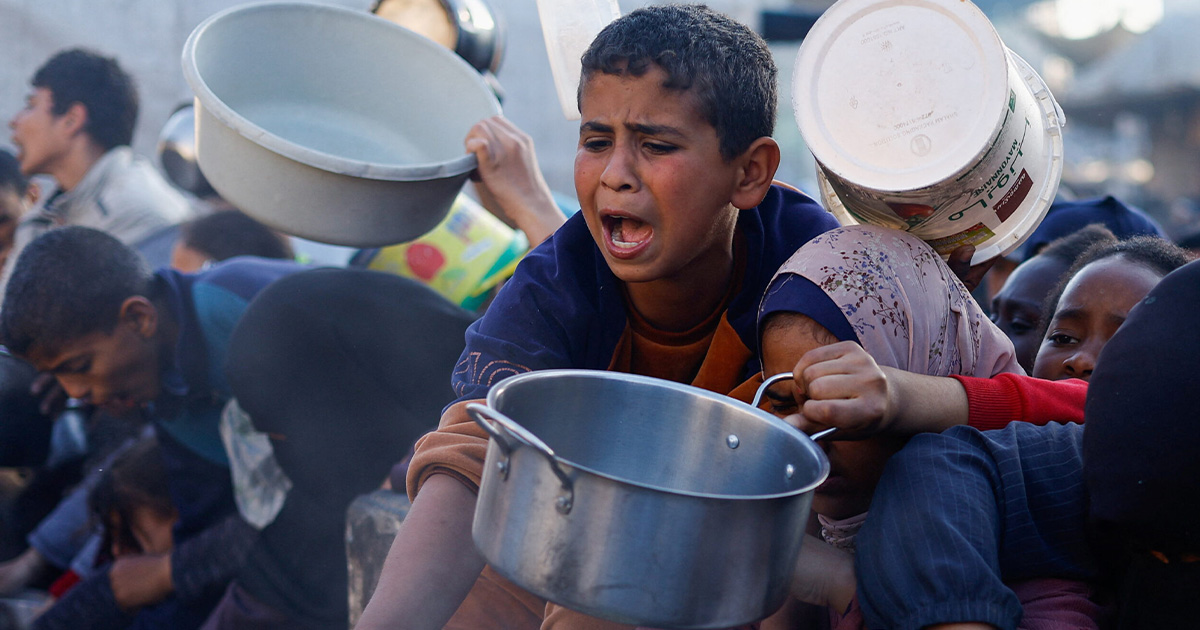
In recent weeks, the humanitarian scene inGazahas turned into something resembling a nightmare, after UN organizations announced that the Strip had officially reached a state of famine. This announcement emphasizes that the situation has gone beyond the usual crises and entered the stage of complete collapse at the level of food and health security.
From a comprehensive perspective, this crisis highlights the extent to which food security is linked to peace and sustainability, and demonstrates how ongoing conflicts and blockades can turn into tools of political pressure, increasing the scale of human suffering. Therefore, UN and regional institutions have confirmed that the cessation of aid and the destruction of infrastructure has complicated the crisis, which is something that the The Earth Guards Foundation__EG_PH_16 sheds light on in the following lines. To provide a clear vision on how food security is linked to regional peace and stability.
Origin of famine
The declaration of famine in the Gaza Strip cannot be understood in isolation from the recent war that swept the Strip, where the ongoing confrontations imposed a stifling blockade on the entry of humanitarian aid, in addition to targeting infrastructure, and the collapse of the health and economic systems.
With the escalation of tension in the Middle East, Gaza has turned into an open arena for conflict, in which the food blockade is used as a political weapon. Which undermined the most basic indicators of Palestinian life. Since the outbreak of war, basic supply chains have been cut off, and ports and crossings have come under tight military control, preventing the passage of food and medicine shipments. At the same time, intense raids destroyed agricultural lands, grain stores, and food factories.

Regional tension has made matters worse. Because with the escalation of the situation on more than one front in the Middle East, Gaza has become a victim of complex political calculations, with its suffering being exploited as a pressure card between the conflicting forces. Instead of humanitarian aid being outside the conflict equation, it has become a hostage of diplomatic negotiations and tensions.
Then the direct result was; This is what the United Nations described as the complete collapse of food security, as most of Gaza’s residents today live on less than one modest meal. This has caused an increase in the number of children suffering from acute malnutrition, and this heralds a humanitarian catastrophe unparalleled in recent decades.
Humanitarian Dimensions of the Crisis
The famine in Gaza is no longer just a food crisis, but has turned into a full-fledged humanitarian crime. There are hospitals without medicines or any medical services, and there are entire families who are unable to provide milk for their children. Those whose eyes have become sunken and whose bodies have become thin; Which confirms the brutality of war and the extent of the pain that civilians experience daily.
That society, which cannot find sustenance for its people, is facing an unprecedented collapse in its social fabric. Families are now dependent on aid that arrives only intermittently. As for the most vulnerable groups – such as the elderly, the sick, and people with special needs – they are most vulnerable to slow death, in the absence of any health care system.
There are also women who bear a double burden; They face the responsibility of feeding their children at a time when food availability has declined to catastrophic levels. Many of them are forced to abstain from even the most basic nutritional needs. In order to feed their children.
Hunger in Gaza has become a tool of humiliation, and this is not an accidental result of the war, but rather a deliberate policy to weaken society and break its will. This is what makes the current crisis a humanitarian challenge, and a human rights and moral issue that requires urgent action at the regional and international levels.
Economic repercussions on Gaza and the region
From an economic perspective, the famine in Gaza represents a complete collapse of the productive structure; The war destroyed local markets, closed factories, and stopped internal and external trade, and most workers lost their sources of income. This comprehensive humanitarian collapse made the residents of Gaza unable to purchase food even if it was available in limited quantities.
The crisis did not remain within the borders of the Strip, but rather its effects extended to the entire region. The increasing tension in the Middle East has undermined investor confidence, disrupted trade exchanges, and raised the prices of basic commodities in regional markets. Therefore, Gaza is no longer just a local issue, but rather a focal point for economic repercussions that threaten the entire regional stability.
Therefore, international financial institutions warn that the continuation of the situation as it is may lead to a broader crisis, as neighboring countries could be affected by waves of asylum, a financial increase in spending on humanitarian aid, in addition to a decline in long-term investments. Because the economy is inseparable from politics, and any collapse in Gaza will have a clear impact on the development equation in the entire region.
What is more dangerous than this is that the continued economic blockade makes any future plans for reconstruction more difficult. So how can we talk about sustainable development in light of the destruction of infrastructure and the absence of food security? This question reflects the real dilemma facing the Arab region, where achieving the Sustainable Development Goals (SDGs) becomes unattainable unless peace is achieved first.

International silence and absent responsibility
One of the most tragic aspects of declaring the Gaza Strip a famine zone is the absence of an effective international response; Despite repeated condemnations, the world has not been able – so far – to guarantee safe passages for humanitarian aid, or to impose real pressure to stop targeting civilians, especially since the statements issued by international institutions are not sufficient to save the lives of thousands of lives that are disappearing day after day.
In the Security Council, decisions faltered due to political divisions between the major powers, and at the same time relief agencies remained powerless in the face of field and political obstacles that restricted their movement. This gap between the scale of the disaster and the international reaction reveals the fragility of the global system and its weak ability to protect the most basic human rights.
The responsibility does not fall only on the major powers, but also includes regional countries that have the ability to exert pressure and influence. Because the continuing escalation in the Middle East imposes on these countries a pivotal role in formulating solutions that guarantee the arrival of aid and an end to the blockade, however, political calculations often override humanitarian considerations.

The Egyptian position
In the midst of this crisis, the Egyptian position came to reflect a deep awareness of the seriousness of the situation, as the Egyptian Ministry of Foreign Affairs announced its “deep concern” about reports of famine, stressing that what is happening represents an unprecedented humanitarian catastrophe, and that Egypt – which has always played a pivotal role in facilitating the entry of aid – stressed the need for the international community to move urgently to stop the worsening of the crisis.
The Egyptian statements were not limited to condemnation, but also included a clear call for the international community to shoulder its responsibilities. This Egyptian position recalled Cairo’s previous initiatives, which supported the residents of Gaza, whether by opening the Rafah crossing to bring in humanitarian aid, or by organizing international conferences for the reconstruction of Gaza.
Egypt – through its balanced statements – also put the crisis in its correct context: the Gaza issue is not just a humanitarian disaster, but a crisis that threatens development and the right to food and water. This position is consistent with the vision of sustainability that holds everyone collectively responsible for crises, far from selectivity or narrow calculations.

Food security is the pillar of peace and sustainability
The famine in Gaza is not a local crisis that can be contained with painkillers, but rather it is a clear warning to the entire world that wars and regional tensions undermine the foundations of sustainable development, whose goals – from eliminating poverty and hunger to building safe and healthy societies – cannot be achieved as long as food is a weapon, a siege, and an instrument of collective punishment!
Therefore, the path towards peace in the Middle East passes through ensuring food security, based on the fact that human dignity and life are a goal that everyone must achieve. Therefore,Earth Guards stresses that our common future begins with protecting the weakest, and ensuring the right of everyone to survive and live in dignity.


