

The Intellectual Property Authority discusses cultural industries at the Cairo International Book Fair
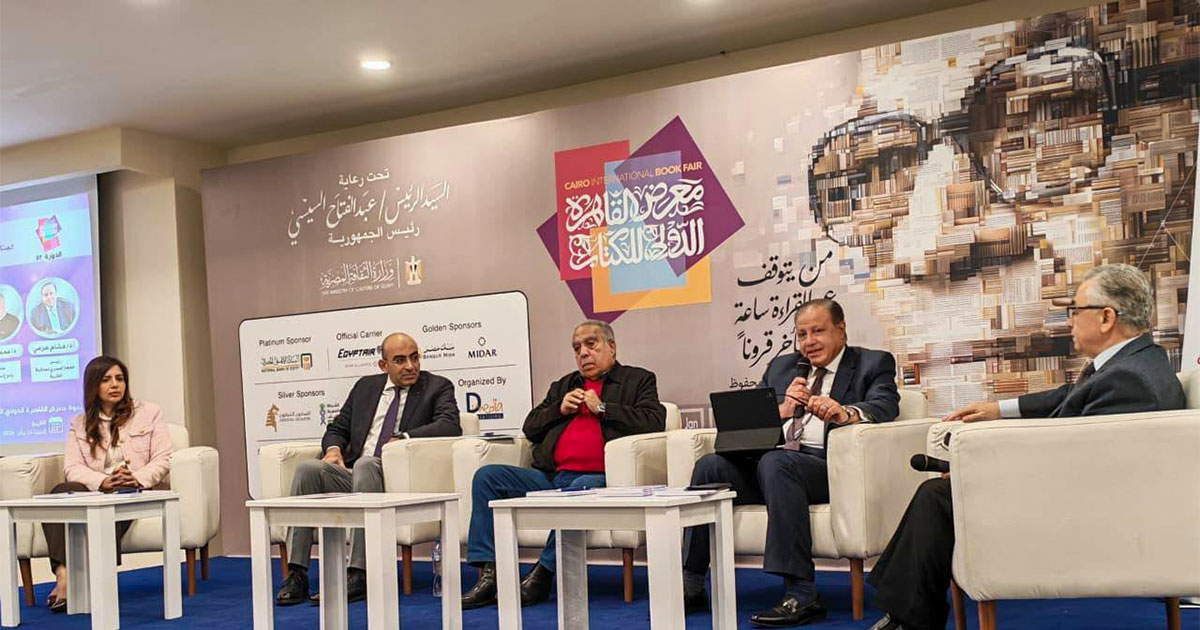

The Intellectual Property Authority discusses cultural industries at the Cairo International Book Fair
Cultural industries are no longer cultural activities or artistic expressions isolated from the path of development, but today they have become one of the rising engines for achieving theSustainable Development Goals (SDGs), with their ability to generate job opportunities, promote comprehensive economic growth, support innovation, and protect cultural diversity.
We should make it clear that cultural industries intersect with a number of Sustainable Development Goals (SDGs), most notably the eighth goal on decent work and economic growth, the ninth goal on industry, innovation and infrastructure, as well as the eleventh goal on sustainable cities and local communities, and the seventeenth goal on partnerships.
These industries also contribute to empowering youth and women, reducing inequalities, and supporting the local economy, through flexible production models that rely on human talent and are based on effective protection of intellectual property as the primary guarantor of sustainable creativity.
With this standpoint,Earth Guardssheds light on the most prominent seminars of the Cairo International Book Fair in its 57th session, in continuation of its ongoing coverage of all sustainable events; So keep reading.
Intellectual property is an introduction to cultural investment
In a step that reflects the growing interest in the cultural economy as one of the tributaries of sustainable development, the Egyptian Intellectual Property Authority organized an intellectual symposium on intellectual property and cultural and creative industries, as part of its first participation in the activities of the Cairo International Book Fair in its fifty-seventh session.
This was in the presence of Professor Dr. Hisham Azmy, “President of the Egyptian Authority for Intellectual Property,” Dr. Mohamed El-Adl, “film producer and distributor,” and Dr. Mai Hassan, “Assistant to the President of the Authority for Trademarks and Industrial Designs Affairs. The session was moderated by Professor Dr. Saeed Al-Masry, “Professor of Sociology at Cairo University, and former Secretary-General of the Supreme Council of Culture.”
The symposium came within the framework of the agency’s direction towards enhancing societal awareness of the economic role of intellectual property, especially in the cultural and creative sectors, as they are tools capable of transforming individual creativity into sustainable economic value. It is an approach that integrates with the axes of the National Intellectual Property Strategy, especially with regard to regulating creative assets and maximizing their economic returns.
Participation of cinema and publishing experts
The symposium witnessed the participation of an elite group of experts and specialists in the fields of cinema, publishing and innovation, where they discussed the challenges facing cultural industries in Egypt, and the roles of legal protection, investment, and digital transformation in supporting these industries, in light of the rapid changes that the world is witnessing, most notably artificial intelligence.

The discussions shed light on Egypt’s extensive historical assets and ancient cultural heritage in the fields of publishing, cinema, and radio, as one of the most prominent sources of soft power. Despite this, the contribution of cultural industries to the national economy is still limited compared to global rates, which is linked to the challenges of managing cultural assets, weak investment mechanisms, and the need to build an integrated system that maximizes the economic return of creativity.
Shifting from protection to economic development
The symposium participants stressed that the concept of intellectual property has become an effective tool to support economic development, through institutional partnerships, early awareness, and reliance on digitalization to preserve cultural heritage – especially audiovisual – and repurpose it economically in a way that preserves its value and ensures its sustainability.
In this context, the discussions addressed the challenges associated with protecting the rights of creators in the fields of cinema and publishing, including piracy, high production costs, and the absence of specialized academic frameworks, as well as concerns associated with the production of counterfeit content using artificial intelligence techniques.
Trademarks and Heritage Crafts
Also from this angle, discussions at the Egyptian Intellectual Property Authority symposium emphasized the importance of linking heritage crafts with trademarks that protect the rights of their owners, while distinguishing between authentic heritage products and those inspired by heritage, in a way that contributes to their protection and marketing in a fair and sustainable manner, and enhances their presence in local and international markets.
Considering the above,FoundationDefenders of the Earth believes that the future of cultural industries is measured by the ability of societies to build an integrated system that protects creativity, invests in it, and redistributes it in a fair and sustainable manner. Because creativity, in its essence, is a renewable and inexhaustible resource.
From the perspective ofEarth GuardsIntellectual property represents the cornerstone of any sustainable creative economy, as a tool and redress mechanism that preserves the rights of creators, prevents the depletion of heritage, and confronts patterns of unfair exploitation, especially in light of the accelerating digital transformations and the widespread spread of artificial intelligence technologies.
Therefore,The Foundation emphasizes that integrating cultural and creative industries into national policies for sustainable development is a strategic necessity to achieve more comprehensive and sustainable growth that balances innovation, freedom of creativity, and protection of rights. That is, the real stake is in building an enabling environment that releases the energy of creators, and transforms culture from a spending burden into a development asset, and from a symbolic discourse into an effective force in the path of comprehensive sustainable development.


