
New Egyptian-European Partnership to Explore Enhanced Water Resource Cooperation

A new Egyptian-European partnership to discuss ways to enhance cooperation in the field of water resources
Egypt’s efforts towards achieving Sustainable Development Goals (SDGs) are increasing through specific projects aimed at strengthening infrastructure and protecting natural resources. Within the framework of this approach, water resources constitute one of the basic pillars of sustainable development, as they are linked to achieving both food, health and environmental security.
In an important step towards this goal, the state aims to implement a group of strategic projects aimed at improving water quality and modernizing infrastructure, such as rehabilitating drains and lifting stations and maintaining important water facilities, in line with the sixth goal of sustainable development: clean water and sanitation.
An expanded meeting with officials of the Development and Reconstruction BankEuropean
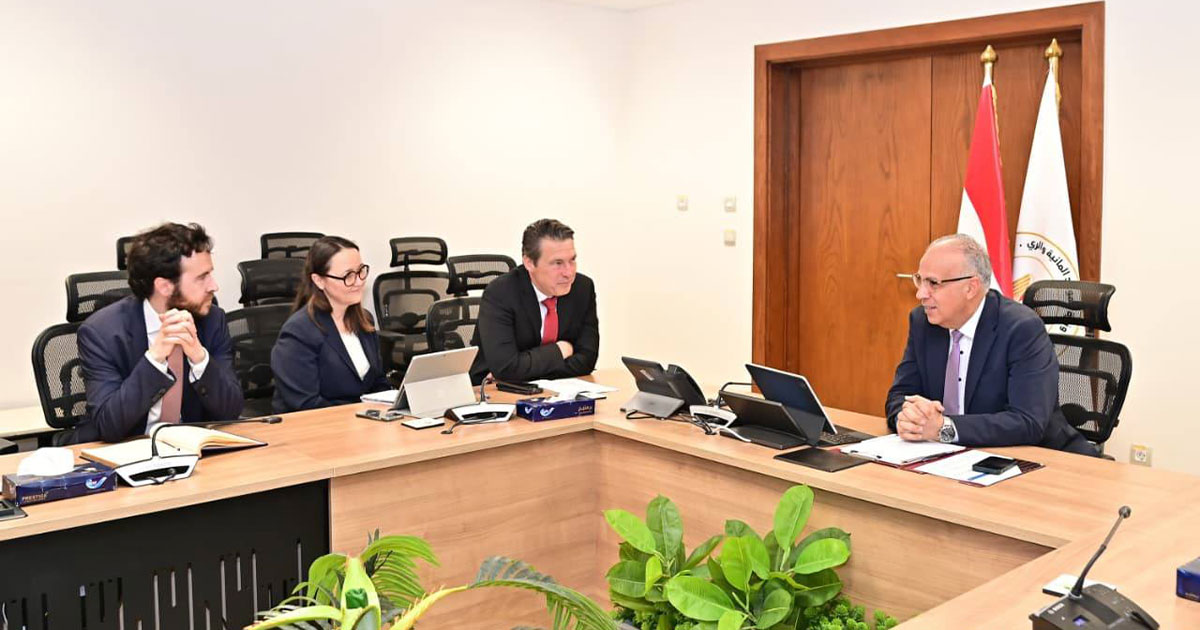
In this spirit, Mr. Dr. Hani Sweilem, Minister of Water Resources and Irrigation, held a meeting with representatives of the European Development Bank and Reconstruction Bank, Ms. Aida Sitdikova, Director of Sustainable Infrastructure for the Middle East and Africa Region at the European Development Bank, and Mr. Mark Davis, Director General of the Southern and Eastern Mediterranean Region at the European Development Bank and the delegation accompanying them, to discuss ways to enhance cooperation between the Ministry and the Bank in the field of water resources. Water.
The meeting included a review of ongoing cooperation projects between the Ministry and the Bank, such as the “Kitchener Bank Rehabilitation Project,” “Rehabilitation of Lifting Stations in Egypt,” and “Rehabilitation of the Rosetta Sea Wall,” in addition to new projects aimed at improving water quality and modernizing the infrastructure.

Accelerated steps to improve water quality and infrastructure
The components of the “Water Quality Improvement Project in the Kitchener Drain” that have been implemented so far with regard to the Ministry of Water Resources and Irrigation were also reviewed. The preparation of the required environmental studies has been completed, and the work of bulldozing, removing weeds and rehabilitating the drain’s bridges is underway. A process has also been carried out to replace and renovate a number of (3) bridges and a number of (1) grass ranges, and a process is being implemented to replace and renew a number of (4) bridges and a number (1) Hadar, and proposed the construction of the Hamul and Samatai stations.
Rehabilitation operations have been launched for a number of lifting stations, and the rehabilitation process of the emergency center in Abu Sakin has been launched. Devices for measuring conductivity and monitoring water quality are also being supplied, and complementary studies are currently being conducted in coordination with the European Development and Reconstruction Bank, where Dr. Sweilem pointed out the importance of making every effort.The necessary efforts to overcome the obstacles facing the project, accelerate implementation rates, adhere to the time programs set for the project, and speed up the tendering and awarding procedures for the rest of the work.
Cooperation in lift station rehabilitation projects
The meeting also discussed ways of cooperation between the Ministry and the Bank in the field of rehabilitating lift stations, under the umbrella of the “Strategic Plan for the Rehabilitation of Lift Stations in Egypt” recently prepared by the Ministry, and studying the proposal to implement projects to rehabilitate stations in partnership between the public and private sectors based on the inventory prepared by the Ministry of the status of stations within the strategic plan.
In addition to discussing aspects of cooperation with the European Construction Bank in the work related to evaluating the structural condition of the Rosetta Sea Wall, where the necessary terms of reference for selecting a consultant to conduct studies have been completed.The technical and economic feasibility of the necessary works, determining the required financing mechanisms, then putting the works forward for implementation.
Maintaining national water security
These strategic water projects reflect Egypt’s commitment to maintaining national water security and enhancing the efficient use of water resources in various sectors. Efforts to improve water quality and rehabilitate drains and lifting stations contribute to supporting agriculture and industry, and reducing water loss, ensuring the sustainability of natural resources for future generations.

These initiatives are also part of the broader approach to achieving the sixth goal of sustainable development, which focuses on clean water and sanitation. By raising the efficiency of water facilities and improving water quality, the state seeks to enhance the health of citizens and protect the environment from pollution, in addition toEnhancing cooperation between various parties, in line with the seventeenth goal of sustainable development, which focuses on strengthening international and regional strategic partnerships to support the effective implementation of sustainable development projects.
The Earth Guards Foundationvalues the partnership with the European Development and Reconstruction Bank, as it is a model of fruitful cooperation in exchanging expertise and technology, and financing vital projects. This cooperation also highlights Egypt’s pioneering role in the region in managing sustainable water resources, and creating a model for integration between the public and private sectors to enhance water infrastructure projects in a sustainable and effective manner.