

Pakistan floods in 2025…a climate disaster that threatens lives and calls for sustainable solutions
Pakistan floods of 2025…a climate disaster that threatens livesand calls for sustainable solutions
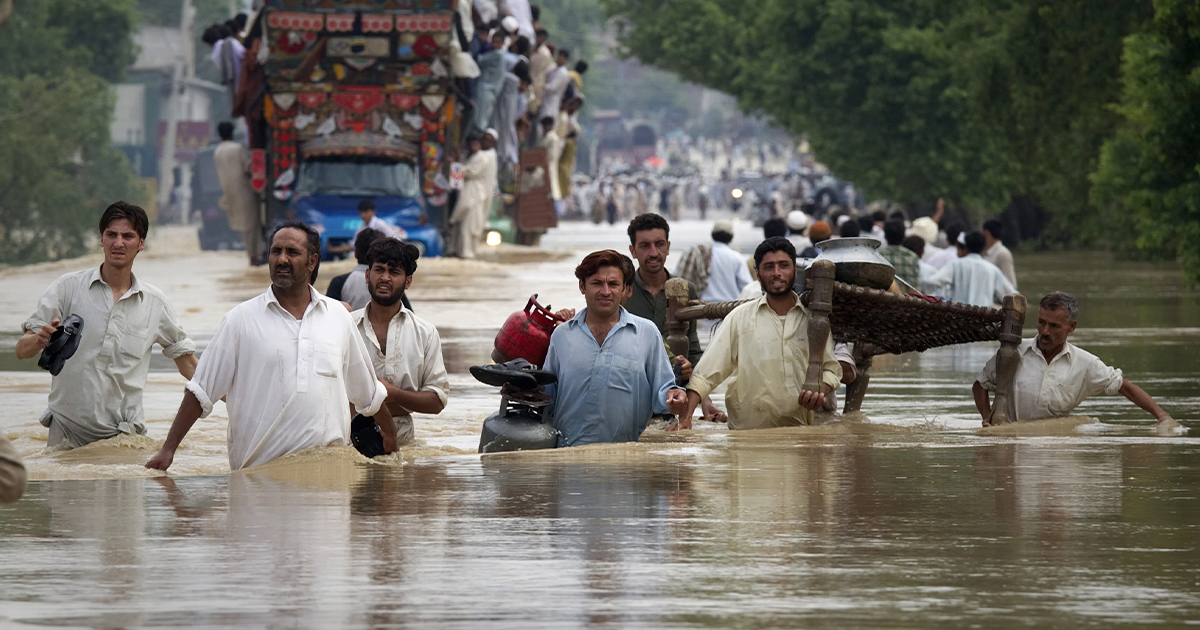
The cries for help coming from Pakistan have not yet subsided, as the death toll continues to rise tragically as a result of the floods caused by heavy monsoon rains. The authorities have confirmed that the death toll has exceeded 307 people, while rescue teams continue their efforts amid extremely difficult circumstances. The province of Khyber Pakhtunkhwa, bordering Afghanistan, was the most affected. Its mountains turned into a scene of sweeping landslides and flash floods that claimed the lives of dozens.
Many victims died under the rubble of destroyed homes, while lightning strikes and torrential rains took the lives of others, and while the authorities declare entire areas disaster-stricken, rescue personnel find themselves facing an almost impossible mission, with blocked roads and landslides impeding access to remote villages. This has prompted the government to deploy more than two thousand relief personnel in an attempt to confront the disaster.

However, the tragedy did not stop at human losses alone; The floods completely swept away at least 74 homes, while a new tragedy was added with the downing of a rescue plane, killing its crew of 5 people. In the Pakistani part of Kashmir, the disaster claimed the lives of 9 other people, making the picture of the tragic situation prevailing over the country more clear.
Non-stop rain and landslides
As the destruction expands, fears increase that what comes next will be more cruel. Meteorology expects heavy rains to continue until August 21, which puts northwestern Pakistan in front of a new catastrophic scenario. For the residents of Khyber Pakhtunkhwa, rains are no longer just a seasonal phenomenon, but rather an escalating crisis that completely disrupts their lives. Blocked roads and landslides prevent aid from arriving, while rescuers are forced to walk for hours in dangerous terrain to reach those trapped.
The spokesman for the state disaster authority, Bilal Ahmed Faizi, explained that the bad weather conditions complicate all efforts, saying: Rescue teams are trying to evacuate the survivors, but many of them refuse to leave for fear of losing their loved ones trapped under the rubble, and here a double human tragedy is evident between the desire to survive and the fear of leaving loved ones under the rubble.
This scene reflects the cruelty of natural disasters, as they turn into a severe test of human solidarity and the ability of societies to cohesion. At a time when residents need shelter, clean water and food, the authorities must move quickly to strengthen rescue efforts and provide resources to protect those affected.
Humanitarian disaster
However, the human dimensions of disasters always reveal the most painful side of the tragedy, as individual experiences reduce the magnitude of losses beyond numbers and statistics; At the heart of this disaster, residents tell poignant stories of the loss of land, memories and loved ones. One farmer from the affected areas spoke sadly about how his family’s agricultural land, which they inherited over generations, had completely disappeared after being swept away by landslides. There was no longer a trace of the field that had been the scene of childhood games; Mud and huge rocks covered everything. This man, who retrieved dozens of bodies from under the rubble, could only express a bitter mixture of grief for the loss of loved ones, and relief at knowing their fate and the recovery of their bodies.
In another story, a teacher in the area spoke about the suffering of families who collect bodies and perform funeral prayers over them in extremely cruel conditions. With bitterness and sorrow, he indicated that he found the bodies of a number of his students, wondering in pain: “What did they do to deserve this?” These personal testimonies summarize the extent of the pain experienced by the local community and place the disaster in its deeper humanitarian context.
From tragedy to responsibility
These events point to a deeper crisis linked to the Sustainable Development Goals (SDGs), specifically Goal 3 on health and well-being, Goal 11 on making cities and communities more sustainable, as well as Goal 13 on climate action; Natural disasters, such as the floods in Pakistan, are not just passing events, but rather are stark indicators of the extent of weak infrastructure, inadequate emergency plans, and the absence of climate justice.
Humans living in fragile regions such as Khyber Pakhtunkhwa or Kashmir contribute the least to greenhouse gas emissions, but are most affected by its consequences. This reality places the international community with a moral responsibility to provide technical and financial support to these regions, and to enhance their capabilities to withstandclimate changes.

In conclusion, theEarth Guards__EG_PH_48 Foundation sheds light on the 2025 floods in Pakistan; Because it reveals that climate change is no longer just an environmental threat, but rather a comprehensive humanitarian crisis that affects security and stability in the most fragile regions, and that what happened in Khyber Pakhtunkhwa and Kashmir demonstrates the extent of the absence of effective adaptation policies and the weakness of infrastructure. Which makes the poor the first to pay the price, even though they contribute the least to the exacerbation of the climate crisis.
This tragedy represents a global lesson that emphasizes the necessity of reformulating the path of development on sustainable foundations, by investing in green infrastructure, developing early warning systems, and strengthening international solidarity in the face of disasters. Protecting societies from tomorrow’s tragedies begins with protecting the planet today, and placing sustainability at the heart of all development policies.


