

President Sisi inaugurates the new Delta project on the Sheikh Zayed Axis to support agricultural development
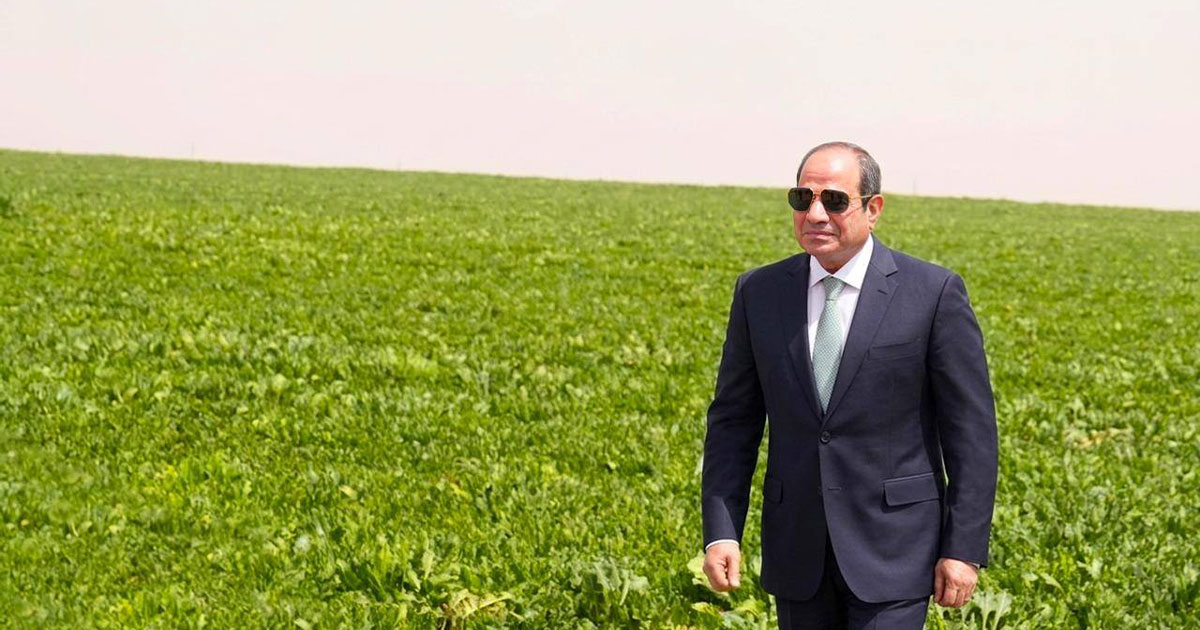

President Sisi inaugurates the new delta project on the Sheikh Zayed Axis to support agricultural development
Agricultural development represents one of the basic foundations for achieving sustainable development, as it is the main driver for enhancing food security, supporting the stability of national economies, and providing job opportunities. In light of the current global transformations, developing the agricultural sector, expanding the agricultural area, and improving the efficiency of water resources management have become strategic necessities that are directly linked to the ability of countries to secure the food needs of their people and reduce dependence on foreign imports.
In this context, eliminating hunger is one of the main goals of the sustainable development agenda, through building more efficient and sustainable food systems and the ability to confront crises, ensuring the safe and stable provision of food for current and future generations.
Therefore, many countries are moving to implement major national projects in the fields of land reclamation, maximizing agricultural production, and developing water infrastructure, as strategic tools for achieving comprehensive development and enhancing food security in the long term. This comes in line withSustainable Development Goals (SDGs), especially the second goal on eliminating hunger, the sixth goal on sustainable water management, in addition to the eighth goal related to providing decent work and promoting growth. Economic.
Opening of the New Delta Project
In the same context, Mr. President Abdel Fattah El-Sisi witnessed the opening of the new Delta project in the Sheikh Zayed Axis in Giza Governorate, where he was received upon arrival by Dr. Mostafa Madbouly, Prime Minister, Dr. Hussein Issa, Deputy Prime Minister for Economic Affairs, Lieutenant General Ashraf Salem Zaher, Commander-in-Chief of the Armed Forces and Minister of Defense and Military Production, Mr. Hassan Abdullah, Governor of the Central Bank, and Lieutenant General Engineer/ Kamel El-Wazeer, Minister of Transport, Dr. Hani Sweilem, Minister of Water Resources and Irrigation, Dr. Sherif Farouk, Minister of Supply and Internal Trade, and Mr. Alaa Farouk, Minister of Agriculture and Land Reclamation.

Facing challenges and consolidating state efforts
Mr. President indicated during his intervention that what happened in the New Delta Project could not have happened except by the grace of God Almighty and the efforts of the generous Egyptian people. His Excellency called on the Egyptian people to be happy and proud of what has been accomplished within the framework of this project within the efforts to achieve agricultural development, pointing out that the project faced great challenges that were overcome in its implementation, noting that the project witnesses a concerted effort of all state agencies, and with the active participation of the private sector, as 150 companies work in agricultural production only, in addition to hundreds of companies in other activities.
With regard to the volume of work carried out within the framework of the project, Mr. President indicated that the cost of the project reached approximately 800 billion pounds, at a cost between 350 and 400 thousand pounds per acre, in addition to the construction of new roads with lengths of up to 12 thousand km.
The challenge of providing the necessary water for the project
In the same context; Mr. President pointed out the challenge associated with providing the necessary water for the project, by collecting agricultural drainage water from the Delta governorates after tertiary treatment, then constructing and lining two paths: the northern path and the eastern path, each of which is 150 km long.
In this context, His Eminence pointed out that the transfer of collected water was contrary to the natural geographical tendency of the lands, which required the establishment of 19 main lifting stations to provide water for the cultivation of more than two million acres. His Eminence also noted the establishment of electricity production stations with a total capacity estimated at about 2,000 megawatts.
This trend reflects the state’s interest in adopting sustainable solutions for managing water resources and maximizing their use, in a way that supports efforts to achieve sustainable development and enhance the agricultural sector’s ability to face future challenges.
Development of the agricultural sector and agricultural development
Mr. President stressed that the strategic vision of the project to develop the productivity of the agricultural sector in Egypt is based on achieving integration between old and new agricultural lands, so that traditional crops such as wheat and corn are produced from clay lands in the valley and delta for their high productivity, then focusing in the new lands on crops that have quality in desert lands, similar to the beet crop, which achieves the maximum benefit from the lands and agricultural cycles.
The project, in turn, achieves comprehensive Sustainable Development Goals (SDGs), especially Goal (2) to completely eliminate hunger, by achieving agricultural development through expanding the cultivation of strategic crops such as wheat and corn with the aim of achieving food security.
Mr. President also noted that the project provides about two million job opportunities, stressing that these are sustainable and not temporary job opportunities, and thus the project contributes to supporting the Sustainable Development Goals (SDGs) related to providing decent job opportunities, and enhancing the participation of the private sector in advancing the wheel of sustainable economic development.
In this context, Mr. President stressed that achieving sustainable development is a continuous and never-ending process, and that ambition also does not end, including maximizing agricultural production and achieving agricultural development, as His Excellency noted the other projects being implemented in Minya, Beni Suef, Kom Ombo, Toshka, East Uwaynat, and Sinai.

In conclusion, the New Delta Project reflects a qualitative shift in the philosophy of development within the Egyptian state, as agricultural development has become based on an integrated development model that combines sustainable management of water resources, maximizing the efficiency of infrastructure, and achieving integration between food security requirements and economic development goals.
The project also embodies the state’s approach towards promoting agricultural development as one of the strategic paths to build long-term production capacity that reduces the impact of global fluctuations on supply and food chains, especially in light of the accelerating economic and climate crises the world is witnessing.
The The Earth Guards Foundation confirms that this new delta project will contribute significantly to achieving sustainable agricultural development, which has become a strategic necessity linked to protecting national security and enhancing the state’s ability to meet the needs of citizens in the future.


