


Virtual Fence: A technological innovation that redefines sustainable grazing

Virtual fencing: a technological innovation that redefines sustainable grazing
Grasslands and natural pastures around the world are under increasing pressure, in light of the growing demand for food and the expansion of agricultural and pastoral activity, which puts these ecosystems before unprecedented challenges. While livestock rearing represents a primary source of food and income in many rural communities, traditional grazing practices often contribute to soil degradation, vegetation decline, and environmental imbalance. In this context, sustainable grazing emerges as an approach that seeks to reorganize the use of pastures, allowing for their renewal and protection without harming the continuity of production.
However, transforming this concept from a theoretical framework into daily practice has been subject to field obstacles for decades related to cost, human effort, and the difficulty of controlling the movement of livestock within vast areas and diverse terrain. With the acceleration of digital transformation in agricultural sectors, technology has begun to impose itself as an element capable of overcoming these restrictions and opening new paths to managing and promoting sustainable grazing in a more flexible and efficient manner.
Sustainable grazing between traditional constraints and technological transformation
Sustainable grazing is essentially based on the principle of distributing grazing pressure on the land, by periodically moving livestock between different areas, which gives plants sufficient time to recover and prevents long-term depletion of pastures. However, the application of this model collided with a complex practical reality, especially in large farms and areas with rugged terrain, where traditional fences require great effort in installation and maintenance, in addition to their high cost.
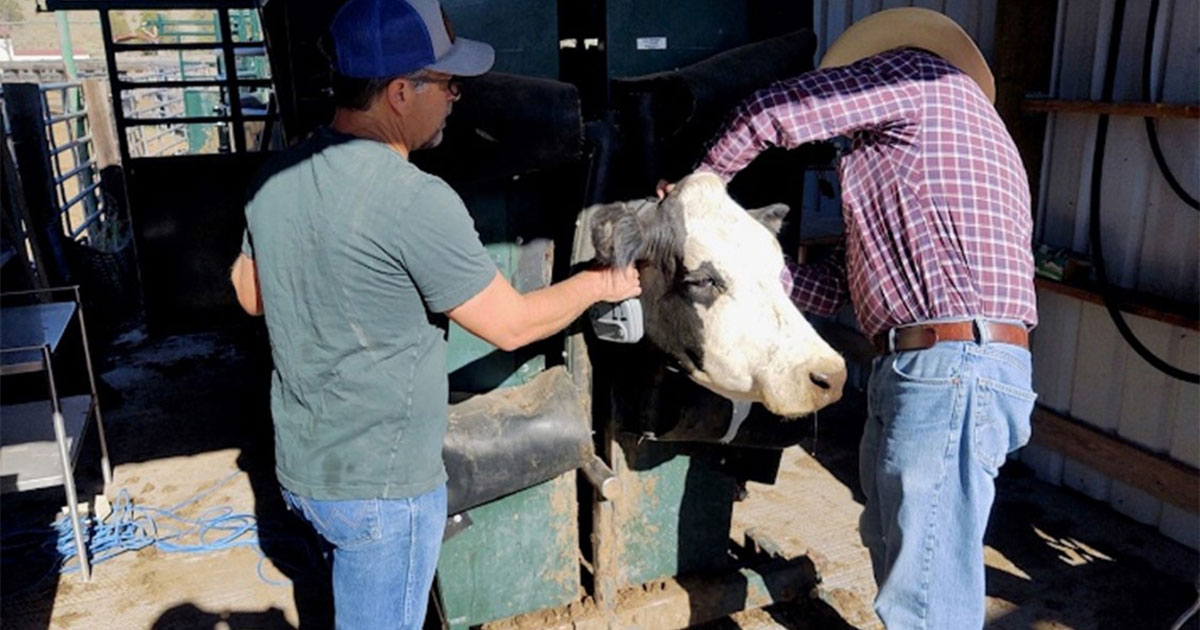
In this context, the emergence of virtual fencing systems represented an important turning point, as it allowed farmers to digitally define grazing areas without the need for physical barriers. These systems rely on smart collars that are attached to livestock and are connected to satellites and digital applications, allowing the animals’ movement to be directed with high accuracy.
This transformation gives farmers the real-time ability to adjust grazing plans according to changes in weather, feed availability, and soil condition, which enhances the practicality ofsustainable grazing. As the scope of these practices expands, a broader question arises regarding their impact on the surrounding environment, beyond the boundaries of the farm itself.

Environmental impact beyond pasture management
The impact of this technological shift extends beyond improving farm productivity, to protecting ecosystems and wildlife. Traditional fences, extending across vast areas, contribute to the fragmentation of natural habitats and hinder the movement of wild animals that depend on seasonal movement for survival. In large grassland areas, this fragmentation poses a direct threat to biodiversity and ecosystem stability.
By reducing reliance on physical fences, technology-enabled sustainable grazing allows the ecological connectivity of lands to be restored, soil health improved, and plant diversity increased. Together, these factors contribute to enhancing the ability of ecosystems to withstand climate change, and provide a more balanced environment that supports livestock and wildlife at the same time, without a fundamental conflict between production requirements and nature preservation. These impacts, in turn, are reflected in other economic and social dimensions.
Economic and social dimensions of sustainable grazing
In addition to the environmental impact, this model carries no less important economic and social dimensions. In rural communities, where family farms form the backbone of the local economy, high operating costs and tight profit margins threaten the continuity of agricultural activity. Sustainable grazing supported by technology reduces costs associated with labor and infrastructure maintenance, and improves the efficiency of resource use, thus enhancing economic viability in the medium and long term.
This model also gives farmers greater control over the management of their resources, and allows for more flexible planning in the face of climate and economic fluctuations. In this sense, sustainable grazing is transformed from an environmental choice into a tool for supporting social stability, protecting livelihoods, and ensuring the transmission of agricultural activity across generations without depleting natural resources.

Application challenges and scaling limits
Despite these advantages, the application of grazing techniques supported by virtual fencing is not without practical challenges that continue to limit the pace of its spread. The high cost of smart collars, along with the short lifespan of the batteries and the need for regular maintenance, represent an obstacle to their widespread adoption, especially on family farms with limited resources. These systems also require an initial stage of training livestock to respond to audio and electrical signals, a process that may not be smooth in all cases, with variation recorded in the response of some animals to the technology.
In addition to the technical challenges, the factor of societal and professional acceptance stands out, as doubts still remain among some livestock breeders about the effectiveness of these models compared to the traditional methods used by previous generations. In this context, partnerships with environmental and development institutions play a pivotal role in reducing adoption risks, by providing technical support, sharing experiences, and accompanying farmers during the first testing stages.
However, field experiences supported by initiatives such as sustainable grazing programs suggest that overcoming these hurdles remains possible, especially with a growing realization that the cost of continuing with traditional models - both in terms of land degradation and higher operational effort - may be higher in the long term. Hence, these technologies are gradually transforming from a risky experiment into a calculated investment option, reflecting a broader shift in agricultural thinking towards more efficient and sustainable practices.
In conclusion, recent experiences reveal that sustainable grazing, when integrated with digital technology within a clear vision, can be transformed into an integrated model that balances agricultural production and environmental protection. It opens new horizons for managing natural resources in a more efficient and fair way.
With this in mind,The Earth Guards Foundation believes that expanding the application of sustainable grazing supported by innovations such as virtual fencing requires policies that encourage more efficient pasture management, investments in environmentally smart agricultural solutions, and partnerships between farmers and environmental actors. These contemporary tools allow protecting grasslands, preserving biodiversity, and ensuring the continuity of pastoral activity, making sustainable grazing a practical path to achieving Sustainable Development Goals (SDGs) related to food security, protecting ecosystems, and supporting rural communities.


