


Major Karim Badr, an icon of justice, peace, and building strong institutions
"حماة الأرض" تكرم بطلًا صنع من جراحه منارةً للاستدامة
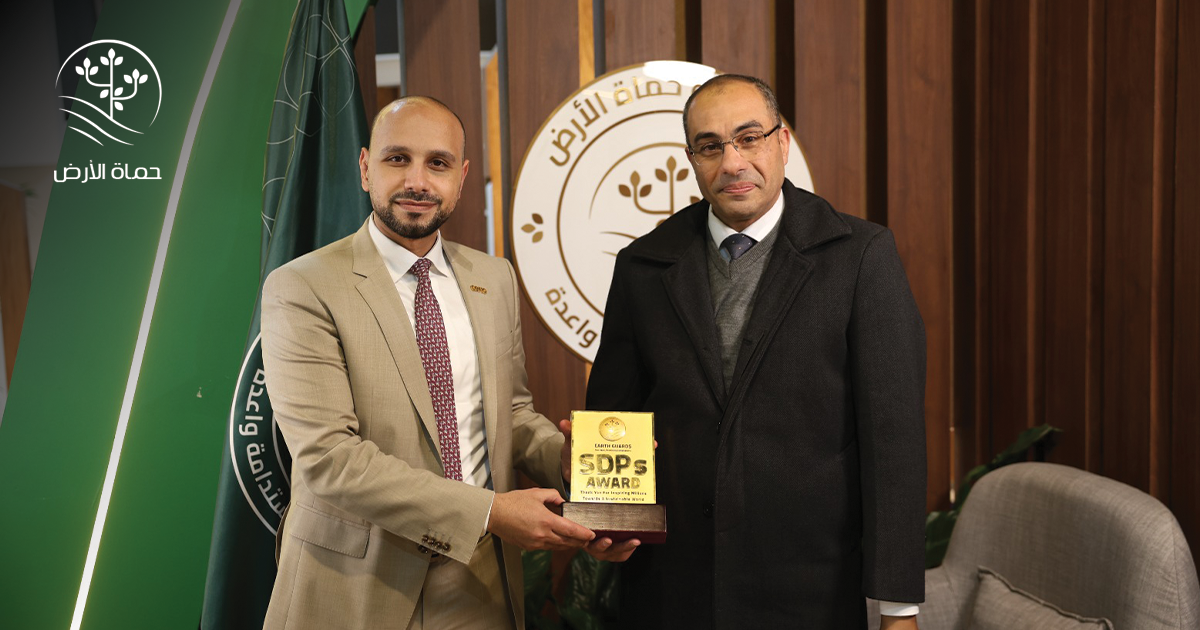

Major Karim Badr, icon of justice, peace and building strong institutions
In the register of nations, there are names engraved in blood on the rocks of national memory. Names that go beyond individual heroism to become a collective symbol for an entire nation. Among these names stands out the name of the combat major Karim Badr, who has become a living embodiment of Goal 16 of the Sustainable Development Goals (SDGs): “Peace, Justice and Strong Institutions”.
On the fourteenth of Ramadan, corresponding to the dawn of July 1, 2015, Sinai was facing one of the most dangerous attempts to undermine the sovereignty of the Egyptian state, when the forces of darkness wanted to cut off part of the body of the nation. A coordinated and comprehensive attack targeted at least 19 security and military points at the same time, launched by hundreds of terrorists armed with mortar shells, RPGs, heavy machine guns, and car bombs.
The goal was to create chaos by trying to implement an integrated project to demolish the state institution in the city of Sheikh Zuweid, isolate it, and declare it a dark emirate. That is, a complete undermining of everything that peace and justice mean, and an explicit demolition of strong institutions.
The epic of “Al-Rifai’s ambushes” is a legendary steadfastness in the face of hell
In the heart of the storm, Abu Al-Rifai’s ambushes were a prime target for the attackers. A small force of Egyptian heroes found itself in an unequal confrontation, bombarded by cars and heavy weapons from every direction. However, their bravery prevented these cars from reaching the main campus of the ambushes. They exploded it before it could reach its destination, carrying a huge explosive wave.
Despite the fall of martyrs and wounded, those who remained held on to their positions and deployed to defend every inch of the pure soil of the homeland, until military support came to them.
When the distress call arrived, the support force moved, led by Major Karim Badr, who stood in front of his men before moving, and said his words that became an indelible combat doctrine: “We agreed before moving that we would meet our Lord with the largest number of them.”
The force advanced with an M60 tank led by the two martyrs, First Lieutenant Muhammad Abdo and First Lieutenant Hussein Al-Sayyid, followed by Major Karim Badr’s vehicle. In record time, the force was at the heart of the clashes, seeking only one goal: the complete elimination of terrorists.
An arm for the homeland and a heart that knows nothing but victory
When First Lieutenant Muhammad Abdo was martyred, the martyr, First Lieutenant Hussein Al-Sayyid, continued driving the tank. The distance between the heroes of peace and the terrorist elements, who tried to approach to avoid the range of weapons, was reduced. From the half-inch machine gun nozzle, the soldier, “Krolls,” detonated a car bomb that was trying to evade.
Major Karim Badr began eliminating the largest number of attackers, before informing the leadership that he would carry out the evacuation himself. When the terrorists intensified their heavy fire on him, and at the height of his sense of danger and his fear of being captured - so that he would not be a burden on his soldiers - he said his immortal words to one of them: “If you find me a burden on you, shoot me with a bullet in the brain so that no one will take me like that.”
Khaledat’s words were the highest expression of refusal to submit to injustice, and of adhering to the honor of the Egyptian military institution until the last breath.
At the height of the battle, while he was destroying enemy vehicles, his armor was exposed to intense fire from RPGs, and the injury was direct and horrific: his left arm was amputated immediately.
Here, where the strongest men collapse, the strength of the Egyptian faith was demonstrated at its finest. He did not scream, nor did he retreat. Rather, he placed his amputated arm on the roof of his armored vehicle with unwavering stability, held his personal weapon in his right hand, and continued fighting. His injury-, which he later described as "A gift from God"-, turned into fuel for a battle that only ended with the victory of truth.
From the field to the men’s factory... when the hero turns into a builder of the future
The story of Major Karim Badr did not end with the end of the battle, nor with President Abdel Fattah El-Sisi honoring him; Because strong institutions are not satisfied with repelling aggression and achieving field victories, but rather strive to sustain their power.
The hero moved to the Military College - the Men’s Factory - bringing with him his experiences, transmitting combat tactics through case studies related to the battle of Al-Rifai’s ambushes, instilling in the hearts of future officers the values of sacrifice, redemption, and loyalty. In order to achieve peace and justice in the entire world.
Every lecture he gave, and every story he told, was a new building block in building a strong and sustainable institution capable of protecting peace and justice for many decades to come. To embody in person how injured heroes do not retire, but rather turn into beacons that light the way for future generations.
The Sustainability Pioneers Shield is a tribute worthy of the greats
In appreciation of this humanitarian and national epic,The The Earth Guards Foundation awarded Major Karim Badr the “Sustainability Pioneers Shield”, which honors exceptional, inspiring figures with sustainable achievements who contribute to achieving a tangible impact within the framework of the 17 Sustainable Development Goals (SDGs).
The story of Major Karim Badr cannot be read separately in the record of military heroics; It is a deep national situation that reveals the dialectical relationship between the individual’s sacrifice and the solidity of the institution, and how one feeds the other in an integrated circle whose greatest goal is the survival of the state, the rule of law, achieving justice and peace, and building strong institutions.


