

President of Slovenia at Cairo University… Discussion on achieving international peace and global challenges
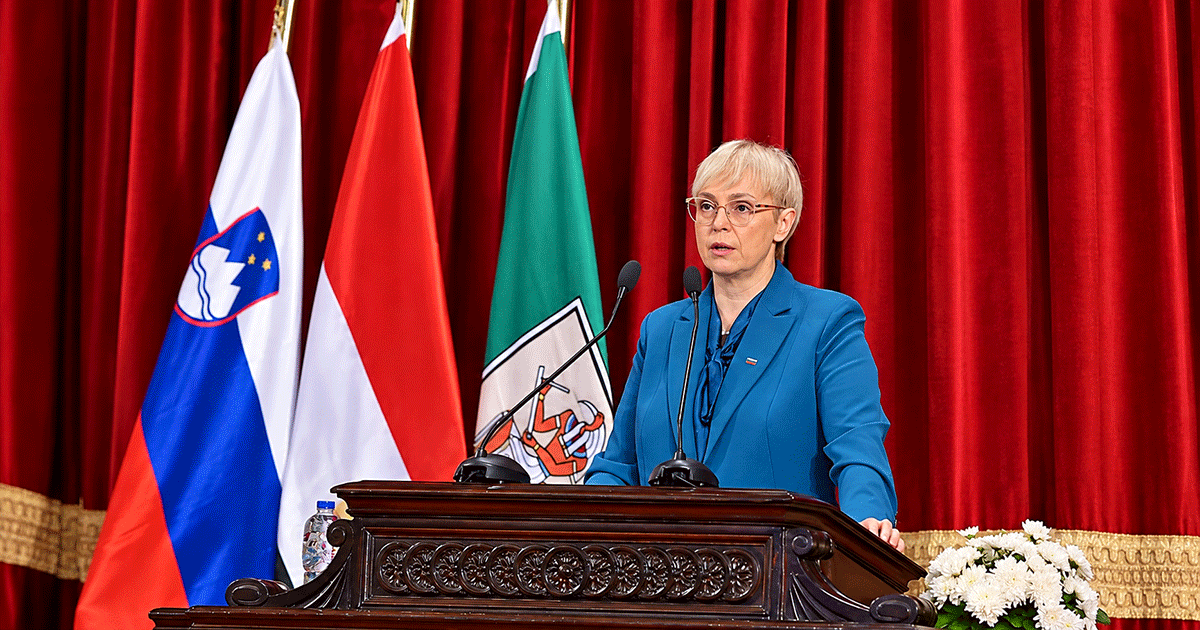

President of Slovenia at Cairo University.. Discussion on achieving international peace and global challenges
Academic institutions play a pivotal role in strengthening international partnerships and expanding areas of cooperation between countries, by exchanging knowledge and experiences, and opening spaces for dialogue between cultures and peoples, in a way that supports mutual understanding and enhances opportunities for joint action to confront global challenges, foremost among which are issues of international peace, protecting human rights, and establishing stability among societies.
In this context, Cairo University stands out as an academic platform for dialogue and exchange of visions, based on its scientific and historical status and its role in building bridges of communication with international institutions and figures, and providing the opportunity for new generations to interact with global issues, and discuss ways to enhance cooperation between… Peoples and creating a more peaceful and sustainable future.
An official visit to Cairo University
In this context, Cairo University received Her Excellency Dr. Natasa Peretz Musar, President of the Republic of Slovenia, on an official visit to the university, in the presence of Dr. Abdel Aziz Qanswa, Minister of Higher Education and Scientific Research, Acting Minister of Culture, Dr. Mohamed Sami Abdel Sadiq, President of Cairo University, and a number of diplomatic and academic figures, and leaders. The university, its faculty, and a large number of students.
The visit witnessed the President of the Republic of Slovenia giving a lecture on “Current and Future Risks”, followed by an interactive dialogue with Cairo University students on a number of contemporary international issues, within the framework of the university’s historical role as one of the most prestigious institutions. The academy in the region, and a platform for dialogue and exchange of visions and ideas between different cultures and peoples.
Dr. Abdel Aziz Qanswa expressed his pride in receiving the President of the Republic of Slovenia at Cairo University, as it is an ancient academic institution that has contributed over decades to preparing generations of leaders, scholars, and thinkers. He stressed that the visit represents an important opportunity to strengthen friendly relations between the two countries, and expand joint cooperation in the fields of higher education, scientific research, innovation, and sustainable development.
This cooperation is related to the fourth goal of the Sustainable Development Goals, concerned with quality education, by supporting the exchange of academic experiences, expanding learning opportunities, and enhancing the role of university institutions in preparing generations capable of dealing with global issues and participating in development paths.
Cairo University A bridge for international dialogue
Dr. Mohamed Sami Abdel Sadiq, President of Cairo University, welcomed Her Excellency the President of the Republic of Slovenia, expressing the university’s pride in this visit, which reflects its scientific and historical status, and confirms its extended role in receiving leaders of countries and prominent international figures, and providing the opportunity for its students to interact directly with them and discuss issues and challenges that concern the world.

The University President stressed that hosting Her Excellency the President is of particular importance in light of her distinguished career in the fields of law, journalism, media, and defending human rights, pointing out that the mission of universities is not limited to producing and transferring knowledge, but rather extends to consolidating the values of dialogue, understanding, and mutual respect, and preparing generations aware of their responsibilities towards their societies and the world, and capable of making a positive contribution in facing challenges and creating the future.
Strengthening cooperation to achieve international peace
During her lecture on “Current and Future Risks”, Her Excellency Dr. Natasa Peretz Musar, President of the Republic of Slovenia, stressed the importance of strengthening international cooperation to protect international peace and security, and the necessity of reforming the United Nations system in a way that enhances its ability to deal with international crises and conflicts, stressing the importance of establishing ethical and legal controls for the use of the “veto” right, in a way that prevents it from being used in a way that hinders addressing grave violations of international law, especially crimes of genocide. and crimes against humanity, guided by the relevant legal principles established by the International Court of Justice.

This proposal is related to the sixteenth goal of the Sustainable Development Goals, concerned with peace, justice and strong institutions, by calling for the development International institutions, strengthening the rule of law, ensuring accountability for violations, and providing more effective mechanisms for protecting civilians and resolving conflicts.
The President of Slovenia also addressed the importance of empowering women and promoting equal opportunities, stressing her support for foreign policy approaches based on reducing inequalities, and expressing her aspiration for the United Nations to witness a woman assuming the position of Secretary-General for the first time in its history. She stressed the need not to remain silent regarding humanitarian crises, stressing that protecting human rights and preserving human dignity is a shared international responsibility that requires clear positions and a real will to act.
The role of youth in promoting international peace
The dialogue addressed the role of youth in promoting peace and spreading the culture of dialogue in a world where conflicts are increasing, and the challenges associated with protecting human rights and privacy in the age of intelligence. Artificial technology, in addition to ways to enhance cooperation between Egypt and Slovenia in the fields of education, scientific research and cultural exchange, thus providing new opportunities for youth in the two countries.
The students also discussed the importance of strengthening international cooperation to confront common challenges in light of diverging national interests, and ways to protect democratic values, human rights, and the rule of law in light of escalating geopolitical tensions.
This axis is linked to the ninth goal of the Sustainable Development Goals, which is concerned with industry, innovation, and infrastructure, as the employment of modern technologies requires supporting responsible innovation, and developing frameworks that guarantee the use of artificial intelligence in a safe manner that takes into account humanitarian and ethical considerations.
Empowering youth and urging them to participate actively
Her Excellency the President emphasized that the voice of youth must be… Be present and influential in shaping their future, as they are the most capable of expressing their aspirations and visions, warning that the absence of their participation leaves room for others to make decisions on their behalf. She indicated her keenness to meet periodically with students in Slovenia and listen to their ideas and suggestions, reviewing a number of youth initiatives aimed at reducing carbon emissions and reducing highway speeds, which contributes to reducing energy consumption and emissions harmful to the environment.
The President of Slovenia called on the youth of Cairo University to actively participate in public life, and to express their ideas and visions through dialogue, writing, and teamwork, stressing that their participation in discussing public issues and decision-making represents a necessity for building a better and more sustainable future.
A qualitative addition to academic and cultural life
At the conclusion of the visit, the President of Cairo University expressed his deep appreciation to Her Excellency the President of the Republic of Slovenia for her generous visit and her keenness to communicate directly with students, stressing that such meetings represent a qualitative addition to academic and cultural life, contribute to broadening students’ horizons and introducing them to various international experiences, and enhance the university’s role in building bridges of communication and understanding between peoples.
In conclusion, the chances of achieving international peace are determined by the extent of the international community’s ability to manage its disputes according to fair legal rules, and to prioritize human protection over narrow political interests, especially in light of the intertwined challenges posed by armed conflicts and technological developments.
The importance of the issues addressed in the lecture at Cairo University emerges from their direct connection to the future of the international system. Reform and review of United Nations mechanisms Using the veto, setting controls for the use of artificial intelligence, and protecting digital privacy are all issues related to the ability of institutions to keep pace with changes and preserve human rights.
From this perspective, the The Earth Guards Foundation addresses international peace as a basic condition for creating a stable development environment, in which opportunities for education, cooperation and innovation are available, and in which the rights of individuals are protected away from the repercussions of conflicts and imbalances of justice. A more sustainable future is linked to the existence of an international system that has effective accountability mechanisms, ensures broader participation in decision-making, and puts technological progress at the service of humanity. This makes justice, the rule of law, and respect for human dignity real foundations for the stability and progress of societies.


