

How the Philippines brought back an ancient habit to tackle plastic waste and reduce the cost of purchasing?

How did the Philippines bring back an ancient habit to confront plastic waste and reduce the cost of purchasing?
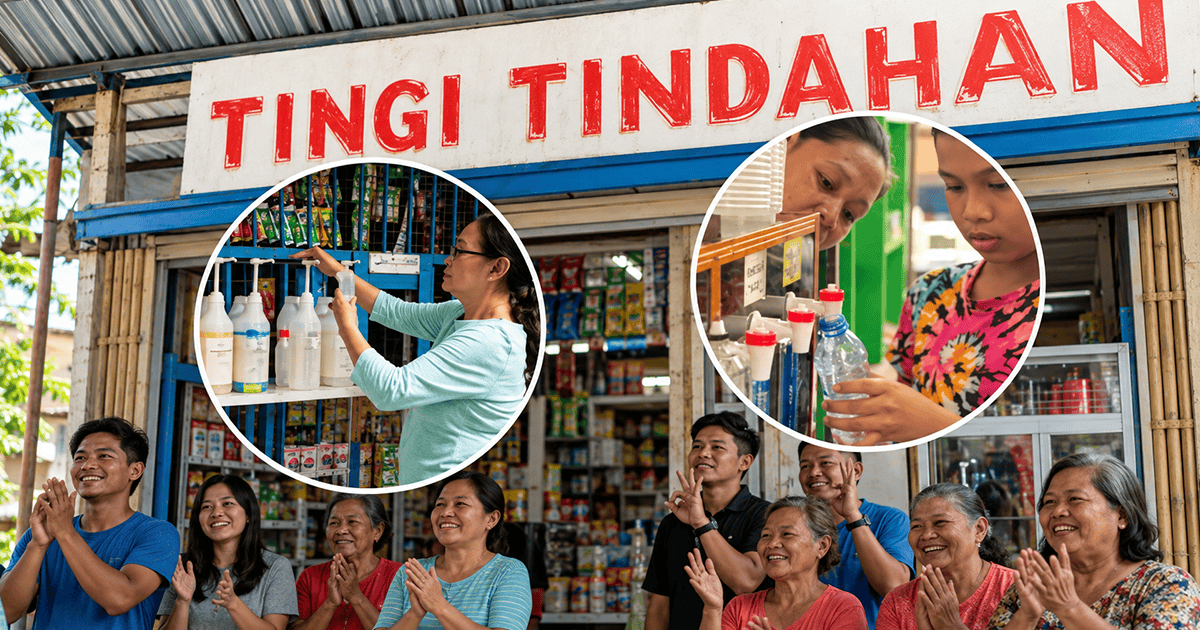
After the school day ends in the Philippine city of Malabon, a different action begins inside a small store in the Botero neighborhood. Mothers enter with their children carrying empty bottles to be refilled with soy sauce or cooking oil, while old ice cream and biscuit containers are transformed into containers for flour and sugar, and children receive sweets and banana chips inside paper bags.
The scene seems simple, but it represents a local attempt to confront one of the biggest problems of plastic waste in the Philippines, a problem linked to a broad consumer culture that relies on buying goods in small quantities inside single-use plastic bags that quickly turn into waste.
From here emerged the experience of Tingi Tindahan “ Tingi Tindahan “, which means “a store that sells small quantities.” It is an initiative that relies on repackaging and reusing old containers, while maintaining the habit of buying small quantities that the population has been accustomed to for decades, but without relying on plastic containers that It has become a major part of the country’s waste crisis.
An old habit returns
The Philippines has known for decades the habit of purchasing goods in small quantities, known locally as Tingi, which allowed families to obtain their daily needs according to their purchasing power.
Before the spread of plastic containers, residents carried old bottles and jars to buy oil, vinegar and basic goods, and they also used woven bags Locally to carry larger products.
But the entry of small ready-made bags into the markets gradually changed this pattern. It provided the consumer with a cheap, pre-packaged product in a quantity that suits his purchasing power, making it an easy option for low-income families.
With the expansion of their use, the problem of plastic waste and its environmental impact began to become more apparent, because these multi-layered containers are difficult to decompose or recycle, and they move from landfills to waterways and then to the sea.
164 million bags per day
The Philippines produces at least 2.7 million tons of plastic waste annually, while it is estimated that about 164 million small bags are used daily. This figure reveals the scale of the challenge faced by waste management systems, especially in low-rise and exposed cities For floods like Malabon.
Khati Nolasco, vice president of the environment committee in the Botero neighborhood, explains that waste accumulates significantly with each hurricane season. The Philippines experiences about 20 storms annually, which results in waste being pushed into drains and waterways.
Cleaning up after floods can take about a month, while bags of soy sauce, vinegar, detergents and shampoo remain among the most common waste.
In a flood-frequent city like Malabon, waste management becomes part of protecting the urban environment and reducing the burden on public services. This is reflected in the target 11.6 of the eleventh goal of the Sustainable Development Goals, concerned with sustainable cities and local communities , which calls for reducing the negative environmental impact of cities, paying special attention to waste management
Store without packages
In July 2024, Nolasco, with the support of the neighborhood administration, led the construction of a Tingji Tindahan store within a vacant space in front of the local council headquarters.
The concept of the store is similar to the small neighborhood stores spread throughout the Philippines, but the main difference lies in the way the products are displayed. The goods are kept inside large glass containers with hand-written names, while liquid oils and sauces flow from containers equipped with taps, and dry goods such as flour, salt, and starch are weighed according to the required quantity.

Customers bring their own packaging, whether it’s an old water bottle, a cookie jar or any reusable container.
And it exists Other stores adopt the same idea in different regions of the Philippines, but Tingy Tindahan has the distinction of being the first store of this type to be established and financed by a local council.
The experiment did not stop at reusable containers; Those responsible for it have cooperated with the Mother Earth Foundation to provide a self-selling machine that allows some detergents and liquid sauces to be filled even after the store is closed, thus expanding opportunities to benefit from the service outside normal working hours.
Cheaper, not more expensive
At first, some residents were hesitant to deal with the store because they were accustomed to seeing products inside ready-made plastic bags. But demand began to increase when consumers discovered that some goods were cheaper than in traditional stores.
For example, the price of a bag containing 100 ml of Vinegar is about 8 Philippine pesos in traditional stores, compared to 5 pesos for the same amount in Tingy Tindahan store, that is, about 37.5% less. Residents can buy only the amount they need, even if their purchasing power is limited that day.
This model gives repackaging an important economic dimension. It allows low-income families to purchase the quantities they need at lower prices, and challenges the common image that stores that reduce waste are limited to consumers who are able to buy in large quantities.
Women at the heart of the model
The store is run by a group of women who work in monitoring waste within the neighborhood. Part of their daily work begins with monitoring the extent of families’ commitment to sorting waste correctly, and they also make some liquid cleaning products that are sold inside the store using purchased materials. From local factories.
But how can a small environmental initiative go beyond waste collection and sorting to open new doors for economic participation for women? The experience of female shop workers at Tinji Tindahan provides a practical answer; Their role combines waste control, production of cleaning materials, and running the store, turning environmental work into an economic and social activity that serves the local community.
This experience embodies an aspect of the relationship between environmental protection and job creation, a relationship that falls within the concerns of Goal 8 of the Sustainable Development Goals, concerned with decent work and economic growth.
145 thousand fewer bags
About a year after the store opened, project management estimates that the initiative has helped prevent at least 145,000 plastic bags from reaching landfills.
This estimated decline in plastic bag use gives the experiment a dimension beyond the results of a single store. It embodies the principle of reducing waste at the source and reusing packaging, which is what targets, target 12.5 of the twelfth goal of the Sustainable Development Goals, on responsible consumption and production.
Although the number remains limited compared to the volume of plastic waste consumed daily nationwide, it provides a practical indication of the impact of a small model when applied on an ongoing basis.
The experience also reveals a difference in how generations view it. The elderly see the store as a return to the way of purchasing they knew in their childhood, while children and young people see it as a new and unfamiliar idea.

This paradox shows that the solution depends on reintroducing a habit It is outdated enough to suit modern consumption challenges and is not entirely new behavior.
Responsibility goes beyond society
Despite the results achieved by Tingji Tindahan, marine scientist Deo Florence Onda believes that addressing the plastic waste crisis cannot depend on communities alone.
Companies that produce and sell goods inside plastic bags make profits from this model, and therefore must bear part of the responsibility for dealing with the waste resulting from it.
In 2022, the Philippines passed the Extended Producer Responsibility Act, which requires major companies to recover a portion of the plastic packaging waste they put on the market, with fines starting at Php 5 million for violators.
But environmental activists say enforcement still suffers from gaps, while some cities struggle to impose tougher restrictions on plastic due to objections from industry and stakeholders.
Malabon itself had tried in 2013 to implement a comprehensive ban on some plastic containers, before withdrawing from it later amid objections, especially with the presence of a number of plastic factories within the city.
Companies’ responsibility expands to include the way packaging and products are designed before they reach the consumer, thus reducing waste at the source. This is an issue that The Earth Guards Foundation addressed in its article: Sustainable design…a new path to confront plastic pollution, which highlights the role of industrial innovation in reducing waste and rethinking the life cycle of products.
Repeatable model
For Nolasco and her team, waiting for national policies to be completed is not an option as hurricane season continues and waste from other areas flows into the city. Hence, those responsible for the initiative are looking forward to transferring the Tinggi Tindahan experience to other neighborhoods in the Philippines, so that its impact extends to communities facing similar challenges.
This experience derives its chances of spreading from the simplicity of its idea and its connection to a consumption habit that the population has known for generations. It revives the purchase of goods in small quantities, while reducing reliance on plastic packaging and maintaining prices suitable for low-income families.
In this combination of popular heritage and modern environmental solutions, one of the ideas that stems from the vision of The Earth Guards Foundation is evident.: Sustainability becomes closer to people’s lives when it takes into account their economic conditions and local culture. Tingji Tindahan’s experience shows how simple habits can turn into tools for protecting the environment, when residents find in sustainable alternatives a daily benefit that encourages them to adopt and continue with them.


