Nepal floods turn into a major disaster…750 dead and more than 3,000 missing

Nepal floods turn into a major disaster.. 750 dead and more than 3,000 missing
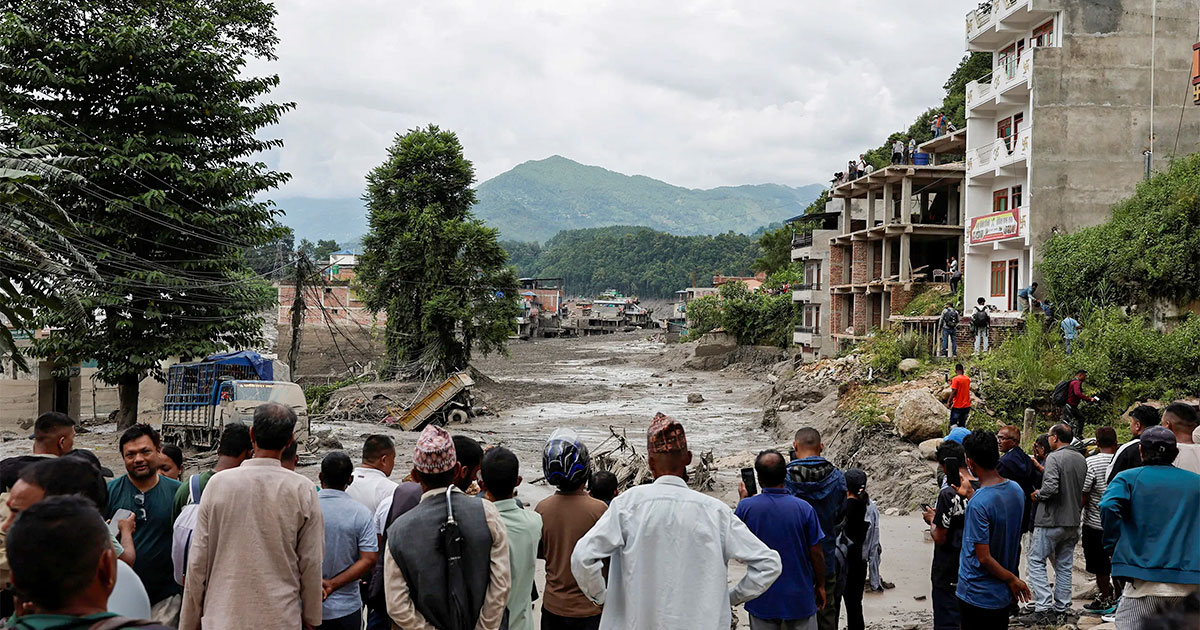
The Nepal floods turned into one of the bloodiest disasters in the Himalayan region in recent years, after the number of victims in Nepal and Tibet rose to 750 people, while more than 3,000 people are still missing. As the rains continued and river levels rose, rescue teams were forced to retreat to higher areas amid fears of new waves of floods and collapses.
The disaster began after an avalanche, followed by a massive flow of ice, rocks, mud and debris across mountain rivers. The effects of the accident quickly expanded across the border between Nepal and China, with Red Cross estimates indicating that more than 90,000 people were affected by the disaster, while China described what happened.It is one of the most severe cross-border disasters that countries have witnessed in recent years.
The developments of the accident also reveal the very complex nature of mountain disasters. The first collapse generated a series of new hazards, from temporary lakes and rising river levels to additional collapses that threatened the rescue teams themselves.
An expanding disaster
The number of deaths in Nepal rose to 734 people, while the number of missing people reached 2,498 people, according to the authorities concerned with disaster management, while rescue teams were able to reach 7,514 people.
In the Tibet region of China, the authorities recorded 16 deaths and 546 missing people in Jirong County, bringing the total toll of the disaster across both sides to 750 dead and 3,044 missing.
These numbers coincided with the continued bad weather conditions,Which forced the authorities to suspend rescue operations several times since Friday, especially with the rise in levels of the Trishuli River after new rains.
Fears also increased about a lake formed near the border between Nepal and China following the mudslide resulting from the collapse of the glacier. The water began to exceed its limits and flow into rivers inside Nepal, prompting emergency teams and residents in some areas to move to safer locations.

Rescue inside tunnels
Rescue efforts in Nepal are currently focusing on hundreds of people believed to be trapped inside tunnels belonging to hydroelectric plants, after huge amounts of ice, rocks and mud rushed through mountain rivers.
The tunnels pose a special challenge for rescue teams because of the difficultyAccess to it and the circumstances surrounding it, which prompted Nepal to request specialized support in specific areas, including rescuing those trapped inside the tunnels, conducting DNA tests, and identifying bodies.
The authorities also need capabilities for cold storage of bodies and forensic expertise, especially with the complexity of the process of identifying some victims days after the disaster occurred.
Experts from India and China are already participating in efforts to open the tunnels, while rescue teams are using equipment to detect signs of life, drones and navigation systems to continue searching in hard-to-reach areas.
On the Chinese side, Beijing sent more than 2,100 rescue workers, along with drones capable of carrying heavy equipment and helicopters to transport supplies to teams deployed near the border.
Missing people from 23 countries
The repercussions of the Nepal floods extended to citizens of many countries, as the Chinese authorities announced that 261 foreigners from 23 countries are still missing in the Tibet region of China.
Among the nationalities revealed by the authorities:
- 104 missing from Nepal.
- 49 from India.
- 33 from Latvia.
- 18 from the United States.
- 15 from Britain.
The Chinese and Nepalese sides are working to exchange information on missing persons, coordinate identification of citizens and foreigners, and enhance cooperation in disaster response.
AsChina has allocated at least 220 million yuan, or about $32.7 million, to support relief operations, in addition to providing urgent cash aid, relief materials, satellite and hydrological data, and tunnel rescue experts.

Danger generates danger
The disaster reveals one of the most dangerous features of floods and landslides in mountainous areas, where a single event can generate a series of successive hazards within a short period of time.
After a lake was formed upstream as a result of the first collapse, water began flowing from it, before data indicated that its size had decreased significantly on Saturday evening.
But the danger appeared again when drones detected a new landslide about 2.8 kilometers from the lake site, which led to the formation of a new natural dam.And another amount of water collects behind it.
This development prompted the authorities to move rescue teams near the Gerung border crossing to safer locations, in light of the possibility of the natural dam collapsing or water levels suddenly rising.
These developments explain why emergency teams are having exceptional difficulty dealing with Nepal’s floods; The geographic landscape itself changes during rescue operations, and a new avalanche or rainstorm can reshape the water’s paths and create new danger zones.
Here, the event is linked to Goal 11 of the Sustainable Development Goals (SDGs) on sustainable cities and communities, especially with regard to strengthening the capacity of communities and infrastructure to withstand disasters, and developing warning, evacuation and response systems in risk-prone areas.
Climate changes mountains
Chinese authorities linked the disaster to the instability of glaciers under the long-term effects of global warming, describing it as a prominent pattern of risks associated with the cryosphere on the Tibetan Plateau.
According to preliminary results reported by China from scientists who followed the accident, the flow resulting from the collapse on the Nepalese side took only six to seven minutes to reach the Jirong border crossing, which reflects the speed of the disaster’s development and the difficulty of responding to it in a timely manner.
Concern increases in mountainous areas as temperatures rise and the stability of glaciers changes, as the melting of ice and changes in its structure can lead to increased possibilities of collapse and the formation of temporary lakes capable of exploding or flooding.
and intersectsThis is the reality with Goal 13 of the Sustainable Development Goals (SDGs) on climate action, which focuses on enhancing resilience to climate risks and natural disasters, especially in areas most vulnerable to the effects of warming.
The Earth Guards Foundation confirms that the Nepal floods reveal the extent of the interrelation between climate change, mountain risks, infrastructure, and the ability of communities to respond. The disaster began with an avalanche, then transformed within minutes into floods, collapses, temporary lakes, and new risks across borders, which highlights the importance of investing in early monitoring, regional cooperation, and preparing for disasters that may become more complex as climate change continues.