

Justice City is a judicial project that strengthens state institutions and keeps pace with the path of sustainable development in Egypt
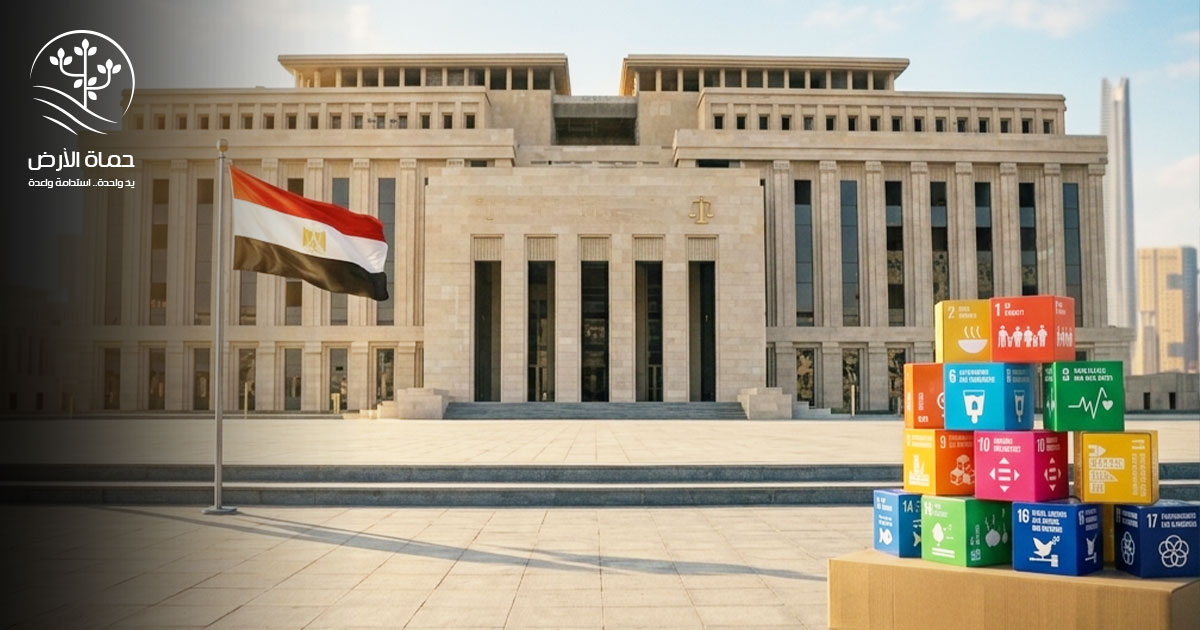

Justice City is a judicial project that strengthens state institutions and keeps pace with the path of sustainable development in Egypt
In a world that is steadily moving towards consolidating the principles of sustainable development and achieving its seventeen goals, justice has become one of the foundations of social stability, and a path to building strong institutions capable of protecting rights, consolidating the rule of law, and ensuring equal opportunities among citizens, which is consistent with the sixteenth goal of the Sustainable Development Goals (SDGs), which is concerned with establishing peace and justice and building effective institutions.
From this standpoint, the Egyptian state is proceeding on an integrated path to develop its institutional structure, first and foremost the judicial system. Therefore, this path includes the Justice City project in the New Administrative Capital, whichDefenders of the Earth highlights in the following lines: To measure the extent of its role in achieving the Sustainable Development Goals (SDGs); So keep reading.
The state’s vision for developing the judiciary
Within the framework of the state’s efforts towards developing the institutional structure of justice and enhancing the efficiency of the judicial system; Counselor/Mahmoud Helmy Al-Sharif, “Minister of Justice,” conducted a field tour inside the Justice City project in the New Administrative Capital. To view the progress of work, and follow the implementation rates in the various components of the project.
The Minister of Justice was accompanied on this tour by a number of senior judicial leaders, led by Counselor Assem Al-Ghayesh, “President of the Court of Cassation and President of the Supreme Judicial Council,” Counselor Mohamed Abdel-Al, First Deputy President of the Court of Cassation, Counselor Abed Rashid, Second Deputy President of the Court of Cassation, along with Counselor Ahmed Refaat, Secretary-General of the Supreme Judicial Council, as well as the First Assistant Minister of Justice.

At the beginning of the visit, the Minister of Justice confirmed that the project - the Justice City Project - is a strategic step within the Egyptian state’s vision to modernize the judicial structure, explaining that the establishment of an integrated judicial urban complex that includes various judicial authorities and bodies reflects the state’s appreciation of the status of the judiciary and its role in consolidating the rule of law.
He pointed out that the project has an integrated system that aims to provide an advanced work environment for judges and members of judicial bodies, in a way that enhances cooperation and institutional integration between them, and in a way that also contributes to raising the efficiency of judicial performance and accelerating the adjudication of cases. In order to achieve complete justice.
A field tour for the leaders of the Court of Cassation
There the Minister and the audience listened to a detailed presentation presented by Major General Staff Ashraf Nabil Al-Husseini, “Assistant Head of the Engineering Authority of the Armed Forces”, in which he addressed the current executive position of the project, the completion rates in its various components, and the extent of the work’s commitment to the specified timetable, ensuring that the project is implemented in accordance with the highest quality standards.
The presentation also included a recent documentary film that reviewed the technical and construction aspects of the city, in addition to a comprehensive explanation of the digital infrastructure system, which the city will rely on in managing judicial work within the framework ofdigital transformationbased on the Sustainable Development Goals (SDGs).

A digital system to speed up litigation procedures
Then the digital transformation system on which the City of Justice will depend was reviewed, which is a system that includes electronic services provided to litigants, and modern technological systems, which will contribute to accelerating litigation procedures and simplifying judicial services, and this is in accordance with international systems in the administration of justice.
Therefore, the attendees praised the remarkable development they saw in the components of the Justice City project, expressing their appreciation for the efforts made by the state in modernizing the judicial structure and developing the work environment within judicial institutions in a comprehensive developmental manner.
Efforts of the Armed Forces Engineering Authority
At the conclusion of the tour, Counselor/Mahmoud Helmy Al-Sharif, “Minister of Justice,” expressed his appreciation for the efforts made by the Armed Forces, represented by the Engineering Authority, praising the advanced completion rates achieved so far in the Justice City project.
In a related context, the Minister affirmed that the City of Justice is a qualitative leap in the path of developing the justice system in Egypt, as it is a civilized project that reflects the state’s orientation towards building a modern judicial system, which is a system that relies on advanced technology. In order to provide judicial services to citizens more efficiently and quickly through digital transformation tools.

Justice City Integrated Judicial Complex
It is worth noting here that the City of Justice is built on an area estimated at approximately 51 acres, and includes a central judicial complex with a number of judicial bodies and institutions, including:
- Court of Cassation
- Supreme Constitutional Court
- Council of State
- Supreme Council of Judicial Authorities and Bodies
- State Litigation Authority
- Administrative Prosecution Authority
- Military Judicial Authority
- Family and Children’s Court
- Economic Court
- International Arbitration Center
What is also worth noting is that the Justice City project includes a group of service facilities, including a guest house and a mosque that can accommodate about 500 worshippers, in addition to major court halls equipped with the latest technology. The city is distinguished by its ability to accommodate more than30 one thousand citizens daily, including litigants and frequenters, as well as workers within judicial bodies.
The city also houses a number of specialized legal libraries, most notably the Library of the Court of Cassation, in addition to a judicial museum that documents the history of the Egyptian judiciary, in a step aimed at preserving the judicial legacy and enhancing legal awareness among current and new generations.
In light of these data, the Justice City project can be viewed as an institutional step that reflects the state’s awareness of the importance of developing the justice system. In line with the Sustainable Development Goals (SDGs) and their social, economic and environmental dimensions.
In this sense, you findHomat Al-Earth Foundationthat the Justice City project is an advanced model for a new phase of modernizing institutions in Egypt. A stage based on the combination of modern institutional structure, digital transformation, and integration of services, which consolidates the concept of complete justice and enhances the state’s ability to build strong and effective institutions.


