

IMF forecasts indicate possible energy shocks and risks in artificial intelligence
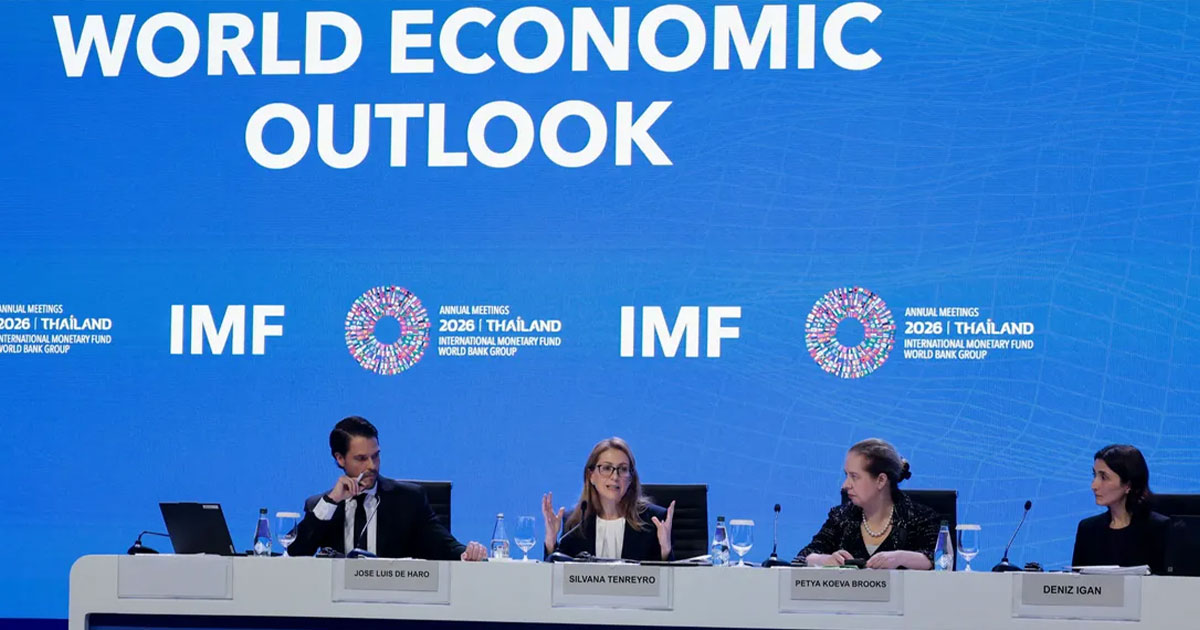

Forecasts indicating possible energy shocks and artificial intelligence risks
forecasts International Monetary Fund for the year 2026. The global economy is facing an economic landscape in which opportunities for expansion intersect with sources of concern. While accelerating technological investments are giving markets a new boost, geopolitical conflicts and energy supply disruptions are putting increasing pressure on growth and inflation paths.
This discrepancy reveals a stage in which the ability of overall indicators alone to express the reality of economic conditions is declining, in light of a clear disparity between countries in possessing the tools for resilience and the elements to benefit from global transformations.
In its latest report on the World Economic Outlook, the International Monetary Fund raised its forecast for global economic growth during 2026 by 0.1 percentage point, to 3.1%, while maintaining its estimate for 2027 at 3.4%.
Economic resilience surrounded by risks
The numbers contained in the report gain their importance from the nature of the circumstances surrounding the global economy. The improvement in the IMF’s forecasts for 2026 comes at a time when markets are facing simultaneous shocks, led by the war in the Middle East, and the pressures it imposes on the energy, trade, and maritime transport markets, in parallel with the expansion of spending on digital infrastructure and artificial intelligence applications.
These data indicate that global growth is based on drivers of varying influence. While technical investments support economic activity in some markets, increased production and transportation costs narrow movement margins for other sectors, especially in economies that depend on energy imports, or lack sufficient financial resources to absorb shocks.
Global Economic Outlook
Part of the resilience of the global economy – according to the new report – is based on the ability of companies to modify supply chains and adapt to trade disruptions, as well as continued demand for technical equipment, data centers and electronic chips.
In this context, a group of risks emerge that may reshape economic expectations during the coming period, including :
- The expanding scope of geopolitical conflicts and their impact on international trade flows.
- The continued rise in oil and gas prices and the accompanying inflationary pressures.
- The global debt burden is increasing and the space available for governments to move financially has declined.
- The expected returns from artificial intelligence investments may decline, which may weaken investors’ appetite.
Artificial Intelligence Risks
Artificial intelligence represents one of the most prominent factors supporting global economic activity, after investments related to it extended to electronic chips, data centers, communication networks, and digital infrastructure.
This boom is reflected in international trade through Increased demand for advanced equipment and technical components, and opens the way for improving productivity and developing work methods in multiple sectors.
However, The risks of artificial intelligence are related – in an important aspect – to the extent of the ability of current investments to achieve economic returns commensurate with the volume of spending. If the results are below expectations, the valuations of technology companies may come under pressure, investments will decline, and the effects of the correction will be transmitted to the financial markets and economies most closely linked to this sector.

AI gains are limited
The indicators contained in the report show that benefiting from the technical boom is not distributed equally among the countries of the world. Economies that own technology companies acquire Large, advanced industrial capabilities and a strong digital infrastructure account for the largest share of investment flows.
The United States and China accounted for more than 75% of net imports of AI-related computing equipment through 2025, according to figures in the report. This reflects a significant concentration in demand for the infrastructure needed to develop and operate these technologies.
As for countries that are still in the early stages of digital transformation, they may face a double challenge: The first is its limited ability to attract major technology investments, while the second is related to the possibility of a widening productivity gap between it and more advanced economies.
Therefore, transforming artificial intelligence into an engine of sustainable development requires policies that ensure its impact is transmitted to the real economy, through Developing human skills, improving the quality of education and training, expanding access to technology, and creating an appropriate environment for innovation and productive projects.
Energy crisis restores inflation
Energy markets also remain one of the most sensitive channels for the transmission of geopolitical shocks to the global economy. The impact of supply disruption does not stop at oil and gas prices, but extends to the costs of transportation, industry, agriculture, and services, and then is reflected in the purchasing power of families and the competitiveness of companies.
According to the International Monetary Fund’s estimates included in the report, the average price of oil is expected to reach $96 per barrel in 2026, before falling to $87 in 2027, compared to about $67.7 during 2025. Natural gas prices are also expected to rise by about 48%. Compared to the previous year.
What if oil rises to $130?
The report presents a more pessimistic scenario that assumes a worsening of the war and a rise in the price of oil to $130 per barrel until the first quarter of 2027. In this case, global economic growth may decline by 0.2 percentage points in 2026 and 0.5 percentage points in 2027.
IMF forecasts
So these developments – both positive and negative – put policy makers before a test that goes beyond maintaining growth rates. What is required is to build economies capable of continuing production, investment, and job creation, even in light of rising energy costs and changing global trade trends.
In this sense, it stands out A set of practical paths that help reduce risks and enhance the benefit of opportunities :
- Enhancing energy security : Diversifying sources of supply, raising the efficiency of use, and expanding investments in renewable energy according to the needs of each economy.
- Developing digital infrastructure : Expanding communication networks, improving institutions’ readiness to adopt technology, and providing an attractive environment for productive investments.
- Investing in human capital : Linking education and training to the requirements of the new labor market, and qualifying workers to deal with Transformations imposed by artificial intelligence applications.
- Improving public financial management : Raising spending efficiency, enhancing financial sustainability, and directing resources to sectors that support productivity and employment.
- Expanding the production base : Supporting small and medium enterprises, strengthening local value chains, and reducing excessive dependence on imports in vital sectors.
These priorities are directly linked to the Sustainable Development Goals, especially those related to decent work and economic growth, industry, innovation and infrastructure, clean energy, and reducing inequalities; Because the sustainability of growth depends on the ability of economies to distribute Its fruits expand the base of its beneficiaries, in addition to preserving resources, as well as enhancing its ability to confront crises.
The Earth Guards Foundation concludes that IMF forecasts reveal a global economy that has the potential to survive, except that it faces a real test in how to manage risks and distribute opportunities; Therefore, we must measure sustainable growth by the actual ability it leaves in societies to live a decent life and confront the crises of tomorrow.


