

The waters of the Nile River in Egypt are a gateway to sustainable development goals and protecting the rights of generations
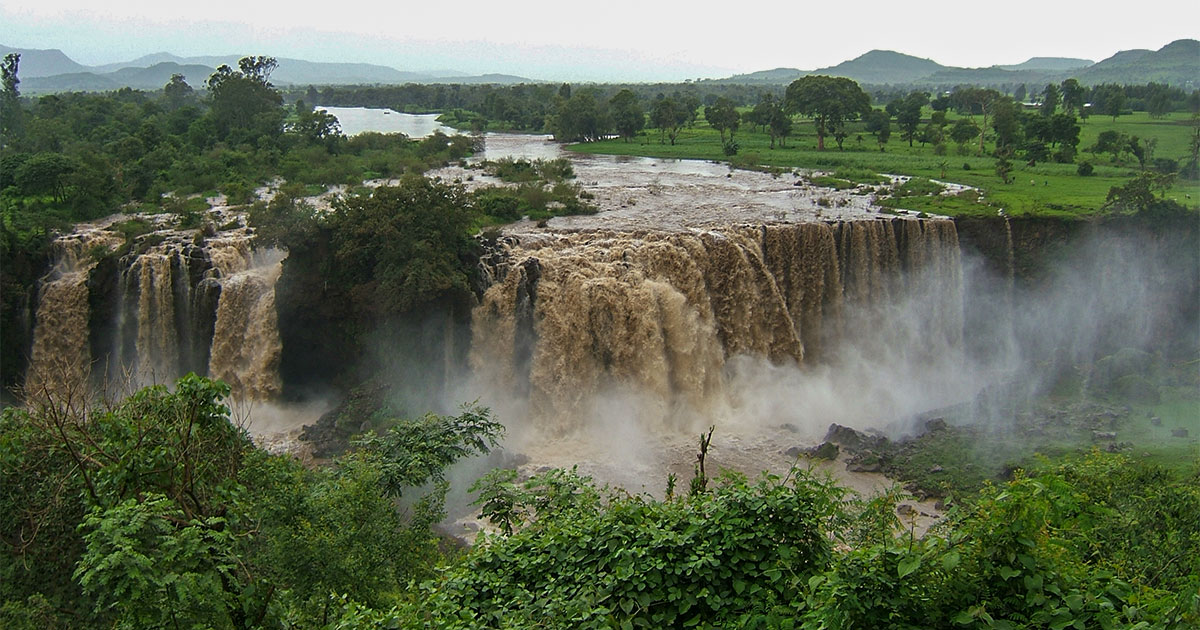

The waters of the Nile River in Egypt are a gateway to sustainable development goals and protecting the rights of generations
The water of the Nile River comes from three major tributaries that meet in Sudan, the largest of which is the Blue Nile coming from the Ethiopian plateau with about 68% of the water at the time of the flood, and Egypt depends on the river for about 97% of its water needs, and its annual share amounts to 55.5 billion cubic meters according to an agreement 1959.
The Nile River in Egypt has a strong and direct relationship to the sustainable development goals; Through it, efforts can be supported to achieve the second goal: total elimination of hunger, the sixth goal: clean water, the seventh goal: clean energy, the thirteenth goal: climate action, as well as the two goals. Sixteenth and seventeenth: Peace and partnerships.
Accordingly, The Earth Guards Foundation will explore in the following lines the role of the Nile River in achieving these development goals according to their three social, economic and environmental dimensions; So keep reading.
Where does the water of the Nile River in Egypt come from?
About 85–86% of the Nile’s water comes from the Ethiopian highlands, while the rest comes from the tropical lakes of East Africa and the swamps of South Sudan. This water reaches Egypt via two Niles that meet in the city of Khartoum, then the river continues its single course north through Sudan, and the Atbara River flows into it, until it reaches Lake Nasser.
This particular point is what makes Goal 6 a development goal Sustainable is more than a slogan; Its goal related to the integrated management of water resources includes cross-border cooperation, especially since Egypt is a downstream state that depends on water that originates outside its territory.

Blue Nile Quantity Source
The Blue Nile originates from the “Gish Abai” spring south of Lake Tana in Ethiopia, and is known there as Abai. Then it passes through Lake Tana, which only supplies it with about 7% of its revenue, and the tributaries and seasonal rains take care of the rest. Historically, this Nile contributed about 68% of the peak monthly flow of the Nile before it was regulated by dams, and most of its water comes in the summer with seasonal rains on the plateau, which is known as the flood. As for the silt, most of it comes from the Blue Nile and Atbara, and the White Nile contributes only a small percentage of it.
The White Nile is the source of continuity
The White Nile emerges from Lake Victoria, at a place where the Ripon Falls were located in Uganda before they were submerged by the waters of the Owen Dam, and then crosses South Sudan. It is longer than the Blue Nile, although it loses about half of its water in the dam swamps in southern Sudan. Due to evaporation. Its value appears in the dry season, when it can contribute about 70-90% of the Nile’s drainage, while the contribution of the Blue Nile declines.
Atbara and Sobat
The Sobat River meets the White Nile near the city of Malakal, and originates from the confluence of the Baro and Pibor rivers. It is always flowing, although its discharge varies between seasons. As for the Atbara River, it is the last tributary that flows into the Nile before it enters Egypt. It is seasonal and almost dries up in the dry season, and it has a significant contribution in the flood season.
| The tributary | Upstream | Contribution | The most prominent period |
| Blue Nile | Lake Tana (Ethiopia) | About 68% of the peak monthly flow | Flood (summer) |
| White Nile | Lake Victoria (East Africa) | About 70-90% of the discharge | Dry season |
| Atbara | Ethiopian Plateau | About 22% of the peak monthly flow | Flood, and it almost dries up in drought |
| Al-Sobat | Confluence of the Paro and Pibor Rivers | Part of the White Nile drainage, and it varies between seasons | Throughout the year |
How long is the Nile River?
It is known that the Nile River cuts about 6,650 km from Lake Victoria To the Mediterranean Sea, passing through eleven countries known as the Nile countries, including: Tanzania, Uganda, Rwanda, Burundi, the Democratic Republic of the Congo, Kenya, Eritrea, and Egypt.
If we imagine a map of the Nile River from source to mouth, we would find successive stations that can be easily traced, including:
- Great Lakes Region : The source of the White Nile, including Lake Victoria.
- Uganda : The river emerges from Ripon Falls, passing through Lakes Kyoga and Albert.
- Khartoum : The White and Blue Nile meet at the Muqrin neighborhood.
- Egypt : It flows north from Aswan to Cairo and the Delta.
Where is the mouth of the Nile River?
The Nile, about 23 km north of Cairo, is divided into two branches: the Rosetta Branch to the west, with a length of 239 km, and the Damietta Branch to the east, with a length of 245 km. They flow together into the Mediterranean Sea, forming the Nile Delta. The most fertile agricultural areas in Egypt. Here the downstream link to Goal 13 (Climate Action) appears; Because sea level rise threatens the incursion of salt water into the delta, and hinders efforts to develop the agricultural sector.
Share of Nile River water in Egypt
According to official data, Egypt needs about 114 billion cubic meters of water every year, and if its resources Water resources do not exceed about 60 billion, so there is a deficit of approximately 54 billion.
This deficit is filled in two ways: reusing water, and importing agricultural crops equivalent to about 34 billion cubic meters of water annually. This is what links the waters of the Nile River in Egypt to the second goal: eliminating hunger. Every cubic meter saved in the field reduces dependence on imports.
Egypt is also working on implementing a national strategy for water resources management, which is a plan based on three practical axes, which we will detail for you in the following lines.
First – rehabilitation of canals and conversion to modern irrigation
The plan aimed to rehabilitate 20 thousand kilometers of subsidiary canals; This led to improved water distribution and the share reaching the ends of the canals on time. Farmers have converted 800,000 acres They switched to modern irrigation at their own expense, after observing an increase in productivity ranging between 30% and 40% and a decrease in the cost of fertilizers, labor and energy.
Second – Reuse of wastewater
The amount of treated water in the Bahr Al-Baqar, Al-Hamam and Al-Mahsama plants reaches 15 million cubic meters every day, and accordingly, official estimates expect that Egypt – with these projects – will become the largest country in the world in reusing water by recycling up to four times.
Third – Technology, legislation and awareness
Egypt uses satellite images for early warning and determining crop structure, a telemetric system for measuring levels (an automatic monitoring system that measures water using a remote sensing method), and operating wells remotely with solar energy.
All of this directly intersects with the sixth goal of the Sustainable Development Goals (clean water and hygiene), which calls for increasing the efficiency of water use, and the ninth goal (industry, innovation, and infrastructure).
Nile water quality and potability
The depth of the Nile course between Aswan and Cairo is about 6 to 8 meters according to Egyptian geographical studies, with a clear variation from one place to another due to carving on one bank and sedimentation on the other. There is no single official number for the greatest depth in the Nile River. The depth changes with the season, location, and cleansing work, and the depths reach their peak behind dams where water collects in lakes.
Technical bodies treat depths and levels as indicators Its operation is monitored daily, because every centimeter of it translates into an irrigation share, generating capacity, and strategic reserve.
Is the Nile River water safe to drink?
Going back to the beginning, we confirm that the Nile is the primary source of drinking water in Egypt; Therefore, its water passes through purification and sterilization stations, before it reaches the faucets in homes. These stations are subject to the Law for the Protection of the Nile River and Waterways from Pollution No. (48) of 1982 and the approved health specifications.
Here three goals meet at one point: the sixth goal, which sets reducing pollution and improving water quality as an explicit goal, and the third goal (good health); Because polluted water transmits diseases, and the fifteenth goal is because river life is a living indicator of the health of the system.
Three priorities For the next stage
Water management stands today at a crossroads, as the challenge has become how to manage it wisely and cooperatively. Therefore, here are three priorities that will be important in shaping the features of the next stage, detailed in what follows.
The first priority is transparency in water data; River levels and water quality deserve regular access to researchers and farmers, because good governance begins when stakeholders share the same information.
The second priority is to link the water, food, and energy issues with one decision; That is, we must always adopt the smart agriculture method and motivate farmers with clear economic incentives, in addition to legislative development.
The third priority is to internationalize the solution at the level of the countries of the entire basin, as water projects on both sides of the river must be a common interest, achieving water security and development support for all within a framework of constructive partnerships.
In the end, it appears to all of us that the Nile River water issue goes beyond the limits of securing daily needs. It affects Egypt’s ability to protect its food, stabilize its economy, preserve its environment, and guarantee the rights of its future generations.
From what was explained above, The Earth Guards Foundation stems from a basic development fact, which is that water security is achieved by integrating national planning with responsible cooperation between the Nile Basin countries, exchanging data, and building common interests; So that every step that protects the river and reduces waste and pollution brings society closer to more stable and just development. Preserving future generations’ right to an indispensable resource.


