

The Chinese “Shanghai Archives” delegation explores Egypt’s living memory at the Dar al-Kutub Museum
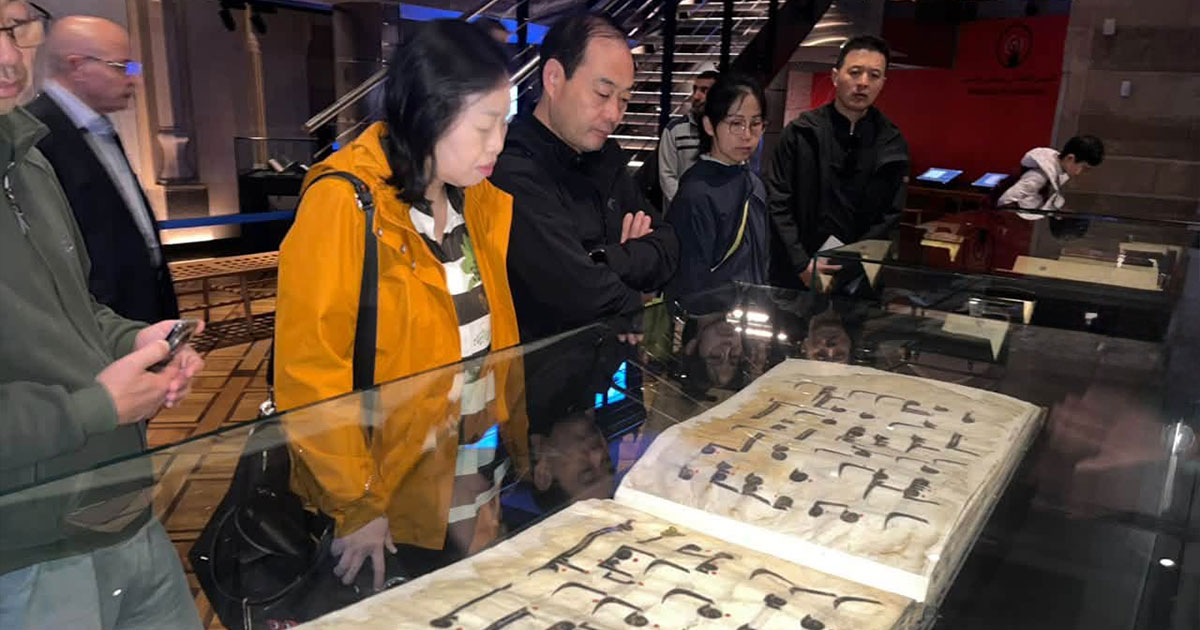

The Chinese “Shanghai Archives” delegation explores Egypt’s living memory at the Dar al-Kutub Museum
In the Dar al-Kutub Museum, civilizations with roots deep in history meet, where you do not need a translator to explain the language of memory. The rare manuscript and ancient documents speak with one tongue, which is the tongue of humanity, which preserves peoples’ cultural heritage in a sustainable manner.
From this sustainable heritage meaning came the visit of a high-level official delegation from the “Shanghai Archives”, affiliated with the Shanghai Municipality in China. To the Dar al-Kutub Museum located in Bab al-Khalq, to write a new chapter in the book on Egyptian-Chinese friendship, and at the same time confirm that culture is the truest bridge and has the most lasting impact.
The first visit of its kind to the Authority
This visit to the Dar al-Kutub Museum came within the framework of cultural exchange and documentary cooperation between the Republic of Egypt and the People’s Republic of China, during which the Dar al-Kutub Museum – affiliated with the General Authority for Books and National Records – received a delegation from the municipality of Shanghai, headed by the Public Relations and Communication Officer at the “Shanghai Archives.” This is the first visit of its kind to the Authority. Which gives it a developmental significance.

A tour through history
The delegation coming from the Shanghai Archives was received by Professor Ayman Shakib, Director of the Dar al-Kutub Museum, who accompanied the guests on a comprehensive tour between the museum’s corridors and historical halls, where he provided a detailed explanation of the history of the Egyptian Dar al-Kutub and its rare archaeological and heritage holdings, including:
- Historical Manuscripts and Mamluk Qur’ans
- Official documents and original maps
- Historical Medals and Coins
Praise for documentation, preservation and restoration efforts
In this important visit, the members of the “Shanghai Archives” delegation, along with the archive’s public relations officer, expressed their great happiness, their great astonishment, and their true pride in the cultural treasures and unique manuscripts that the Dar al-Kutub Museum abounds with.
The Chinese delegation also praised all the efforts made in documenting, preserving, restoring and coordinating Egyptian and Arab manuscripts. The members of the delegation confirmed that the visit to the museum was an important step towards strengthening cultural relations and opening broad horizons for cooperation. Constructive and exchange of experiences between the Egyptian and Chinese sides in the fields of archiving and heritage preservation, and this is in light of digital transformation efforts and the spread of artificial intelligence technologies.

Development serves heritage memory
From this angle – the angle of preserving heritage and archiving it digitally – the significance of this visit to the Dar Al Kutub Museum intersects with a number of the seventeen sustainable development goals, especially Goal No. 11 (sustainable local cities and communities), which is based on strengthening efforts to protect the cultural and natural heritage in the world, and preserve this heritage.
On the other hand, the documentation, restoration and preservation of manuscripts and documents taking place in the Creation Section within the museum is a direct application of this development goal, when scientific expertise is exchanged with the Shanghai Archives. And other leading global institutions in this field.

When memory becomes a bridge
Also, what the Dar al-Kutub Museum witnessed in Bab al-Khalq is more than a passing visit; It is a silent dialogue between two memories; One of them is the banks of the Nile and the other is the banks of the “ Huangpu River”. Perhaps the Chinese guests’ astonishment at what they saw was a more eloquent message than any speech, which is that nations that preserve their documents preserve their identity, and that cooperation in preserving heritage is an investment in the future, not a luxury in the present.
Thus, the visit of the “Shanghai Archives” delegation to the Dar al-Kutub Museum in Bab al-Khalq has its own significance in what it reveals about the transformation of the concept of heritage itself. Arabic manuscripts and other treasures of the Arab nation are a common knowledge resource, by which ability is measured Nations must preserve their identity and use it to build their future.
Thus, the story of the museum teaches us that memory is what we have from the past, and it is what we can protect well in the future. When institutions that preserve memory across the Nile and Huangpu cooperate, they preserve ancient papers and at the same time confirm that civilizations that preserve their documents preserve their identity, and that investing in heritage is in essence an investment in a future that does not lose its connection to its roots.
Therefore, the most important question that The Earth Guards Foundation poses at the conclusion of the article remains: What follows the visit? The value of high-level meetings is measured by the joint training programs they produce, documentation projects, exchange of researchers, and unified standards for digital preservation, in order to achieve the goals and objectives of sustainable development, especially the seventeenth goal: establishing partnerships to achieve sustainable development. the goal.


