

5 Key Facts About the 1.5°C Global Warming Threshold

5 Information of interest to you about the global warming rate of 1.5 degrees Celsius
In 2024, the world recorded the first year in which it exceeded Global warming A threshold of 1.5 degrees Celsius, compared to pre-industrial levels, and although scientists evaluate global warming over decades rather than calendar years, the signal is unambiguous; We are heading towards a future that is warmer than the Paris Agreement target, and even if all climate commitments and policies are implemented, warming is expected to reach at least 1.8 degrees Celsius!
From here it will be presented to you The Earth Guards Foundation On its website, there is 5 information about the global warming threshold, which is 1.5 degrees Celsius, and what this has to do with the sustainable development goals of various dimensions, including the environmental dimension; So keep reading.
Here's the scary truth
In a new report issued by the United Nations Environment Programme, entitled “Limiting the Overshoot of Warming,” there is an urgent call to confront the rising rates of global warming, and to make it a priority to keep the overshoot period and the peak of warming as short and as low as possible, and then reduce temperatures after that.

If previous reports of the United Nations Environment Program have identified numerous solutions to limit the threshold for global warming, this report shows what is at stake if these solutions are not implemented quickly and on a large scale. But what does that mean in practice? To answer this question, here are five pieces of information that are considered essential in this field.
1. Crossing the threshold is a long path
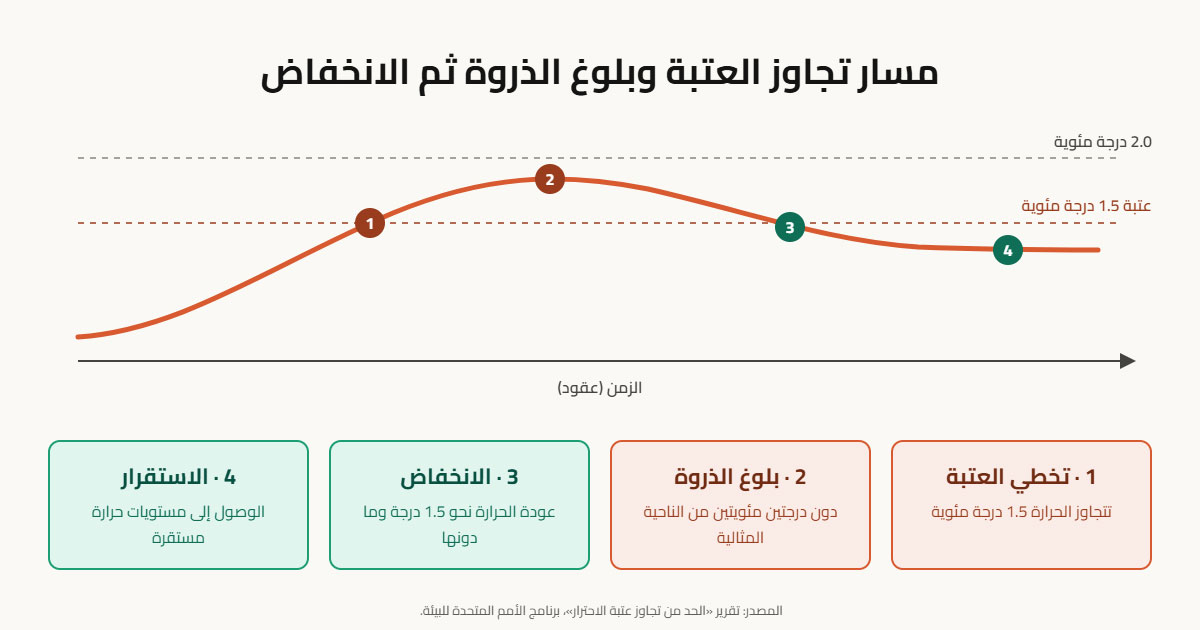
Changes in global warming rates take decades, and if we are able to limit and then reduce the peak, exceeding 1.5 degrees Celsius will be a curved line. The report's authors called this path "the path of crossing the threshold, reaching a peak, and then declining," and it is a path that passes through four stages:
- The temperature exceeds the threshold of 1.5°C.
- Reaching the peak, ideally maintaining it below 2 degrees Celsius.
- decline.
- Reaching stability levels.

2. Exceeding 1.5 degrees does not mean abandoning the target
Article No. (2) of the Paris Agreement obligates countries to keep the average rise in global temperatures well below two degrees Celsius, and to strive to limit it to 1.5 degrees. But 1.5 degrees has never been a safe level; Because we are already experiencing heat waves, fires, droughts and extreme weather events.
As the threshold is crossed, these effects will intensify at a non-linear rate, worsen over time, and may reach irreversible turning points, such as:
- Forest degradation.
- Ice melting.
Therefore, mitigation costs will rise significantly, with increasing reliance on carbon dioxide removal rather than just reducing emissions. Climate conditions will limit our ability to adapt; Which raises humanitarian dilemmas such as the inundation of small island developing states; Therefore, the immediate priority remains to reduce emissions quickly and sustainably. Addressing the threshold exceeding 1.5 is part of responsible preparation for a risk that is increasingly difficult to ignore.
3. Adaptation and mitigation are promising paths
The report calls for us to stop treating climate change mitigation and adaptation as two separate paths; Efforts in both fields must be accelerated simultaneously, on a larger scale, with greater ambition, and with closer interconnection. Achieving net zero emissions may be enough to stop temperatures rising, but restoring climate stability below 1.5 degrees requires reaching negative net emissions.
4. Removal of carbon dioxide is necessary
Removing carbon dioxide means pulling it from the atmosphere and storing it safely. The report acknowledges that even lower-threshold routes would require increased total removals; These are processes that include ecosystem-based practices, such as afforestation and soil management. It is the most feasible option, but it has its limitations: it requires large areas of land; This forces a rethink of agriculture and sustainable livelihoods.
5. Hypothermia is not the end
Here is an important question: What will the world look like when temperatures drop and the climate stabilizes? According to the report, Atallah, head of the Climate Adaptation and Resilience Division at UNEP and coordinator of the report, explains that the climate system is like a huge kettle: reducing emissions reduces the intensity of the flames, achieving net zero limits further rise, but the accumulated heat does not disappear; It takes decades or much longer for oceans, ice sheets, and ecosystems to respond. This makes predicting the future difficult.

In conclusion, these five pieces of information that I covered The Earth Guards Foundation It reveals a shift in thinking about the climate crisis, more than it reveals a new number; The time has passed when we used to ask: Will we exceed 1.5 degrees Celsius? We have already crossed it in 2024, and the question becomes: How long will we remain above it, and how high will we reach?


