

Wildfire Smoke Disrupts Bird Populations and Threatens Ecosystem Balance
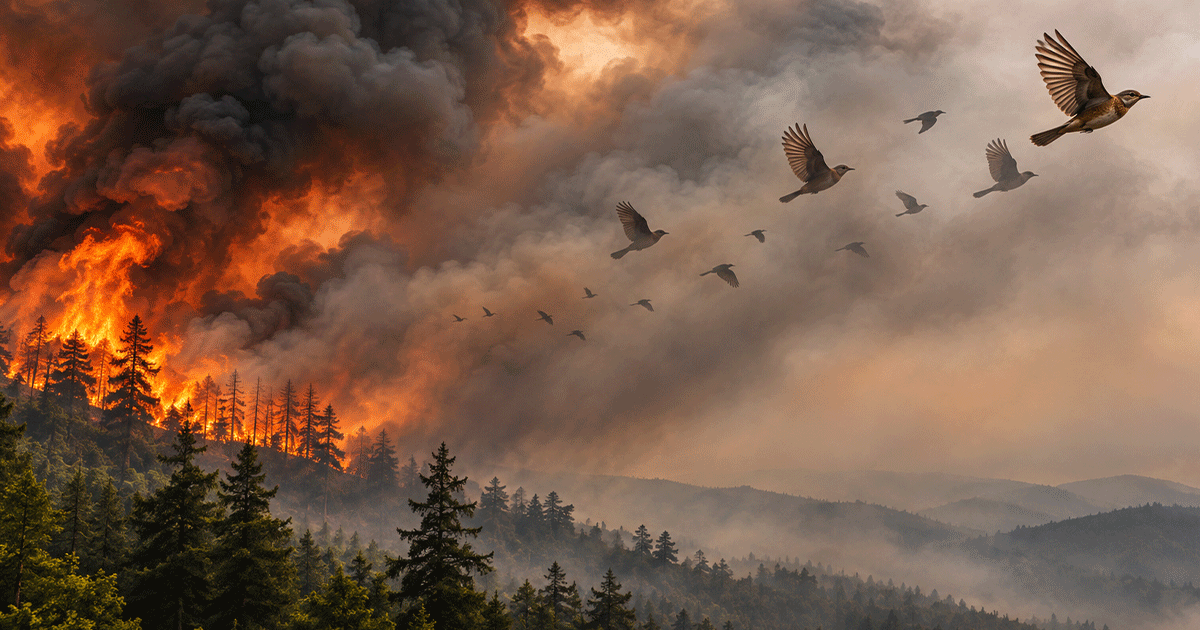

Forest fire smoke haunts birds and threatens the balance of ecosystems
New research reveals that Forest fire smoke It could have an ecological impact far beyond the areas reached by the fire, after researchers found a link between increased exposure to smoke and a decline in bird diversity in the following breeding season.
The study relied on 15 years of data in the United States and found that areas exposed to higher levels of smoke recorded fewer bird species over the following year, even in locations where areas had not burned nearby.
The findings highlight a less obvious aspect of wildfire damage: smoke carried by wind over long distances can affect ecosystems and biotic communities beyond the fire itself.
Smoke exceeds the limits of fire
However, wildfires cause direct damage to homes and natural habitats Forest fire smoke It can travel hundreds of miles with the wind, expanding the impact to areas far from the fire.
To understand this effect, researcher Sarah Mayer studied… Swiss Federal Institute of Technology In Zurich, in collaboration with Erik Strobel of the University of Bern, the relationship between smoke exposure and bird diversity in the United States.

The researchers focused on what happens during the breeding season following fires, with the aim of finding out whether smoke leaves a mark that persists after the event itself ends.
For a broader understanding of the impact of forest fires on ecosystems and biodiversity, read also: Forest fires are an increasing threat to the balance of our planet.
15 years reveal birds' decline
The study was based on program data North American Breeding Bird Survey, a long-term program that began in 1966 to track bird populations in North America.
The researchers analyzed data from about 2,800 data Track to monitor In the United States during the period from 2008 to 2022, each trail is about 40 kilometers long and includes approximately 50 monitoring points for birds that are seen or heard.
This data was combined with high-resolution measurements of particulate matter from wildfire smoke, allowing researchers to compare pollution levels with changes in species numbers and distribution.
The team also studied the extent of the balance of bird numbers between different species and the extent of evolutionary difference between them, to obtain a broader picture of the impact of smoke on biodiversity.
Bird diversity decreases 3%
The results showed that when an area transitions from a normal year to a year more exposed to smoke, the number of bird species there in the following breeding season decreases by about 3% on average.
In a typical trajectory of about 55 species, this equates to a decline of about one or two species, while some of the sites most exposed to smoke recorded larger declines.

Although the percentage seems limited, researcher Sarah Mayer believes that the problem lies in the difficulty of knowing which species may disappear and the role they play within the ecosystem.
The loss of a single species can be impactful if it performs an essential function, making biodiversity decline a factor capable of altering the balance of an ecosystem even when the numerical decline appears small.
Unburned areas are also affected
The researchers were careful to separate the impact of wildfire smoke from other factors that typically accompany fires, such as heat waves, drought, and land use change.
They also tested the possibility that diversity declines were a direct result of habitat destruction, but the results persisted even in tracks where no areas within a 5-kilometre radius had been burned.
The study also took into account the possibility of birds moving to nearby areas to escape smoke, but a decrease in diversity remained apparent after these movements were included in the analysis.

The study does not definitively determine what happens to the birds themselves, but other research suggests that exposure to smoke may be associated with weight loss, respiratory damage and behavioral changes during the breeding season.
This intersects with the fifteenth goal of the Sustainable Development Goals on life on land, especially since protecting biodiversity depends on understanding the indirect pressures that may affect species even outside the directly affected areas.
The loss extends to the ecosystem
Birds perform essential functions within many ecosystems, including spreading seeds, pollinating plants, and helping to control pests.
Therefore, the decline in bird diversity could spread to other species of plants and animals, and affect sectors such as agriculture and forestry.
The study shows that these losses are difficult to include in traditional economic calculations. While the cost of a burned building can be estimated relatively easily, measuring the economic value of biodiversity loss becomes more complex.
The increase in forest fires with rising temperatures and drought also adds a climate dimension to the problem, in line with the thirteenth goal of the Sustainable Development Goals on climate action, especially with the widening scope of impacts that go beyond the fires themselves.
In light of these developments, it is indicated The Earth Guards Foundation The damage caused by forest fire smoke may affect biodiversity and ecosystem functions, which requires including the effects of smoke in assessing losses and future fire management strategies.


