

As part of efforts to preserve human heritage, a new archaeological discovery redraws the features of Ramesses II

As part of efforts to preserve human heritage, a new archaeological discovery redraws the features of Ramesses II
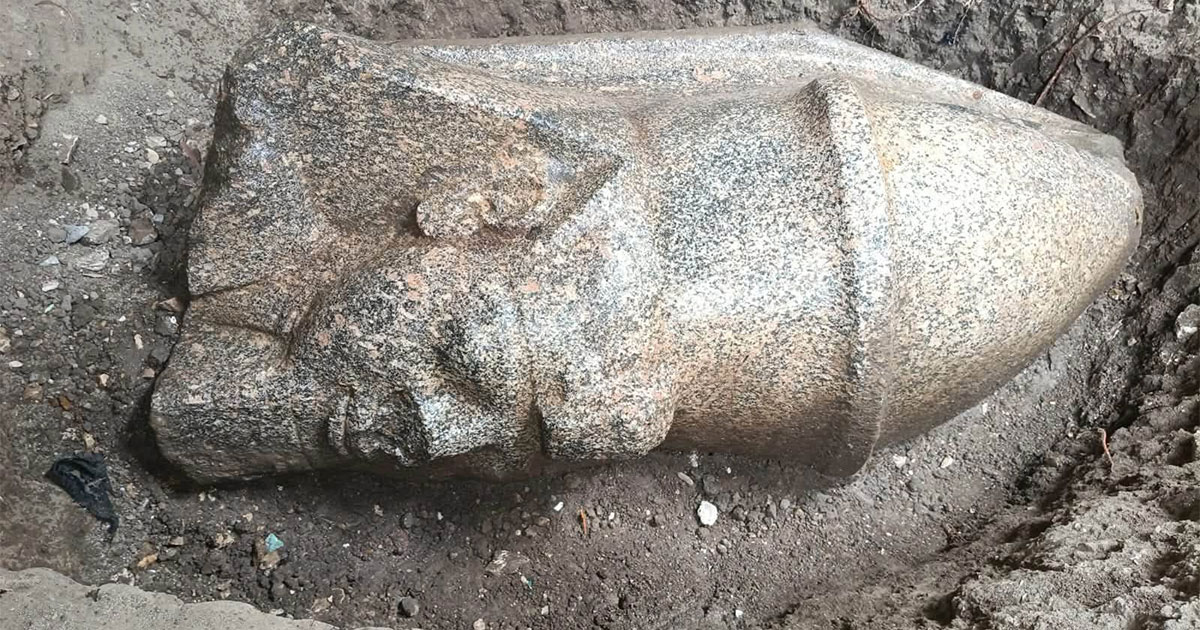
The Egyptian archaeological mission affiliated with the Supreme Council of Antiquities – as part of efforts to preserve human heritage – uncovered the remains of two huge royal statues, one of which is of King Ramesses II, and the other is likely also of him, with a block of pink granite inscribed with his royal titles, while working on salvage excavations in the “village of Behbeit Al-Hajara” in Gharbia Governorate.
The story began with a report from a citizen who found an inscribed block on his land, so he took the initiative to inform the archaeological inspection. This discovery brought back the question about the role of such national efforts in preserving Egypt’s human heritage. That is, this archaeological discovery is a practical test of the sustainable development goals, especially the goal. 11, whose goal No. 14 is based on strengthening efforts to preserve human heritage, as well as Goal 16 (strong institutions and the rule of law), and Goal 17 (partnerships), in addition to education (Goal 4) and sustainable tourism (Goal 8).
What exactly was revealed in Behbeit al-Hajar?
The salvage excavation work resulted in three main pieces:
- Head of a colossal statue
- And a second, almost complete, royal statue
- Engraved granite block
Below are the details of each, as explained by officials of the Ministry of Tourism and Antiquities.
First discovery: huge head with double crown
The height of the discovered head is approximately two meters, and the king appears wearing the double crown, which symbolizes the unification of Upper and Lower Egypt. The remains of the upper part of the back column were also found, which bears an inscription with the Hurrian title of the king, “Har-ka-nakht-meri-maat.”

What does head size tell us?
The size of the head indicates that the original height of the statue – including its base – may have been more than 8 metres. This reflects the enormity of the statue and its artistic importance, and gives an idea of the status of the site in which it was erected.
Second discovery: a royal statue with a headdress
The second discovery is a royal statue more than two meters tall, and it is likely that it also dates back to Ramesses II. And he misses The statue has its legs and base, and shows the king wearing the royal headdress known as the “mongoose”, with part of the top missing.
Granite block: inscribed royal titles
Regarding the inscribed block, it is made of pink granite, is about 1.30 meters long, and is located approximately one meter to the north of the second statue, and bears the remains of hieroglyphic inscriptions that include two titles for the king, namely:
- Nesso Beyti – King of Upper and Lower Egypt
- Sa Ra – son of Ra

| Item | Its most prominent features |
| Head of the first statue | The double capital, and a column on which the Hurrian title appears |
| The second statue | The royal mongoose, without legs or base, with a clearly preserved face |
| Granite block | Pink granite and hieroglyphic inscriptions |
Who is Ramesses II?
As for who is Ramesses II? He is the third king of the Nineteenth Dynasty. He ruled Egypt for about 66 years (approximately 1279-1213 BC), and describes him as Many consider him the greatest king of the Pharaohs, and are credited with building major temples, such as Abu Simbel and the Ramesseum, and establishing a new capital in the eastern Delta. To know the reason for his fame, it is enough to follow the details of his life as recorded in the inscriptions and mummy.
The importance of the new discovery
The Ministry of Tourism and Antiquities confirms that excavations and studies at the site are continuing. In order to find other archaeological elements and study the relationship of the pieces to each other and to the site, this is only because the new archaeological discovery is of great importance for understanding an important historical period in ancient Egypt.
What clarifies this importance is that the construction of the Temple of Isis in Behbeit al-Hajar is attributed – for the most part – to eras later than the reign of Ramesses II, and this opens up more than one possibility; There may have been an older facility on the site, and the statues may have been moved from another location, a phenomenon known in… Delta ruins, where many pieces of property have been reused.
Ramses II achieves development goals
Looking at this archaeological discovery that redraws the history of Ramesses II is related to a number of the 17 Sustainable Development Goals, especially Goal 16, which calls for achieving the rule of law and building effective and accountable institutions.
We can see this clearly in Goal 17, which is embodied in the partnership between the citizen and the state. Therefore, Mr. Sherif Fathi, “Minister of Tourism and Antiquities,” expressed his appreciation for the awareness of the citizen who informed the competent authorities immediately after finding the block, stressing that this reflects the importance of society’s role in protecting the cultural heritage and preserving it for future generations.
The summary and conclusion of the speech is that the most telling thing about the discovery of Bahbit al-Hajar is the distance Between what we know about Ramesses II and what we still do not know about him; A head exceeding two meters high, another royal statue, and inscriptions bearing Pharaonic titles. Three pieces of evidence open new questions about an important era in the history of ancient Egypt.
Therefore, The Earth Guards Foundation hopes that this news coverage will be an explicit call for more national efforts, which fully appreciate Egypt’s antiquities; With a desire to preserve a global human heritage that is consistent with what the 2030 Sustainable Development Plan calls for.


