

Because of the French demonstrations.. Is the ancient Egyptian writer in danger?
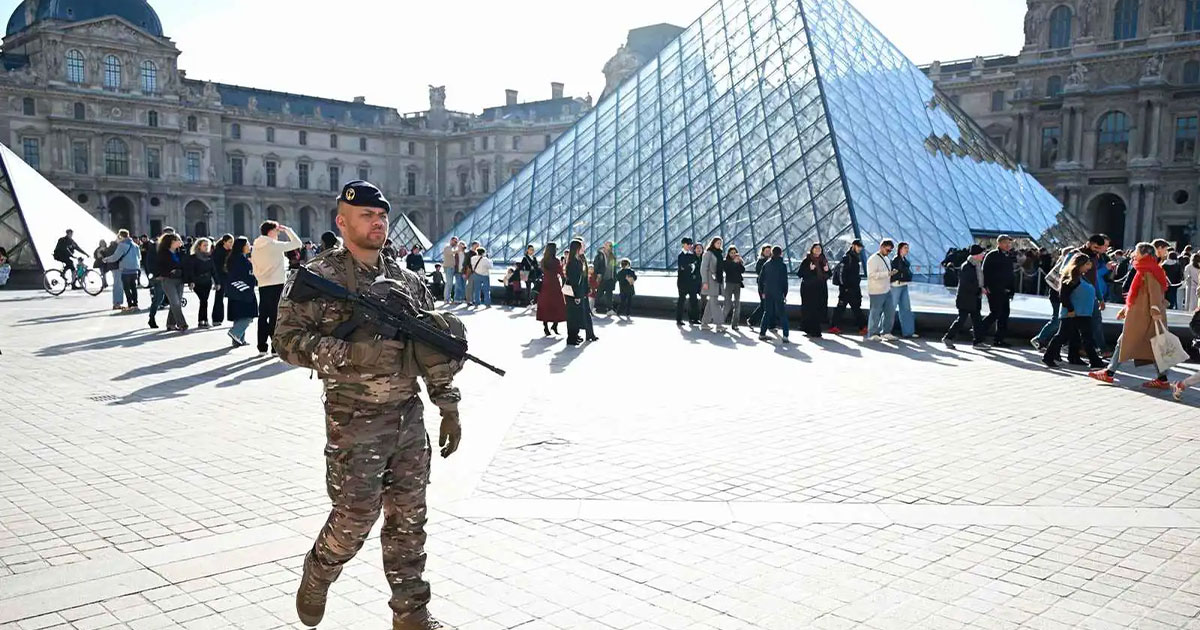

Because of the French demonstrations.. Is the ancient Egyptian writer in danger?
The recent demonstrations in France turned from the streets to the entrance of the Louvre Museum, which contains about 55 thousand Egyptian pieces; Therefore, here comes an important question about the eleventh goal of the Sustainable Development Goals: Sustainable Cities and Local Communities, one of whose goals is based on the need to protect human heritage.
Hence, The Earth Guards Foundation In this article, you will discuss what happened at the Louvre Museum, what is in the Egyptian Antiquities Department, how museums are protected in times of danger, and what is the relationship of all of this to the 2030 Sustainable Development Agenda.
What is happening in the French demonstrations?
The French capital, Paris, is witnessing protests and chaos that have reached the famous French Louvre Museum, where protesters surrounded its main entrance. The authorities closed the museum the next day to control the heated situation.
Because of the French demonstrations, specialists and officials in the Egyptian antiquities sector expressed their deep concern. Because the Louvre is one of the largest international museums that contains Egyptian antiquities that are up to 5,000 thousand years old! Therefore, they called on France to implement intensive measures to protect these priceless global monuments.

What are the antiquities of ancient Egypt in the Louvre?
The Egyptology department located in the French Louvre Museum includes about 55 thousand pieces, as we mentioned previously, and they are distributed among 19 A showroom covering two entire floors.
Among the most prominent of these Egyptian pieces are:
- Seated Writer Statue
- The Sphinx that was discovered in the ancient Egyptian capital Tanis
- Statue of Akhenaten
What is the name of the statue of the ancient Egyptian writer?
One of the most prominent Egyptian antiquities displayed in the Louvre Museum is the statue of the Egyptian Scribe, one of the most famous masterpieces of ancient Egyptian art, which dates back to approximately 2450 – 2325 BC, and is known as « The Seated Scribe », and is also described as the “squatting scribe” because of the shape of his sitting position.

What did Egypt and its experts demand?
Because of France’s demonstrations and their damage to the statue of the Seated Writer – and other great Egyptian antiquities – Egyptian officials issued a statement in which they expressed their deep concern for the safety of Egyptian historical artifacts, and demanded the French authorities and the Louvre administration to take the maximum immediate security and precautionary measures.
The rationale for this demand was that about 55,000 Egyptian artifacts must be secured in the Louvre Museum, amid protests and acts of violence taking place in the French capital, as it is possible that protesters will infiltrate the museum. Thefts occur, or damage occurs to precious world antiquities.

What protects museums in times of danger?
In this Context: The president of the International Association of Egyptian Archaeologists explained that major museums are directly linked to security and civil protection agencies. Hence, the measures that must be taken in this regard range according to the danger and its severity, such as fire, intrusion attempts, protests, and wars.
This may mean:
- Paying additional forces for insurance.
- Re-evaluation of the security system.
- Evacuating important pieces to safer locations in extreme cases.
Therefore, the danger surrounding the Egyptian antiquities in the Louvre Museum reveals a truth that goes beyond the limits of the French protests. Because civilization – any civilization – loses its evidence when it loses something of its human memory, if institutions are unable to Preserving what generations inherited from their ancestors.
This is confirmed by the statue of the seated Egyptian writer – with its connotations of knowledge, codification and administration in ancient Egypt – since it is a historical witness to a society that realized early on that preserving knowledge is a condition for the sustainability of a person’s impact after his departure.
Accordingly, the most profound paradox in this matter is that Egyptian antiquities located outside Egypt’s borders pose a responsibility that goes beyond the ownership of the pieces and their display sites. Although these evidences belong to the history of a specific civilization, they contribute directly to shaping the common memory of humanity. This makes its safety a moral and institutional responsibility that cannot be postponed.
Thus, the question raised by The Earth Guards Foundation is about the fate of the statue of the ancient Egyptian writer and others. The Egyptian antiquities lead us to a broader question: What future can we build if we do not preserve the evidence that explains our beginnings? Because sustainability is, in essence, a contract between generations that take over the world from each other, and this contract is not complete if the children lose their traces that give their history its sustainable meaning.


