

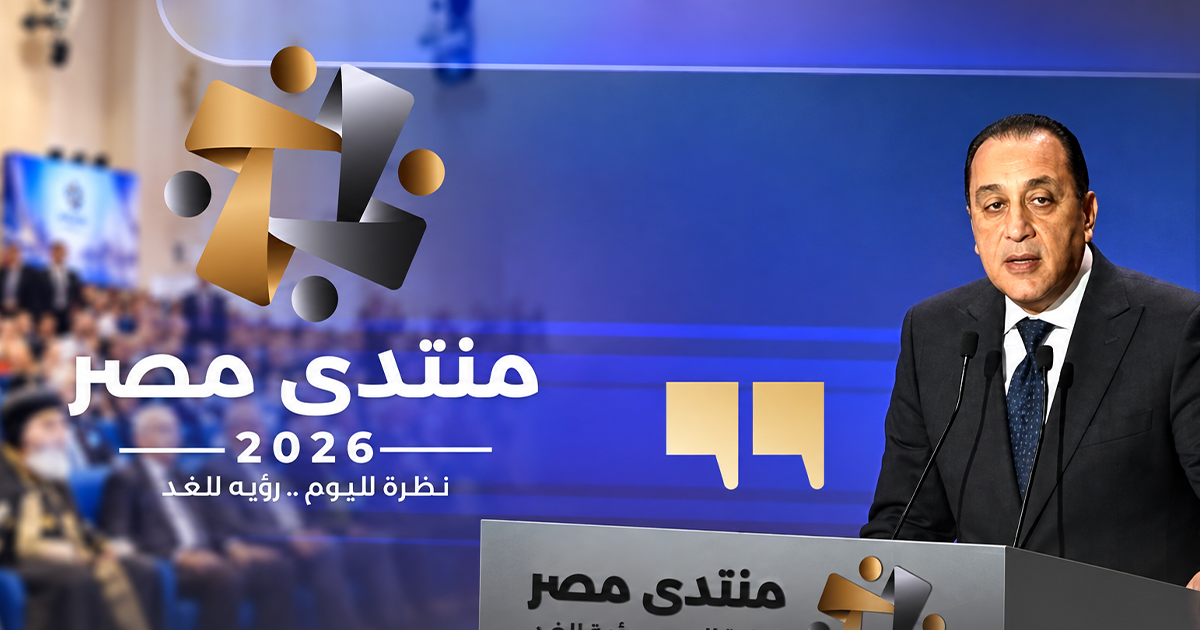
Egypt Forum 2026.. Outputs and recommendations that turn into government mandates to achieve comprehensive development

Egypt Forum 2026.. Outputs and recommendations that turn into government mandates to achieve comprehensive development
Within the framework of the Egyptian state’s direction towards achieving sustainable development and enhancing the quality of life of citizens, the Egypt Forum 2026 came to present a set of files related to the future of the national economy and the development of basic services, through a package of programs and targets whose effects extend to the sectors of health, education, work, production, investment and infrastructure, in addition to digital transformation, clean energy and social protection.
These files reflect a trend towards linking development plans to the needs of citizens, enhancing the efficiency of public institutions and services, and expanding opportunities for participation in economic activity. These files intersect with a number of sustainable development goals, and are linked to the state’s ability To achieve more comprehensive and sustainable development in the coming years.
Expanding the umbrella of social protection
Within the framework of efforts to enhance social protection and improve the standard of living of citizens, the outcomes of the Egypt Forum 2026 included a set of targeted measures to reduce living burdens, expand job opportunities, and improve basic services.
In this context, the government aims to increase allocations for services that directly affect the lives of citizens to about 4.8 trillion pounds by the fiscal year 2029/2030, compared to about 2.3 trillion pounds, in addition to expanding initiatives to support the marriage of young people in the most vulnerable categories, and increasing the number of beneficiaries from two thousand to four thousand cases.
These trends are linked to the first goal of the Sustainable Development Goals, which is concerned with eliminating poverty by enhancing opportunities for… Gain income, improve access to basic services, and expand social protection.
Increasing agricultural area and enhancing food security
Enhancing local agricultural production represents one of the basic paths to increasing food availability and improving the state’s ability to meet the needs of citizens. In this context, the outputs of the Egypt 2026 Forum included targets for expanding the agricultural area and raising rates of self-sufficiency in strategic crops. The state aims to increase the agricultural area from about 10.5 million acres to 12.5 million acres by 2030, and raise the self-sufficiency rate in wheat from about 55% to 60%, in a way that supports food supplies and reduces dependence on imports.
Supporting farmers and reducing burdens
To enhance farmers’ ability to achieve these goals, it included Outputs: Increased crop supply prices; It aims to raise the price of supplying a ton of wheat from 2,500 to 2,650 pounds, and a ton of sugar beets from 2,000 to 2,300 pounds. It also included launching an initiative to support agricultural activities during the upcoming winter season, aiming to prepare one million acres of small holdings, each of which has an area of less than two acres, to grow wheat using agricultural mechanization units, in a way that facilitates agricultural operations and reduces its cost for small farmers.

The importance of these measures is complemented by their connection to the efficient use of agricultural and water resources and increasing the return on available land. Enhancing food security requires developing local production in parallel with improving the management of the resources on which it depends.
Hence, these targets relate to the second goal of the Sustainable Development Goals, which is concerned with eliminating hunger, achieving food security, and improving Nutrition and promoting sustainable agriculture.
Developing health care services
In parallel with the interest in enhancing food security and improving the basic necessities of life, health care emerges as another aspect of development directly linked to the quality of life of citizens. In this regard, the outcomes of the Egypt Forum 2026 are aimed at completing the governorates of the second phase of the comprehensive health insurance system, and increasing the financial allocations allocated to eliminating waiting lists for critical cases in government hospitals and hospitals of the General Authority for Healthcare and Health Insurance.
The development of medical services extends to raising the efficiency of responding to emergency cases, by including and developing a thousand equipped ambulances, in addition to expanding early detection of diseases. Plans aim to launch an initiative to detect six main types of cancer Children, at an estimated cost of about one billion pounds.
These targets reveal the importance of combining expanding health coverage, improving the speed of service delivery, and enhancing opportunities to detect diseases at early stages. These are paths linked to the third goal of the Sustainable Development Goals, good health and well-being, which aims to ensure a healthy life and promote well-being for all at various stages of life.
Developing the educational system and technical education
Interest in building a human being extends from health care to education, as it is one of the basic determinants of individuals’ ability to acquire skills and participate in development. In this context, the outcomes of the Egypt Forum 2026 included plans to develop 600 technical schools in cooperation with the private sector, in a way that strengthens the connection of technical education with the needs of the labor market, in addition to expanding Egyptian schools. Japanese to 500 schools within three years, and work to make this model available in all government schools by 2030.
The objectives also include studying the establishment of a national scholarship fund, under the supervision of the Presidency, to finance university scholarships and scholarships for postgraduate studies for distinguished Egyptian students wishing to study abroad.

These trends reflect an interest in developing different education paths, from school to university, in parallel with improving the conditions of teachers and expanding opportunities for enrollment in education. These are aspects related to the fourth goal of the Sustainable Development Goals, Quality Education, which calls for ensuring comprehensive and equitable quality education and promoting lifelong learning opportunities for all.
Developing infrastructure and basic services
The outputs of the Egypt Forum 2026 include plans To develop infrastructure and basic services, by allocating 5 billion pounds annually to develop drinking water and sanitation services in cities and villages in various governorates, in addition to implementing the national program to develop local roads with investments amounting to 42 billion pounds, with the goal of completing it within three years.
The plans also include implementing a housing and urban development program that aims to provide one million housing units within four years, as well as completing the stages of the “Decent Life” presidential initiative, which supports improving living conditions and expanding the scope of benefit from basic services.
Digital transformation and information architecture
In a related context, digital transformation represents one of the main axes for developing public services and raising the efficiency of their management. The outputs aim to complete the digitization of government services provided to citizens and investors And government agencies within three years, and increasing the number of services available through the Digital Egypt platform from 250 to 500 services before the end of the year, in addition to developing Internet services and raising their efficiency.
These goals are linked to the eleventh goal of the Sustainable Development Goals, sustainable cities and local communities, by improving basic services, developing urban environments, and enhancing the quality of life.
Supporting projects and achieving economic growth
The human building system is completed by his ability to transform the knowledge and skills he acquires into job opportunities and stable income. This links the development of education and vocational qualification with employment and economic growth.
This trend extends to supporting productive activities and projects capable of creating new job opportunities. Plans include launching the “Young Manufacturers” initiative, and accelerating… Implementing the “Future Factories” and “Productive Village” initiatives, in addition to developing mechanisms to deal with troubled factories and restart them.
The “Productive Village” initiative also aims to establish industrial complexes in a thousand villages by 2030, expanding economic activity in rural areas and linking job opportunities to local productive capabilities.
National Program for Economic Transformation
The National Economic Transformation Program for the period from 2027 to 2030 aims to raise the economic growth rate to 6.8% by the fiscal year 2029/2030, compared to about 5.1% currently, and to increase the contribution of private sector investments from 57.7% to 67%, in parallel with reducing the unemployment rate from 5.8% to 5.5%.
These targets gain their importance from their connection to the ability of growth to provide better jobs and expand productive activity, in a manner consistent with With SDG 8, Decent Work and Economic Growth, which supports sustainable and inclusive economic growth, productive employment, and decent work for all.

In conclusion, the outcomes of the Egypt Forum 2026 confirm that achieving comprehensive development is linked to the integration of social, economic and service policies, from expanding the umbrella of social protection and enhancing food security, to developing health care, education and infrastructure, supporting investment and production and providing job opportunities.
In this context, The Earth Guards Foundation stresses the importance of viewing these assignments as interconnected paths to achieving sustainable development goals, ensuring that economic growth is directed towards improving living conditions, promoting social justice, and raising the efficiency of resource use. The Foundation follows up on these trends from Its belief that sustainable development is measured by its ability to make a tangible and lasting impact on human life, and by the extent to which public policies reflect society’s needs and priorities.


