

Ibn al-Haytham.. How did questions of light turn into a revolution in knowledge?
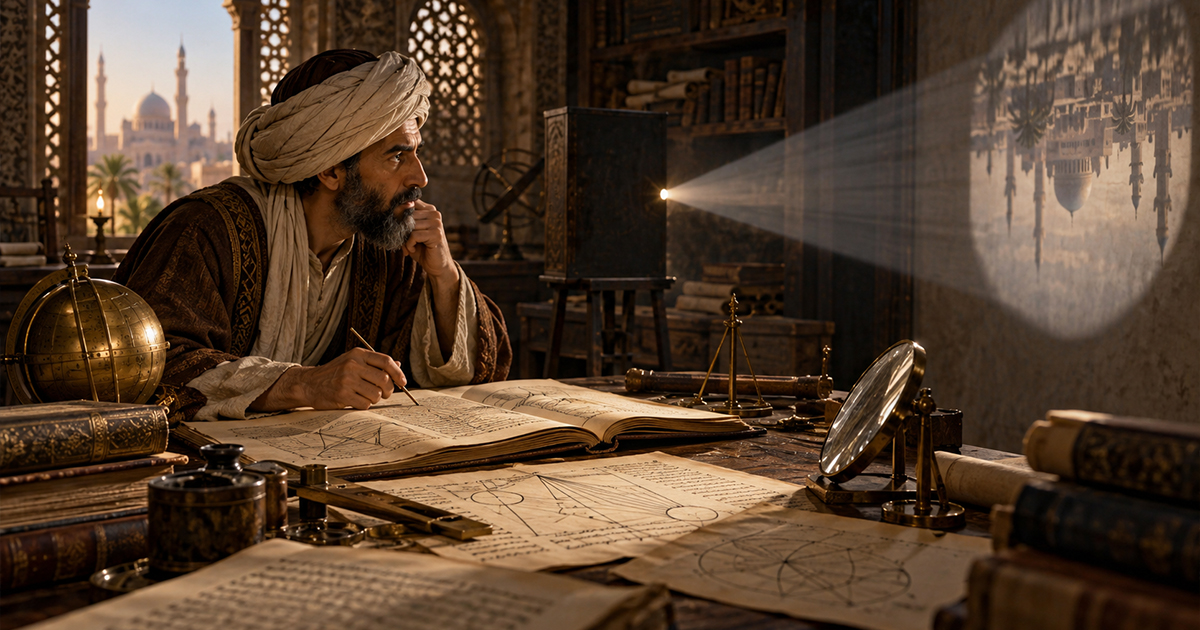

Ibn al-Haytham.. How did questions of light turn into a revolution in knowledge?
What if a ray of light entered a dark room through a small hole and painted an image of the outside world on its wall? The phenomenon may seem simple to those who today know how images are formed, but it was part of deep questions that have occupied scientists for centuries: How does the eye see things? Does something emanate from it that reveals the world, or does light come to it carrying its image?
About a thousand years ago, it was Ibn al-Haytham He is one of the most prominent people who sought to answer these questions. However, what made his contribution a landmark in the history of science was his method of searching for the truth. He put ideas to the test, and made experiment a partner with mathematics in understanding natural phenomena.
From that scientific journey, a story opens that goes beyond the limits of optics, reaching meaning Scientific innovation The importance of knowledge in building a more sustainable future.
From Basra to Cairo…a journey beyond knowledge
Al-Hasan bin Al-Hasan bin Al-Haytham was born in Basra in 354 AH / 965 AD, at a time that witnessed a flourishing of mathematical, astronomical, and philosophical knowledge. His interests extended to multiple fields of knowledge. He studied philosophy, mathematics, physics, and astronomy, and left books that dealt with various scientific and intellectual issues.
And she points His biography prepared by the University of St Andrews He worked in the administrative field during his youth, before devoting himself full time to scientific research. Then he moved to Egypt in the Fatimid era, where his name was associated with an attempt to regulate the flow of the Nile waters.

Historical sources narrate that he proposed an engineering project to control the river’s waters, before realizing the difficulty of implementing it. Although accounts differ regarding the details of this experience, they reveal an aspect of the breadth of his interests, from theoretical issues to practical problems.
In Cairo, Ibn al-Haytham continued researching and writing, until his works on light and vision became among the most prominent remains of his scientific legacy.
The book of views reveals the secret of light
The interpretation of the vision has been the subject of long debate among scholars of antiquity; Some theories have assumed that the eye sends rays towards objects in order to see them.
But Ibn al-Haytham turned to a different explanation, based on the arrival of light from objects to the eye, and he based his studies on experiments that dealt with the behavior of rays, their reflection and refraction.
He collected the results of his research in ""Book of Sights", consisting of seven parts, which dealt with the nature of light, visual perception, mirrors, and phenomena related to vision.

One of the phenomena most closely associated with his scientific legacy is what is known as the dark room. When light passes through a small opening into a dark place, a mirror image of the external scene can be formed on the opposite surface. This phenomenon helps understand how light propagates in straight lines.
His experiments were not error-free according to what we know today. Some of his explanations of the structure of the eye and its functions remained limited to the knowledge of his time. But the value of his work appeared in his reliance on observation, experimentation, and analysis, rather than being satisfied with an inherited interpretation without examination, and here the features of an approach that would have a lasting impact on the history of scientific research began to take shape.
When doubt became a path to knowledge
Why is questioning a scientific idea a step toward progress, not a threat to knowledge?
The writings of Ibn al-Haytham provide a striking answer to this question. In his author ""Doubts on Ptolemy"He discussed some of the views of the Greek scientist Ptolemy, and revealed the contradictions he saw between astronomical models and physical explanations.
His goal was not limited to rejecting his predecessors or merely disagreeing with them. Rather, the search is for an explanation that stands up to proof. And she explains A study published by the UNESCO website by researcher Muhammad Rezaullah Ansari Ibn al-Haytham used experiments to test hypotheses, and linked their results to mathematical descriptions of phenomena. In his studies of light, he combined observation of the reflection and refraction of rays, and the search for scientific rules that explain their behavior.
Even his ideas themselves did not remain immune from revision. According to the researchers’ study, Ibn al-Haytham’s interpretation of the phenomenon of larger celestial bodies appearing near the horizon has evolved. He moved from an interpretation influenced by Ptolemy to a treatment that highlighted the role of visual perception.
These details carry a meaning that goes beyond the history of optics, providing a lesson that resonates through the ages: when knowledge is subject to revision, it gains a new opportunity to develop and does not lose its value.
This idea opens a door for reflection on contemporary education. How can generations be prepared to face problems that their predecessors did not know about, if they do not learn to question, analyze, and test evidence?
Developing these abilities supports the spirit Target 4.7 of Sustainable Development Goal 4, on quality education, which calls for empowering learners with the knowledge and skills necessary to support sustainable development. Education that provides room for critical thinking gives people the knowledge and ability to employ them in facing new challenges.
A thousand years of light… a renewed legacy
Centuries after the passing of Ibn al-Haytham, the science of optics continued to develop through the contributions of scientists from different civilizations and eras, until its applications became part of the details of modern life.
Light, which preoccupied researchers with questions about reflection and refraction, is today based on multiple technologies, from optical fibers used in communications to medical devices that rely on light for photography and examination, as well as solar energy technologies that convert sunlight into electricity. Ibn al-Haytham’s applications belong to a long process of development in the understanding of light in which his works had an important position.

In 2015, UNESCO celebrated his legacy in a… Events of the International Year of Light and Light-Based Technologies, which aimed to highlight the role of these technologies in facing global challenges related to energy, education, agriculture and health.

Here another question arises: What makes an ancient scientific discovery relevant to a more sustainable future?
The answer lies in the ability of knowledge to accumulate and transform into useful solutions. Research that begins with understanding a natural phenomenon may, over generations of development, open horizons for technologies that increase the efficiency of resource use, improve health services, or facilitate access to information.
From this standpoint, you gain Target 9.5 of SDG 9, on industry, innovation and infrastructure, of particular importance; It calls for strengthening scientific research and technological capabilities and encouraging innovation.
Perhaps this link between knowledge and application is also evident in a contemporary experience that I discussed The Earth Guards Foundation on the role of scientific research in supporting the sustainability of Egyptian universitiesThe value of research goes beyond the limits of academic publishing to its ability to serve society and meet its challenges.
Thus, bridges of knowledge extend between the past and the present, so that sustainability becomes one of the fruits of the scientific legacy when it is transformed into research and innovations that serve humanity and the future.
The world is gone, but the questions remain
Ibn al-Haytham passed away in Cairo around the year 430 AH / 1040 AD, and his works remained part of a long history during which man’s knowledge of light and vision developed.
Perhaps what is most distinctive about this story is that its author was a researcher who made reviewing and testing ideas a path to knowledge, even when those ideas came from the greatest names in the history of science.

Hence, his story acquires a human meaning that is consistent with a message The Earth Guards Foundation In spreading awareness of sustainable development; Preserving scientific heritage is embodied in reviving the values of knowledge, research and experience, and employing them to create solutions that serve humanity and create a more sustainable future..
Between a dark room in which scientists tested the path of light, and modern laboratories searching for answers to the challenges of energy, health, and the environment, a journey continues that has not yet ended.
The tools may change and the questions may changeBut the ability to search for evidence remains one of the most valuable things that civilizations pass on to future generations.


