

Giants in the History of Science: Three Immortal Flashes That Changed the Concepts of the Universe and Life
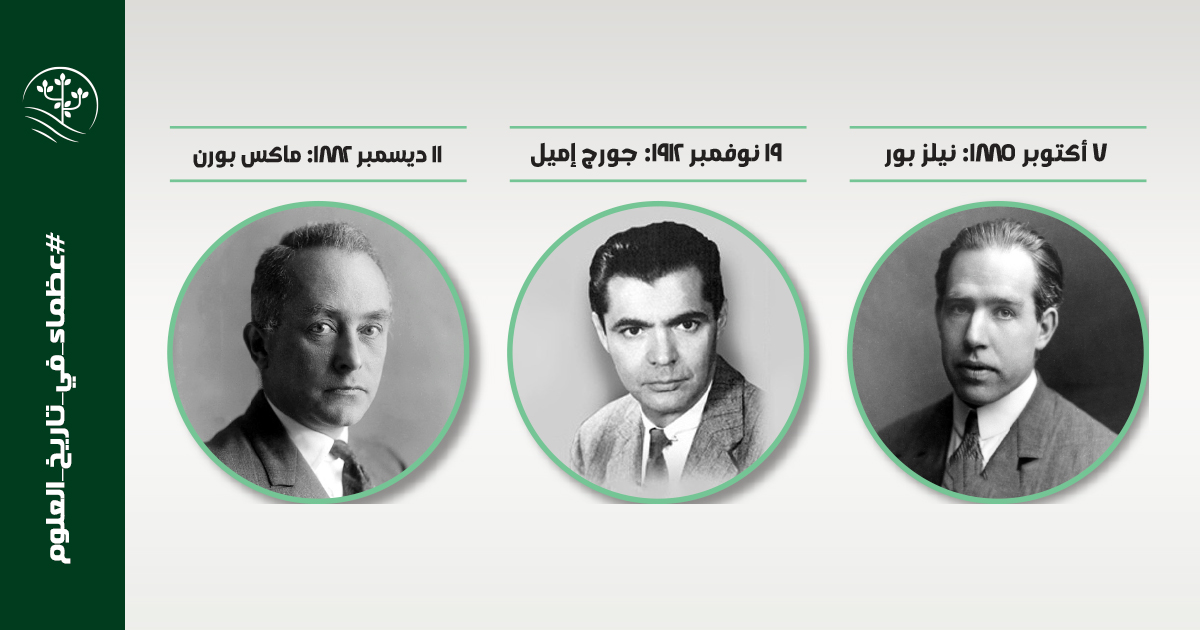

Great people in the history of science… Three immortal flashes that changed the concepts of the universe and life
The history of science is full of a large number of greats in many fields between different time periods, and here we highlight with you three of the most prominent scientists who made pioneering and sustainable achievements in science.
7October 1885: Niels Bohr
The Danish physicist Niels Henrik David Bohr was born in Copenhagen on October 7, 1885. He is one of the pillars of modern physics and made prominent contributions to the theory of the structure of the atom. In 1913, Bohr presented a revolutionary model of the atom, in which he explained that electrons revolve around the nucleus in specific orbits, and that they absorb or release energy. This perception changed scientists’ understanding of the structure of matterA radical change.
For this reason, Bohr won the Nobel Prize in Physics in 1922, before he founded the Institute for Theoretical Physics in Copenhagen, which became a global center for developing quantum mechanics research, until Niels Henrik David Bohr became one of the most prominent people who linked science and philosophy.
19November 1912:Georges Emile
On the nineteenth of the year 1912, the Romanian scientist George Emil Palade (in Romanian: George E. Palade) was born. He is one of the most prominent scientists ofCellular Biology in the twentieth century. He devoted his life to understanding the fine structure of the cell and its internal functions. He was one of the first to use the electron microscope in studying living cells. This allowed him to discover previously unknown cellular structuresBefore.
Paladi is credited with discoveringribosomes, which are the particles responsible for producing protein inside cells, an achievement that changed scientists’ understanding of the mechanism of life at the molecular level. He then won the Nobel Prize in Medicine in 1974; This is in recognition of his pioneering contributions that laid the foundations of modern biology.
Paladi was also distinguished by a scientific vision that combined experimental accuracy with philosophical contemplation on the essence of life. He believed that science was a tool for discovering beauty in the hidden system of organisms, and that understanding the cell was the first step towards understanding man himself.
11December 1882: Max Born
Max Born’s birth on December 11, 1882 in the German city of Breslau was the beginning of an intellectual path that reshaped the foundations of physics intwentieth century; Born was a scientist conducting experiments and a philosophical mind searching for a hidden logic among the parts of the vast universe.
Through his fundamental research in quantum mechanics – especially the statistical interpretation of the wave function – Born showed that the locations of atomic particles are not known precisely, but rather their existence is understood according to probabilities distributed in the fabric of space. Thus, he established one of the pillars on which the edifice of quantum mechanics was built. Therefore, in 1954, he won the Nobel Prize in Physics.
In conclusion, these three flashes reveal that the history of science is progressing with bold intellectual leaps that redefine reality itself. Niels Bohr reformulated the image of matter, Pallady decoded the secrets of life from within the cell, and Max Born displaced absolute certainty in favor of a probabilistic understanding of the universe.
And thus knowledge is revealed – that knowledge that you seeEarth Defenders Foundation A path to achieving sustainability – as a humanitarian project, it explores present answers, expands the horizon of future questions, and confirms that the greatest discoveries are those that change the way we think about the Earth.


