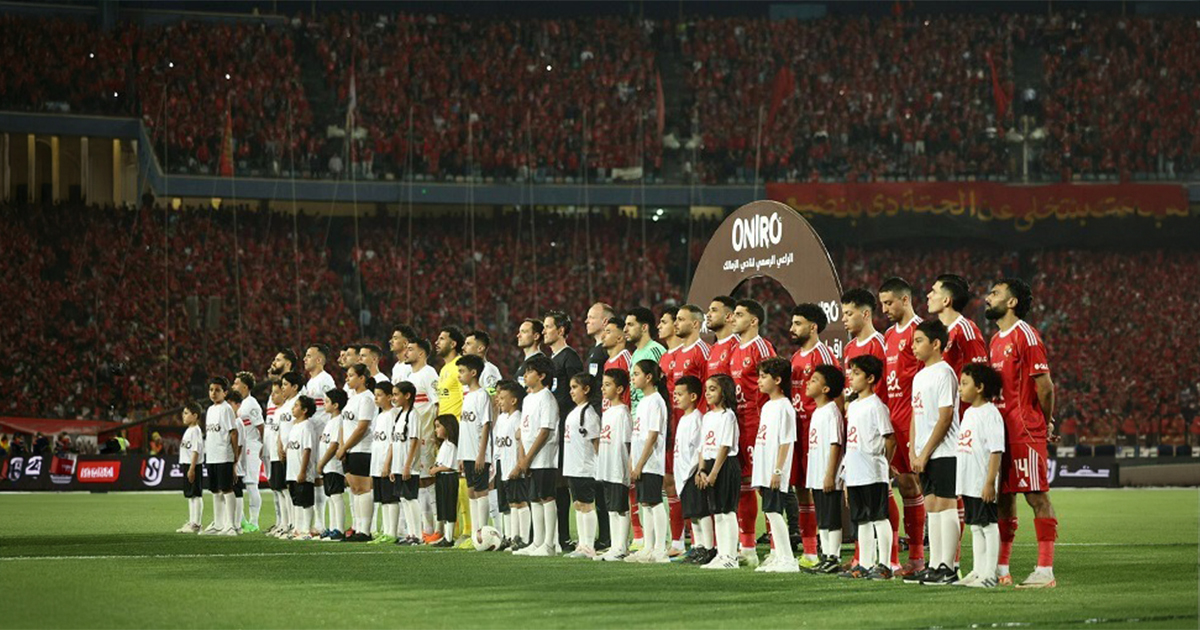
The Al-Ahly and Zamalek match outside the stadium.. How does the summit test the concept of social sustainability?
When the gates to Cairo Stadium open this afternoon, two fans, each of a different color and affiliation, will move towards the stands. 40 A thousand fans They will attend the Al-Ahly and Zamalek match, with 20 thousand for each team, before one of the most sensitive confrontations in Egyptian football begins at eight in the evening.
On the field, the mission will be clear: two teams looking to win. As for the stands and outside them, there is another, more extensive test. How can tens of thousands express their strong affiliation to two competing parties, and then share the same place within rules that guarantee safety and respect for others?
From here you go out Al-Ahly and Zamalek match From the ninety minutes to touch on one of the dimensions of development that sometimes seems far from football: Social sustainability; That is, the ability of society to maintain safe and comprehensive ties that allow for diversity and multiple affiliations without competition turning into exclusion or violence.
The Al-Ahly and Zamalek match goes beyond the stadium
Al-Ahly or Zamalek fans do not need much explanation to understand the importance of the summit. For many, the club goes beyond football, becoming a link to memory, family, and friends. Encouragement may be transmitted between generations until the color, the logo, and memories of victories and defeats become elements of personal identity.
This ability to create belonging is one of the social forces that sport carries. The United Nations 2030 Agenda explicitly describes sport as: An important factor in achieving sustainable developmentIt points to its contribution to promoting tolerance and respect, empowering youth, and supporting health, education, and social integration.
This role also extends to Sustainable Development Goal 3, good health and well-being; Sports are linked to physical activity and mental health, while a positive sports experience can support a sense of belonging and social connection. Thus, the value of sport becomes broader than the result itself, to include what it leaves behind in the health of individuals and their relationships with society.
إذن، المسألة أوسع من كرة تدخل الشباك. Millions of people can find in the club a community to which they belong, a space for shared joy, and a conversation that brings together friends, colleagues, and perhaps strangers who have never met before, but the power of belonging itself raises another question: When does love for the team turn into fanaticism against the opposing fans?
Affiliation or fanaticism?
Sports psychology studies explain that cheering for a team can give an individual a sense of identity and belonging, while more extreme forms of group identity may, in certain circumstances, be associated with hostility or disorderly crowd behavior.
A recent study published in the journal Frontiers in Psychology In 2026, entitled Collective Narcissism and Stadium Atmospheres: Predictive Indicators of Dysfunctional Fan Behavior, it addressed the behavior of football fans and concluded that the relationship between collective identity and dysfunctional behavior does not move in one direction; Emotions related to competition, the nature of the stadium atmosphere, and the social context play roles in shaping behavior, and here an important difference appears: Strong encouragement does not necessarily mean fanaticism.
It is natural for a fan to prefer his team to win, to mock a result athletically, to celebrate a victory, or to be angry at a defeat, while there remain boundaries that separate competition from insult, incitement, and violence.
From the perspective of social sustainability, what is needed is a society whose members can manage their differences without identity turning into an excuse to exclude others.
Safety starts before the whistle
Before the players moved inside the green rectangle, management of an event that included tens of thousands began weeks before the match. According to the person responsible for ensuring sporting activity, organizational preparations began more than two weeks ago in preparation for the Al-Ahly and Zamalek match, with the doors of the Cairo Stadium opening at three in the afternoon, that is, five hours before the start of the match, to receive 40,000 fans.
The announced prohibitions include flammable materials, fireworks, fireworks, and laser devices, as part of measures aimed at the safety of attendees.
Entry and security procedures may seem like mere organizational arrangements, but they are directly related to the safety of the community and its ability to safely accommodate large gatherings. The success of an event that includes tens of thousands is measured by the ability of the masses to enter, encourage, and leave without violence or risks threatening their safety.
From this angle, crowd management goes beyond its logistical dimension to become part of a broader social experience. If he needs The supporter of each team has a safe space in which to express his affiliation, while ensuring the same right to the opposing fans.
Managing a match of this size also extends beyond the stadium gates; The movement of tens of thousands to the surrounding area, the organization of entry, and then the exit of the crowd after the end of the meeting, all test the city’s ability to accommodate a large crowd event safely and efficiently.
And here it appears The eleventh goal of sustainable development In a practical way; Sustainable societies and cities need safe and inclusive spaces, and organizational capacity that allows people to use them and participate in major events without human density turning into a source of danger or chaos.
Does the ball teach us the difference?
There is a simple paradox in football matches: both sides enter knowing that they are different, each crowd wanting something completely opposite to what the other crowd wants. A goal for Al-Ahly means joy for one side and sadness for the other, and vice versa. However, the game is essentially based on accepting the existence of the opposing party; Without it, competition loses its meaning, and in this sense, the stadium provides a microcosm of an idea that any society needs: Difference does not necessitate hostility.
Just as the Al-Ahly and Zamalek match needs a law, rule, and limits that regulate competition, social relations need rules that protect people’s right to difference and prevent competition from turning to violence.
And here it becomes Sixteenth goal of sustainable development Closer to the runway than it seems; It places peaceful and inclusive societies and the reduction of violence among the foundations of sustainable development.
Youth and terrace culture
Young people carry a large part of modern football culture, whether inside the stands or through the social media platforms on which the match continues before its start and after its end.
In this space, a sarcastic phrase or a funny image can become part of the fun of competition, while the language itself may turn into abuse or incitement when it goes beyond sports banter to belittle the competitor or his audience.
Therefore, the culture of encouragement is not determined by security rules alone; The audience itself participates in making it through the chants, the method of celebration, the nature of the discourse used on digital platforms, and how to deal with the fans of the other team after the match ends.
Hence the role of youth in transforming competition into a space for belonging without hostility, and in establishing the idea that the power of encouragement can be combined with respect for the competitor. The more this culture expands, the closer the amphitheater becomes to a social space that allows for difference within Secure borders, which is one of the meanings on which social sustainability is based.
It will end Al-Ahly and Zamalek match Either team wins or they share the points, and some fans will leave happier than others. But the social value of an event can also be measured by what happens after the last whistle.
Can a fan love his club so much and leave the competitor the same right? Can the stands retain the heat of competition without becoming a space for hostility? Can a city that receives tens of thousands of people of different affiliations guarantee their safe exit and return?
The summit is granted The Earth Guards Foundation An introduction to reading sustainability from a different social angle. Sustainable societies need social ties capable of tolerating difference, and safe spaces in which people can express their identities without fear or violence.
Social sustainability does not require the Al-Ahly fan to become less affiliated with Al-Ahly, nor does the Zamalek fan to abandon his passion for Zamalek. The real test is simpler and more difficult at the same time: Can we agree strongly, disagree strongly, and then walk off the stage still able to respect each other?