

30 hours under water… Bangkok floods push thousands into shelters and test infrastructure
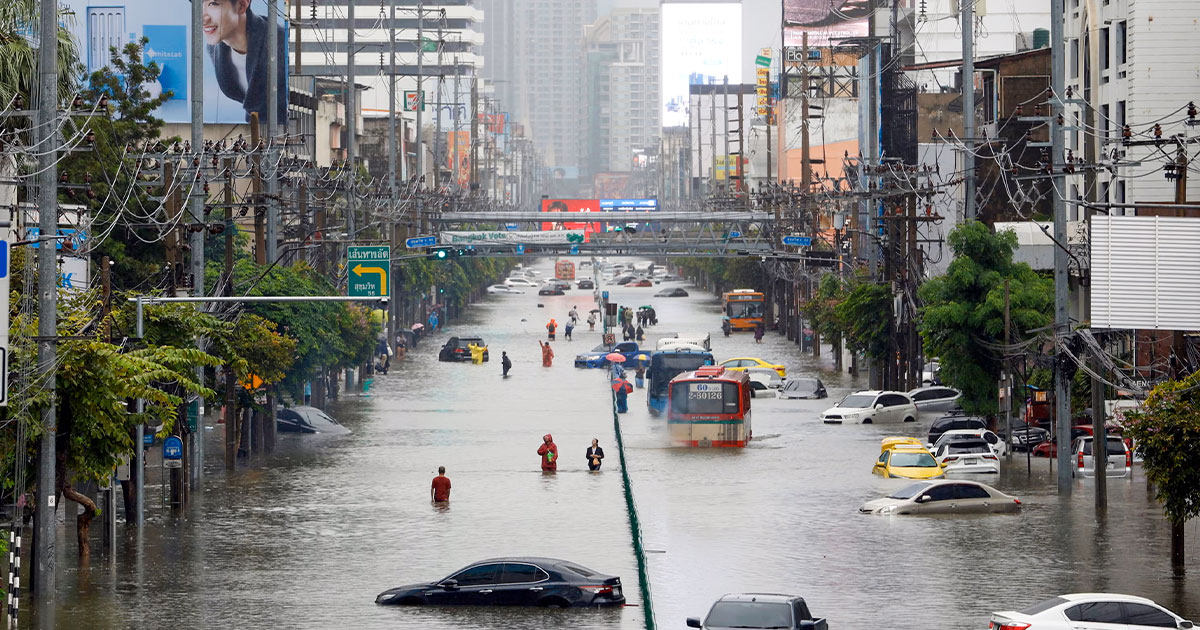

30 hours under water… Bangkok floods push thousands into shelters and test infrastructure
Kosin Nilset kept pushing water out of his house with a broom all day last Sunday, after the ground floor remained flooded for about 30 hours. The man and his family lifted as much furniture as they could when the water exceeded the barrier adjacent to the “Khlong Prem Prachakon Water Canal – Khlong Prem Prachakon,” but the flood preceded them into the rest of the house.
Then, “Kosin,” a 44-year-old employee, said: The water level this time exceeded what he remembered from the 2011 floods, which killed more than 500 people across Thailand and damaged millions of homes.
Behind his door were floods Bangkok depicts the same scene in other neighborhoods; Roads flooded with water, shops whose courtyards turned into deep puddles, and schools opened their doors to receive thousands of residents after days of heavy rain.
52 thousand families in the middle of the water
The floods – according to data from the Bangkok Metropolitan Administration, which declared a state of disaster in the capital – affected about 52,000 families, while about 4,900 people moved to temporary shelters, after the amount of rain in some neighborhoods of the city exceeded 330 millimetres, in addition to water levels that remained high within the network of rainwater drainage channels.
To understand the scale of the disaster, we must know that the people of Thailand are accustomed to seasonal rains, the season of which reaches its peak in September every year, without The reality reveals that what happened this year has actually gone out of the ordinary for them.
The reason for this is that the Bangkok floods quickly became a disaster that struck homes, work, education, and everything involved in daily movement. This forced the authorities to continue operating drainage systems and try to push water out of the affected areas.

To follow how floods are turning into widespread humanitarian crises in Asia, read : Nepal floods are turning into a major disaster .
A city moving with difficulty
In East Bangkok Residents walked through turbid water, which in some places reached knee-deep, wearing plastic coats, holding boxes of their belongings and floating containers. In the parking lots of some grocery stores, movement itself became an arduous task, and several roads remained under water. Which prompted Bangkok Governor Chadchart Sitipunt to ask residents to reduce movement as much as possible.
The repercussions of the crisis also extended to the markets, as some store shelves were empty over the weekend after residents rushed to buy basic needs, while the government called for avoiding buying driven by fear and panic, and warned merchants against raising prices.
The important question here is: Is emergency response alone sufficient for a city inhabited by millions? Therefore, the eleventh goal of the Sustainable Development Goals, regarding sustainable cities and local communities, sets: The ability to withstand In the face of disasters within the pillars of a safe city.
Schools become shelters
In a school in the “Kheha Romklao area”, the function of the classrooms changed in a few hours, as about a thousand affected people were transferred to a shelter center set up inside the school, and there some of them slept on benches in the corridors, and others slept on the floors of the classrooms whose tables and chairs were pushed aside to make room for families.
As the effects of Bangkok floods continue the authorities announced the closure of hundreds of schools on Monday, adding a new burden to families who are simultaneously trying to protect their homes and property and search for a safe place to stay.
Therefore, this response reveals one aspect of the resilience of cities; Because the school building is transformed when necessary A rescue space, and the city’s public structure becomes a social support network in a moment of crisis, and this is what crystallizes the eleventh goal of the Sustainable Development Goals: sustainable cities and local communities.

I have been sleeping on the table for two days
Along the Prem Prachakon Canal, Thidarat Silsuan, 56 years old, chose to stay in her house alone, even though water had seeped into sensitive parts of it. Her choice was to clean the place and save what could be saved of her possessions.
This woman spent two days sleeping on a table away from the water, and tried to raise her belongings to higher levels, before stopping in front of the large appliances that were difficult to move, including the refrigerator and the washing machine, which remained in their place while waiting to be exposed. To be damaged in heartbreak.
After the water recedes
When the water level began to decrease, some residents returned to their homes carrying brooms, bowls, and cleaning tools. The first task seemed simple:
- Water output
- Drying what remains
So, the story of Thydarat leaves behind traces that extend beyond the mud and damaged furniture, and gives the figures of the disaster a more immediate face; Every damaged home carries a financial cost, a psychological crisis, hours of painstaking work to remove water, and days that residents may need to restore the details of their normal lives.
When rain becomes a test for the climate
Based on that catastrophic scene, we find meaning and truth in scientists’ warnings about the danger of global warming due to fossil fuel emissions. This increases the intensity and frequency of extreme weather events.
Based on the thirteenth goal of sustainable development, on climate action, the ability to adapt to these risks becomes part of the daily preparedness of cities. This is through:
- Improving drainage networks
- Expanding alarm systems
- Identifying the areas most vulnerable to drowning
- Develop evacuation plans that can be implemented quickly
Therefore, the Bangkok floods give these goals concrete meaning; Every hour that the water delays receding, its effects extend to homes Schools, roads, and markets, and with them the cost of returning to normal life increases.
In conclusion, the views of Bangkok for The Earth Guards Foundation places advance preparation at the heart of cities’ ability to confront climate change; Because resilient drainage systems, urban planning, more flood-resistant housing, and prefabricated shelters all make a crucial difference when huge amounts of rain fall in just a few days.
Then the most sustainable city becomes the one that can absorb the shock, protect its residents, quickly restore its services, and then use what the disaster has revealed to reduce losses when the rains return again. Thus, sustainability goals are achieved comprehensively and fairly.


