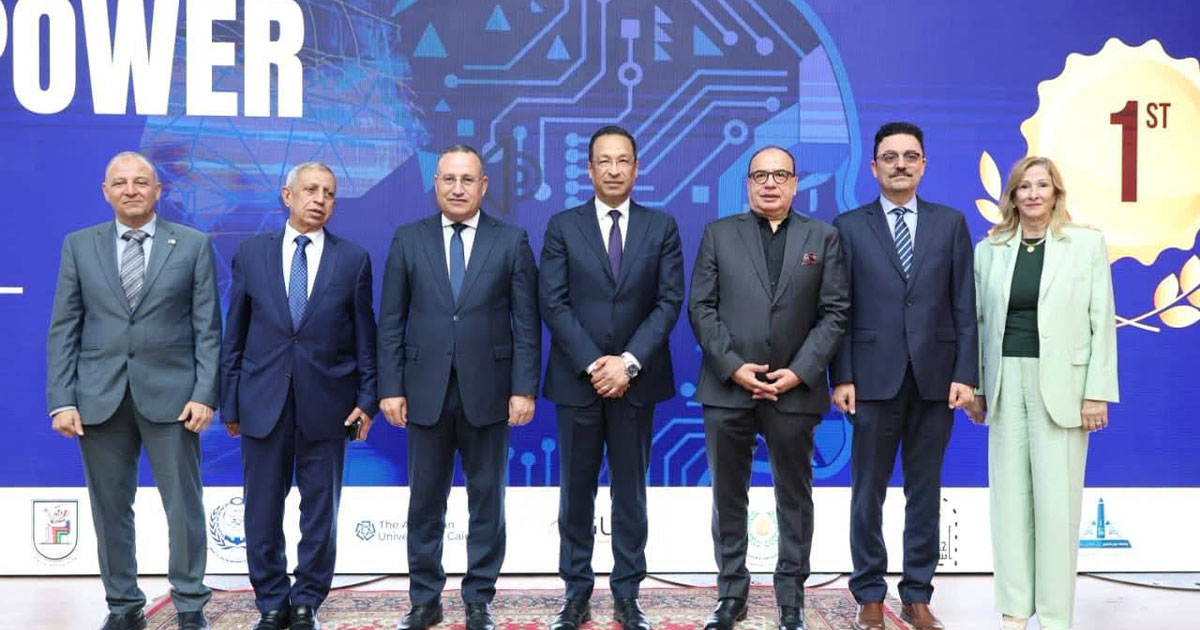
Conclusion of the fourth session of the initiative to build the capabilities of Egyptian universities in artificial intelligence
In recent years, Artificial Intelligence has become one of the main drivers for reshaping various sectors, raising the efficiency of services, and innovating new solutions to the challenges facing societies. With the acceleration of technological developments globally, the ability to possess knowledge and develop human competencies has become a crucial element in achieving real benefit from these technologies.
Accordingly, the Egyptian state is working to build specialized national capabilities in the field of artificial intelligence, by supporting training and innovation and linking academic knowledge with practical applications, which contributes to preparing a generation capable of developing technological solutions that suit society’s needs and national priorities, and enhancing the role of youth in the transformation process.Digital.
445 projects to innovate digital solutions in vital fields
In this context, Eng. Raafat Hindi, Minister of Communications and Information Technology, and Dr. Abdel Aziz Qanswa, Minister of Higher Education and Scientific Research and Acting Minister of Culture, witnessed the conclusion of the activities of the fourth session of the Capacity Building Initiative for Universities in the field of Artificial Intelligence, at the Digital Egypt Innovation Center “Cretiva” in Giza, which was launched by the Ministry of Communications and Information Technology, with the aim of enhancing knowledge, building capabilities, and supporting innovation in the field of artificial intelligence.
The fourth session witnessed the provision of specialized training in the field of artificial intelligence to 1,090 students from 10 public, private and private universities, including: Cairo University, Ain Shams University, Assiut University, Mansoura University, andAlexandria, and the American University in Cairo.
Participants in the initiative implemented 445 projects to create technological solutions in five vital areas:
Smart Agriculture
Smart Traffic
Smart Government
Digital Healthcare
Smart Economy
In line with a number of Sustainable Development Goals (SDGs), most notably the second goal on eliminating hunger, the third goal on good health and well-being, and the ninth goal related to industry, innovation and infrastructure.
An artificial intelligence hackathon was also organized to focus on creating smart solutions in the sectorNew and renewable energy, with the participation of 105 students representing 21 teams from ten universities. The qualifiers resulted in 10 teams qualifying for the final stage.
The focus on developing smart solutions in the new and renewable energy sector is linked to the seventh goal of the Sustainable Development Goals (SDGs) on clean energy at affordable prices, and the thirteenth goal on climate action, by enhancing the efficiency of resource use and supporting innovation in confronting environmental challenges.
Building national capabilities and smart applications with artificial intelligence
Engineer Raafat Hindi confirmed that the expansion of the initiative to build universities’ capabilities in the field of artificial intelligence reflects the success of the partnership model between the government, universities, and the private sector, and linking academic knowledge with practical applications and labor market needs.
He explained that the target is being targetedBuilding Egyptian capabilities capable of developing solutions that suit language, culture, and national needs, pointing to the efforts of the Applied Innovation Center in transforming research and development into practical applications that serve priority sectors, including the development of the “Crank” model as a huge linguistic model in the Arabic language, in addition to applications for artificial intelligence in the fields of health, agriculture, and education.
Engineer Raafat Hindi pointed out that choosing the New and Renewable Energy Challenge as the focus of the hackathon came because it combines a national priority, a promising professional opportunity for participants, and a wide space to make a real impact in society. Pointing out the need to develop smart solutions that help predict production and demand, improve network management, achieve responsible consumption, reduce waste, and increase the efficiency of resource use.
He also pointed out that the next step is:Building a clear path for promising projects, linking them to guidance and incubation, and to entities that can test them and benefit from them, thus contributing to transforming them into products, startups, or usable solutions.
He called on all participants to continue working on developing their projects, stressing that the Ministry will continue to support them to provide the necessary guidance to transform their ideas into projects with a tangible impact.
Linking education and scientific research to industry needs
In his speech, Dr. Abdel Aziz Qanswa pointed out that the Ministry continues to support digital transformation efforts in the higher education and scientific research system, noting that the shift to smart universities comes at the top of the Ministry’s work priorities, in light of the rapid developments that the world is witnessing in the fields of artificial intelligence and technology.Digital technology, and the new requirements it imposes on higher education institutions and their outcomes.
Stressing the need to benefit from the capabilities offered by artificial intelligence in developing the educational process and supporting university services, pointing to the focus on strengthening the link between the academic community and industry, and working to bridge the gap between educational outcomes and labor market requirements, as well as supporting applied scientific research.
He also pointed out the importance of establishing Technology Parks within universities, as platforms for transforming the results of scientific research and innovative ideas into industrial and economic projects, by supporting emerging companies, transferring and localizing technology, and strengthening partnership with the industry community.
National Strategy for Artificial Intelligence
The capacity building initiative for universities in the field of artificial intelligence has become a pioneering model of effective partnership between the Ministry of Communications and Information Technology, Egyptian universities, and the private sector, to prepare a new generation of competencies capable of leading the future of artificial intelligence in Egypt.
This initiative comes within the framework of implementing the National Strategy for Artificial Intelligence (2025-2030), which places capacity building and developing national talent at the top of its priorities, based on the state’s belief that the human element is the main driver of innovation, and that investing in youth is the most sustainable investment.
In conclusion, the initiative to build the capabilities of universities in the field of artificial intelligence represents a strategic step towards building an integrated national system for innovation, in which humans are the focus of development and the maker of technological solutions that respond to nature.Local challenges. Possessing specialized knowledge in this field has become one of the determinants of competitiveness, especially with the transition of artificial intelligence from the experimental stage to being an influential element in reshaping the economy, services, and scientific research.
For its part, The Earth Guards Foundation appreciates the efforts made to link Egyptian universities with practical applications and the needs of different sectors, which opens the way for transforming youth energies and research ideas into implementable projects, and enhances Egypt’s ability to build a national innovation system more closely linked to Sustainable Development Goals (SDGs). The Foundation also confirms that developing models and applications Artificial intelligence that takes into account language, culture, and national needs represents an important step towards possessing technological tools stemming from the Egyptian reality, and maximizing the use of technology in serving…the society.