
Discussing types of healthy foods within the work of the nineteenth session of the Codex Committee
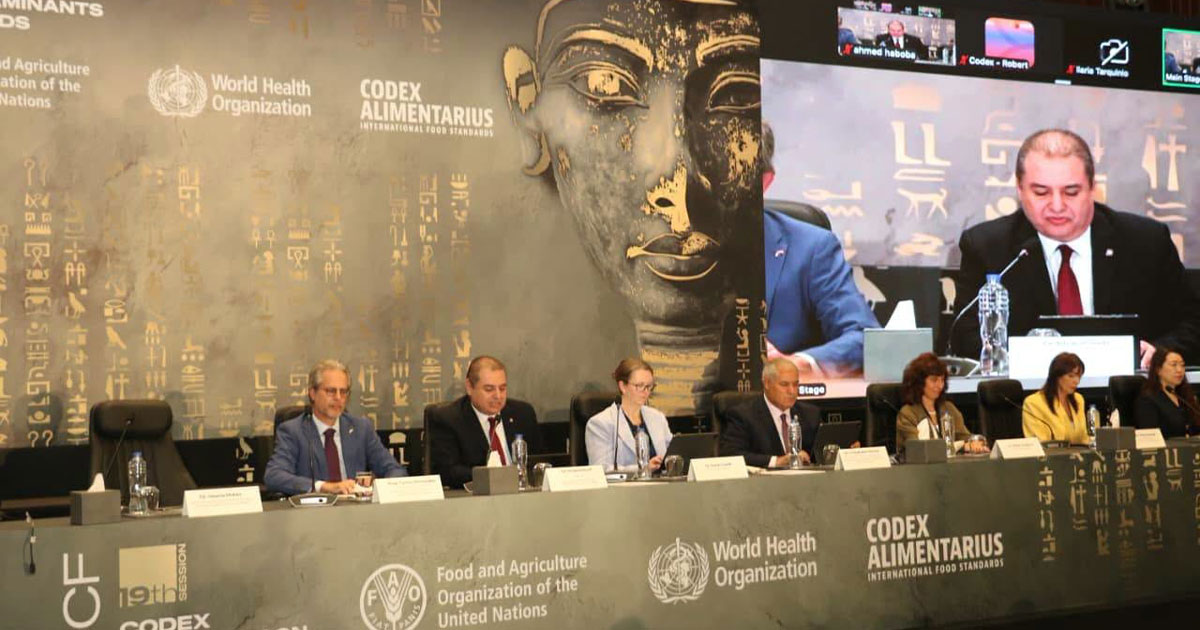

Discussing types of healthy foods within the work of the nineteenth session of the Codex Committee
Types of healthy foods are linked to precise standards that go beyond nutritional value to ensuring that products are free of contaminants, which may threaten the safety of consumers; Safe food represents one of the basic foundations of public health, just as the quality of food control affects market confidence and the stability of international trade.
In this context, Cairo hosted the work of the nineteenth session of the International Codex Committee, the committee concerned with food contaminants, with a high-level international presence that included representatives of 83 countries, in addition to 22 international organizations and monitoring bodies.
Cairo becomes a center for food safety
The activities of the nineteenth session of the Committee on Contaminants in Foods (CCCF19), affiliated with the Joint Codex Alimentarius Commission between the Food and Agriculture Organization of the United Nations (FAO) and the World Health Organization (WHO), were launched in a presence that reflects the growing importance of unifying food standards and strengthening international cooperation to protect the health of consumers.
The opening session witnessed the presence of 280 participants in the conference hall, in addition to 136 participants via virtual communication, bringing the total number of those registered to 416 international experts and officials working in the fields of food safety and setting standard specifications.
The session was opened by Dr. Khaled Sofi, “President of the Egyptian General Authority for Standardization and Quality, and Chairman of the Egyptian Codex Alimentarius Committee,” on behalf of the Minister of Industry, Eng. Khaled Hashem, and with the participation of Dr. Sally Hoover, Chair of the International Codex Committee on Contaminants in Foods.

The opening platform included a number of experts and officials, including:
- Professor Rana Jamali, “Vice President of the Food Industries Chamber.”
- Dr. Sarah Cahill, “Secretary of the Codex Alimentarius Commission.”
- Dr. Abdul Hakim Al-Waer, “Representative of the Food and Agriculture Organization.”
- Engineer/ Tycho Vermeulen, “Agricultural Advisor at the Embassy of the Kingdom of the Netherlands to Egypt.”
- Dr. Iman Helmy, “Representative of the National Food Safety Authority in Egypt.”
Types of healthy foods in light International standards
The importance of the Codex meeting goes beyond exchanging technical expertise; Its work directly relates to controls that determine acceptable levels of contaminants in food and feed, and supports countries’ ability to prevent health risks associated with exposure to harmful substances through food.
This session discusses a number of important scientific and regulatory files, most notably :
- Mycotoxins : Study of drafts and recommended maximum limits for these toxins, which may form in some crops and food products due to the growth of certain types of fungi.
- Chemical pollutants : Researching the levels of contaminants that can reach food during the stages of production, handling, and manufacturing; This supports the development of control procedures and reduces exposure to health risks.
- Heavy Metals : Review of the proposed limits to limit the presence of some harmful metals in food products, according to available scientific evaluations.
- Risk assessment : Reviewing the assessments issued by the Joint FAO-WHO Expert Committee on Food Additives (JECFA), and benefiting from them in formulating international recommendations and standards.
Together, these files highlight the close relationship between Types of healthy foods and food safety and its ingredients; Because judging the quality of food requires looking at its composition and nutritional value, in parallel with examining potential contaminants, as well as estimating levels of exposure to them, allowing for making regulatory decisions based on scientific evidence.
How do food standards contribute to consumer protection?
Maximum limits for contaminants play a pivotal role in building an integrated food safety system, by establishing scientific references that guide producers and regulatory authorities when assessing risks and improving production practices.
The importance of these standards includes three interconnected dimensions, which are:
Health Dimension
These standards reduce the possibility of consumers being exposed to contaminants that may lead to health harm, depending on the nature of the substance and the amount and duration of exposure.
The economic dimension
These specifications also help support the smooth flow of food trade, by providing common reference rules that reduce the level of regulatory differences between markets.
Therefore, the effectiveness of these standards is closely related to the extent of their practical application, their ability to develop inspection and analysis processes, and their efforts to improve tracking and control systems along food supply chains.
Specifications and quality cooperate internationally
The organization of this session was the result of… The fruits of the efforts of the Egyptian Codex Unit at the Egyptian General Authority for Standardization and Quality, in its capacity as a point of contact with the Codex Committee in the Arab Republic of Egypt, where it coordinated the administrative and technical aspects of the meeting, and followed up on the participation of Egyptian and international delegations.
This role reflects the importance of the institutional and technical structure necessary for Egypt’s participation in formulating international discussions related to food standards, exchanging experiences in the fields of risk assessment and pollutant control, as well as strengthening communication between institutions concerned with consumer protection and developing the food industry.
Hosting such meetings also provides an opportunity to expand channels of cooperation between experts and regulatory bodies, in a way that supports the development of national practices, and in a way that also enhances the presence of Egyptian institutions in discussions related to the future of global food standards.
Food safety is a pillar of sustainable development
In the context of the sustainable development goals, the work of the nineteenth session of the Codex Committee on contaminants in food confirms that protecting consumer health begins with a regulatory system capable of monitoring risks and dealing with them according to clear scientific foundations.
From this standpoint, The Earth Guards Foundation believes that the themes of the nineteenth session of the Codex Committee are of great importance in improving the types of healthy foods, and that this should occupy a fundamental position in sustainable development policies; Because it is directly related to human health, production efficiency, and market stability.


