

Illegal immigration… How did one rumor push 72,000 immigrants to the borders of Europe?

Illegal immigration.. How did one rumor push 72,000 immigrants to the borders of Europe?
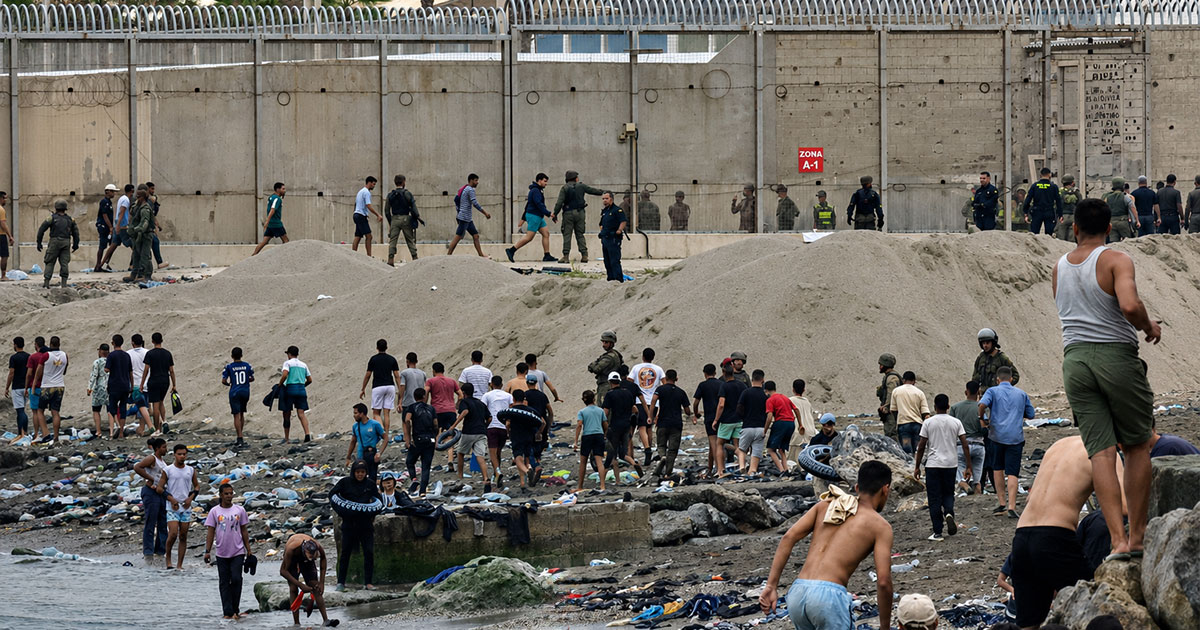
In the sea off Ceuta, where there is no time to think. Dozens of bodies move through the water, hands searching for anything to hold on to, while each person tries to reach the other side before their strength runs out. A bystander described the scene, saying that people were trying to grab each other to survive, while everyone was trying in turn to escape so as not to be pulled under and drown.
Within hours, illegal immigration turned into a tragedy of a magnitude difficult to ignore. About 72,000 people began crossing into the Spanish enclave of Ceuta, located on the northern tip of Morocco. Some of them swam around the border fence, while others died from drowning or as a result of the stampede. According to local officials,At least 88 people lost their lives trying to cross.
But the irony came quickly; Within just 24 hours, most of them had returned to Morocco. The field crisis began to subside, while its images began a new life on screens, turning in a few days from a human tragedy into a political material that reopened one of the most sensitive files in Europe.
The sea is filled with passers-by
Most of the passers-by were young men looking for work and an opportunity to build a better life, according to the material reported by the press. There have been no reports indicating that any of them have arrived on the Spanish mainland, as moving from Ceuta to within Spain is very difficult for those who do not have the required documents.
This fact did not prevent the scenes of men climbing rocks or walking in the streets of Ceuta from spreading widely.Through social networking sites. By the time these clips became a daily topic of discussion, Spain had already announced that most of the migrants had returned to Morocco.
Here a clear gap appeared between what happened on Earth and what remained in digital memory. The images continued to spread after the intensity of illegal immigration subsided on the ground, and with them a different narrative began to take shape about whether Europe was facing a border crisis or a short-term humanitarian spectacle that had been exaggerated politically.

A rumor ignites the road
Before thousands of young people reached the sea, the story had begun on phone screens.
Misleading information was spread across social media sites based on a ruling by the Spanish Supreme Court regarding the non-immediate deportation of migrants arriving by sea.As the ruling circulated, its meaning on platforms turned into a simpler and more dangerous message: the border between Morocco and Spain has become open.
On Instagram, posts appeared encouraging crossings, while clips on TikTok showed places from which to swim, and users on Facebook began following the movements of Coast Guard patrols. It is not clear who is behind a number of these accounts, especially after some of them disappeared following the events.
Thus, the old ambition mixed with the search for an opportunity with information that arrived at the right moment. The rumor helped turn the desire to leave into a broad mass movement, revealing a complex side of illegal immigration in an age when a short post can influence the decisions of thousands of people.
Searching for an opportunity
Behind the big numbers, the shadow of the humanitarian motiveSimpler: Work and a better life.
This aspect opens a direct window on Goal 8 of the Sustainable Development Goals (SDGs), concerned with decent work and economic growth, especially Goal 8.5, which calls for achieving full and productive employment and decent work for all. The thousands who moved towards Ceuta began their path in economic environments that made job opportunities and stability a decisive factor in the decision to leave.
The economic factor explains why a rumor about open borders was able to find an audience willing to risk the sea for the prospect of a new opportunity.
Meanwhile, the level of surveillance on the Moroccan side of the border was greatly reduced during the spread of the rumor, allowing huge numbers to cross. Analysts put forward political explanations for this, including tension related to the visit of Spanish Prime Minister Pedro Sanchez to Algeria, in addition toTo transformations in regional relations, but these possibilities remained under analysis and were not decided conclusively.
The image becomes politics
After most of the crossing was completed, another battle began over the interpretation of the images. Tommy Robinson described Ceuta on the
Journalist specializing in refugee and immigration affairs, Daniel Trilling, rejected this characterization, pointing out the difficulty of these people reaching the European mainland from Ceuta, and considering that talk of an invasion of Europe does not reflect the facts.
However, images of illegal immigration have become an influential tool in shaping public opinion, after politicians and public figures used them to presentCrossing as a widespread security threat, with descriptions such as “fighting-age men” – an expression used by some hardline rhetoricians to suggest that the presence of large numbers of young men being a potential security threat – repeated and also calls for tighter anti-boat measures.
This speech reveals how an image, when separated from its context, can push the discussion towards fear instead of investigating the causes of migration and its safe paths, which intersects with Goal 10 of the Sustainable Development Goals (SDGs), specifically Goal 10.7, which calls for facilitating orderly, safe, regular and responsible migration.
Harder boundaries
The story of Ceuta does not begin in 2026 alone. Since the 2015 refugee crisis, the European Union has increasingly tightened its borders and reduced legal entry routes, as well as relying on countries outside the country.Union to carry out part of the task of immigration control.
Trilling believes that this policy has given countries like Morocco a pressure tool that can be used in times of political disagreement. Ceuta previously witnessed a similar scene in 2021, when about 10,000 people crossed during a diplomatic crisis between Morocco and Spain. Close models emerged in the relationship between Türkiye and Greece in 2020, and Poland repeatedly accused Belarus of encouraging migrants to head towards the borders of the Schengen Area.
In this sense, illegal migration reveals a paradox in European deterrence policies: as organized routes diminish, some people turn to more dangerous routes, and when large groups succeed in breaching borders at once, they produce shocking scenes that are later used to demand more barriers and security measures.

Safer methods
This episode directly intersects with Sustainable Development Goal 10, on reducing inequalities, specifically target 10.7 which calls for facilitating orderly, safe and responsible migration and movement through well-planned and managed policies.
This goal acquires its humanitarian meaning when the alternative to the organized route becomes a swim around a border fence or a trip that may end in the sea. Managing illegal migration is related to the presence of paths that reduce the incentives to resort to methods that threaten human lives.
In an emergency meeting, European Union interior ministers confirmed that the Schengen area was not threatened by the numbers that arrived in Ceuta, but the political repercussions continued, and 22 European officials signed a letter calling for stronger borders, while other positions emerged trying to combine tighteningOversight and opening safe paths.
After the images calm down
Within a few days, most of the passers-by had returned, and the streets of Ceuta had calmed down, but the images remained in the public domain. This is perhaps what the crisis is most revealing: the event can end much faster than the political narrative it generates.
Hence the importance of dealing with illegal immigration as an issue that begins before a person reaches the border. From job opportunities, available mobility routes, the information on his phone, relations between countries, all the way to the way images of migrants are used to shape public opinion.
In this context, The Earth Guards Foundation points out that achieving safer and more sustainable mobility is linked to the ability of policies to protect people in addition to managingBorders. The numbers that filled the news bulletins in Ceuta were, in the end, people who moved in search of a better future, and some of them did not reach the other side.
When the last image disappears from the screen, the question that Ceuta poses remains: Will the harder borders prevent the next migration journey, or make the path to it more dangerous?


