Egypt enhances economic cooperation with BRICS countries to confront global economic challenges
The global economy is exposed to rapid transformations that require countries to strengthen their capabilities to confront economic and trade challenges, in light of the disruption of supply chains, increasing levels of uncertainty, and changing patterns of trade and investment. In the face of these developments, cooperation between developing economies is gaining increasing importance, through expanding areas of integration, stimulating trade, and developing partnerships that open the way to new opportunities for growth and investment.
Deepening economic and trade cooperation represents one of the paths supporting building more resilient economies, especially with the growing need to diversify markets, strengthen value and production chains, and benefit from the comparative advantages of countries in a way that supports their abilityCompetitiveness and enhances its contribution to the global economy.
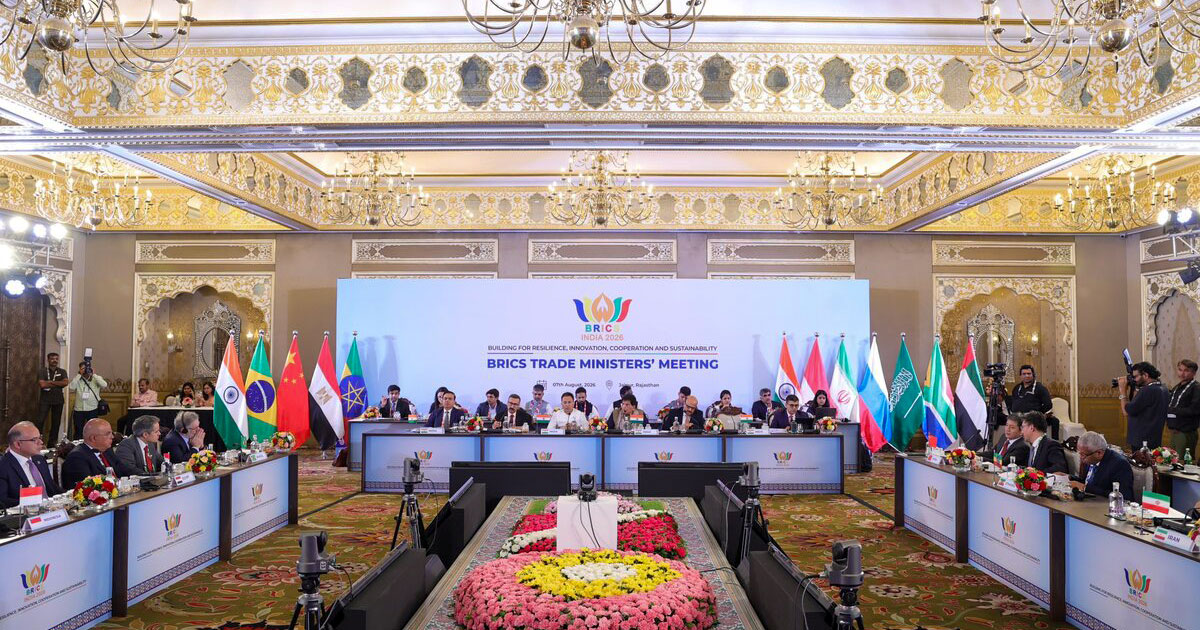
From this standpoint, the Arab Republic of Egypt participated in the work of the sixteenth meeting of BRICS Trade Ministers, which was held in the Indian city of Jaipur, within the framework of the Indian presidency of the group for the year 2026, and under the slogan “Building Resilience, Innovation, Cooperation and Sustainability.”
The Egyptian delegation was headed by Dr. Mohamed Farid Saleh, Minister of Investment and Foreign Trade; The Egyptian participation aimed to utilize Egypt’s membership to enhance economic, trade and investment cooperation, and to transform multilateral cooperation frameworks into practical opportunities for Egyptian companies, in a way that supports increasing exports, attracting quality investments, enhancing integration, and raising the competitiveness of the Egyptian economy.
BRICS is one of the most prominent cooperation frameworks between emerging economies. It aims to strengthen development ties among its members and expand areas of coordination on international economic issues, thus contributing to supporting sustainable development and enhancing the role of member states in the global economy.
Increased trade volume
Egypt’s participation comes in light of the increase in the volume of trade exchange between it and the countries of the group to 53.5 billion dollars during the year 2025, compared to 45 billion dollars during the year 2024, with a growth rate of about 18.8%.
Egyptian exports to the countries of the group also increased to $13.772 billion during the year 2025, compared to $9.451 billion during the year 2024, with a growth rate of about 45.7%, while imports amounted to $39.679 billion, compared to $35.549 billion during the year 2024, with a growth rate of about 11.6%.
Egypt’s participation aims to enhance intra-trade, increase Egyptian exports, attract more investments, and open new markets for Egyptian products, thus enhancing the integration of Egyptian companies into global value chains.
Deepening economic and trade cooperation
In Egypt’s speech during the opening session, Dr. Mohamed Farid Saleh explained that the BRICS countries represent more than 27% of the global GDP, and about 68% of the GDP of the countries of the Global South, while intra-trade between the countries of the bloc is still less than the available economic potential, as it represents about 5% of global trade and about 20% of the trade of the countries of the South until 2024, which reveals broad opportunities to enhance trade and investment among member states.
Accordingly, the Minister called for enhancing intra-trade between member states, with a focus on manufactured goods and products with high added value, and enhancing cooperation in technology-intensive industries, through implementing joint projects in the fields of infrastructure, new and renewable energy, and information and communications technology.
This is in addition to developing innovative financing tools and transforming initiatives and understandings into practical projects, in a way that enhances the competitiveness of the economies of member states and supports more comprehensive and sustainable growth, in line with the ninth goal of the Sustainable Development Goals (SDGs), which calls for strengthening industry, innovation, and infrastructure.
Dr. Mohamed Farid also stressed that Egypt, since joining the BRICS group in 2024, attaches great importance to enhancing its participation in the mechanisms and activities of the group, as it is a promising platform for deepening cooperation.economic development and the development of practical solutions to challenges related to trade, investment and development.
Expansion plans of Indian companies in Egypt
In a related development, Eng. Khaled Hashem, Minister of Industry, held an expanded meeting with a number of major Indian groups and companies, members of the Federation of Indian Chambers of Commerce and Industry (FICCI) and with the participation of an elite group of Egyptian businessmen in the sectors of the leather, packaging, food and chemical industries, to discuss expansion plans in Egypt, listen to the companies’ needs, and identify opportunities that can be converted into implementable industrial projects.
The Minister of Industry stressed that the strength of political relations between Egypt and India provides a basis for moving to a greater level of economic cooperation, indicating that the volume of current investments and industrial partnerships does not reflect the capabilities available to them.The two countries.
He explained that Egypt aims to move, in cooperation with India, from trade to attracting Indian companies to manufacture inside Egypt, transfer technology, deepen the local component, develop suppliers, and use Egypt as a center for production and export to the Middle East and African markets and other markets with which Egypt has trade agreements, pointing out that the private sector must lead this transformation, while the government works to provide the necessary environment for investment, solve problems, connect investors with local partners, and provide information, industrial sites, and services that help the project move quickly from study to implementation.
Promising industrial sectors for cooperation and investment
The meeting witnessed the discussion of cooperation and investment opportunities in a number of industrial sectors, including:Among them are chemical industries, energy, electricity transmission networks and associated infrastructure, in addition to food industries, grains, strategic storage, and consumer goods, which opens new areas for industrial investments.
The discussions also addressed opportunities for cooperation in the fields of hydrogen and green ammonia, agriculture, food processing, supply chains and logistics services, as well as petrochemicals and industrial materials, in a way that supports the development of industrial projects and expands areas of cooperation between the two sides, which is in line with the seventh goal of the Sustainable Development Goals (SDGs) related to providing clean and affordable energy, and the second goal related to the complete elimination of hunger.
Transforming cooperation into joint investments and industry
The Minister of Industry confirmed continued coordination with the Federation of Chambers of Commerce and IndustryThe Indian Council (FICCI) and the Egyptian-Indian Business Council to target new Indian companies, organize sector meetings, and link companies with Egyptian opportunities, manufacturers and suppliers, noting that the success of this move is measured by the volume of investments that are moving into implementation, the expansions that are already beginning, the technology that is being localized, the percentage of the local component, and the ability of new projects to export.
The Minister of Industry stressed that the opportunity facing Egypt and India goes beyond the exporter-importer relationship, and that the goal is to build a network of investments and joint production and supply chains, combining Indian industrial and technological capabilities, the Egyptian production base, and Egypt’s location and ability to access regional and international markets.
In conclusion, Egyptian moves within the framework of economic cooperation with the BRICS group reveal that the true value of economic partnerships,It is determined by its ability to move to a deeper level, in which trade relations turn into investments and productive projects, the local component increases, and companies are connected to production and supply chains capable of creating added value and sustainable export opportunities.
In turn, The Earth Guards Foundation stresses the importance of integrating new investments with Sustainable Development Goals (SDGs), so that industrial growth is part of a broader system that includes innovation, infrastructure, clean energy, food security, and effective partnerships. This gives member states an opportunity to transform existing capabilities into long-term cooperation that creates value beyond trade and supports an economy more capable of production, competition and sustainability.