

Temporary removal or permanent destruction? Where do eternal chemicals go after water purification?
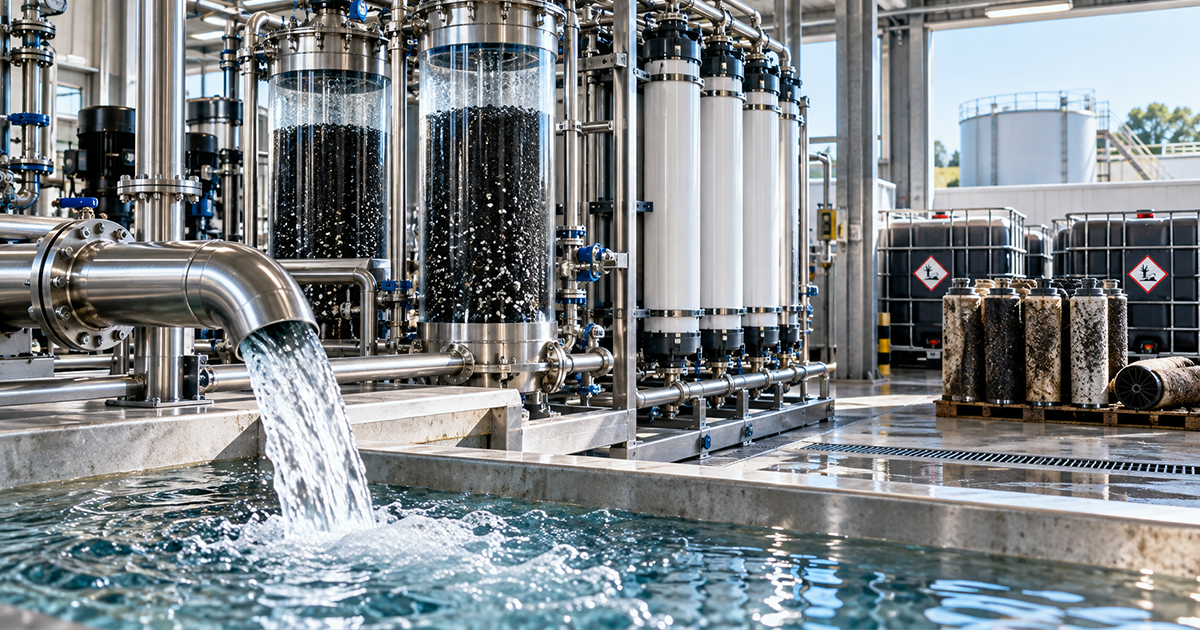

Temporary removal or final destruction? Where do eternal chemicals go after water purification?
Water may emerge from the treatment plant at a much lower concentration of eternal chemicals, known scientifically as perfluoroalkyl and polyfluoroalkyl substances ( Per- and Polyfluoroalkyl Substances ( PFAS ), so the result appears at first glance as if the problem has ended. However, clean water tells us what came out of it, not where the removed compounds went.
Some treatment technologies separate permanent chemicals from the water and collect them in filters, adsorbents, or concentrated liquid streams, which means the pollution is transferred to wastes that need Turn to management. On the other hand, other techniques aim to chemically dismantle compounds, and here the question becomes more complex: Were they actually destroyed, and what materials resulted from the process?
This makes the difference between removal and destruction an essential element when evaluating any technology for treating eternal chemicals, especially with their widespread use in water purification systems and industrial waste treatment.
Removing PFAS does not end the journey
Removal means separating PFAS compounds from the water or stream being treated. The direct result here is a decrease in their concentration in the treated water, while the compounds themselves may still be present in another substance.
The US Environmental Protection Agency explains that several technologies are used in treating drinking water Mainly based on this principle, among them are granular activated carbon, and ion exchange resins, and reverse osmosis and nanofiltration.
Activated carbon works through adsorption, where the compounds stick to the surface of the material used in treatment. Performance is affected by the type eternal chemicals water characteristics and operating conditions, and the ability of activated carbon to capture these substances varies; Some types are difficult to trap inside the filter, and may pass through the water instead Of sticking to it.

Ion exchange resins use another mechanism to capture compounds, while reverse osmosis and nanofiltration membranes separate contaminants from the water and produce a more concentrated stream that needs subsequent treatment.
The efficiency of these technologies intersects with Target 6.3 of the Sixth Sustainable Development Goal, which calls for improving water quality and reducing pollution and the release of hazardous chemicals. However, achieving this goal requires paying attention to the waste resulting from purification, so that improving water at a certain point does not cause pollution to move to another location.
To understand how some treatment materials capture pollutants from water, read: Applications of adsorption in water purification.
Where does the pollutant go?
Here begins the stage that may disappear from some comparisons between water treatment technologies.
A filter that has trapped eternal chemicals will eventually reach a point where it needs to be replaced or replenished, and the concentrated liquid generated by the membranes also needs to be destination and treated, and the remaining solids or liquids become part of the environmental and operational cost of the system, so evaluating treatment by purified water alone provides an incomplete picture.
The complete path begins with untreated mixed water, passes through treated water, and then follows every material that exits the system: spent filters, concentrated liquids, solids, and any emissions that may be produced during subsequent stages.
And here stands out Target 12.4 of the 12th Sustainable Development Goal, which relates to the environmentally sound management of chemicals and wastes throughout their life cycle, and reducing their release into water, air and soil.
Spent filters and concentrated liquids are part of the environmental responsibility that should be included in the treatment plan, and are not side details in the purification process.
What does PFAS destruction mean?
Destruction is different from simply separating compounds from water; Its goal is to dismantle the chemical structure of the eternal chemicals compounds themselves .
Among the techniques that have been researched in this field is Supercritical oxidation with water “Supercritical Water Oxidation” (SCWO), which is a process that uses water under high temperatures and pressures to create reactions that help break down organic compounds.
In three trials reported by the US Environmental Protection Agency in 2022 on firefighting foam, researchers recorded a reduction of more than 99% in the PFAS compounds included in the targeted analysis.
But the number needs context, as the results are related to the compounds that were measured, the type of material that was tested, and the operating conditions used. The agency also pointed out the importance of examining other types of waste, studying gaseous outputs, and verifying the possibility of the appearance of harmful side products.
Therefore, this result alone is not sufficient to prove the complete destruction of all PFAS compounds; Verifying the effectiveness of the technology requires analyzing the outputs Liquid, solid and gaseous, to ensure that the decrease in concentration reflects the breakdown of compounds, and not their transfer to other products.
Disposal and destruction are two different outcomes
Interim guidance issued by the U.S. Environmental Protection Agency in 2026 discusses options including underground injection, landfills, and some forms of thermal treatment in specific circumstances.
The agency emphasizes that these guidelines provide non-binding technical recommendations, and do not impose new requirements for the destruction or disposal of eternal chemicals. The environmental risks of each option also vary depending on the nature of the waste and operating conditions, with the continued need to study emissions and potential side products. These options fall within the management of PFAS waste, but their use does not automatically prove that the chemical compounds have been destroyed.
has A pollutant moves from one stage to another within a broader system that includes capture, transport, treatment and final disposal, so each part of this pathway needs independent evaluation.
Why is 99% not enough?
Suppose that a hypothetical experiment recorded a decrease in the concentration of a certain eternal chemical compound from 1,000 units in the incoming water to 10 units in the outgoing water.
The result means a 99% reduction at the measurement point, but it alone does not reveal the amount of the substance that was retained or transferred to the treatment waste, nor does it prove its destruction; Knowing the full fate of the compound requires tracking water quantities and flows, along with the various outputs of the process.

Perhaps some of the compound was trapped in a filter, or transferred into a liquid stream Concentrated, or has undergone a chemical breakdown process, and the test may not have included additional compounds already present in the sample.
This is why high percentages require a reading that exceeds the number itself: Where was the sample taken? What compounds were measured? What is the scope of the analysis? How was the waste dealt with?
How do we read a PFAS treatment claim?
Any technology can be evaluated through a set of simple questions: What material was treated? Drinking water, industrial waste, or extinguishing foam? What types of PFAS were measured? Does the result describe removal from water or chemical destruction? What happened to the resulting liquids, solids and gases?
It is also important to know the size and duration of the experiment; Laboratory results differ from a limited pilot-scale experiment, and both differ from continuous operation on an industrial scale.
Other factors enter into the practical evaluation, including energy and material consumption, the costs of replacing filters, transporting waste, and treating it afterwards.
These questions reveal the difference between a technology that achieves a good result in a limited test, and a treatment system that can maintain its performance over time, while bearing its costs and environmental responsibilities.
Water treatment begins at the source and ends at the waste
The importance of this integrated assessment becomes apparent when considering cases of prolonged contamination with eternal chemicals; Compounds that reach water sources may become a long-term challenge for purification and waste management systems. Read also : Eternal Chemicals in Lancashire .
Protecting water resources is inseparable from managing what is captured by treatment systems, and reducing the concentration of pollutants in the water does not exempt responsible parties from monitoring their fate afterwards.
This comprehensive reading is consistent with the interest of the The Earth Guards Foundation in sustainability solutions that take into account the environmental impact of pollutants through the various treatment stages. The efficiency of the solution begins with choosing the appropriate technology, but extends to testing its outputs, managing its waste, and verifying its performance in actual operating conditions.
The success of water purification begins at the station’s exit; It is also determined by what happens to the pollutants collected by the filters, and by the system’s ability to prevent them from returning to the environment in another form.


