

Egyptian-Tunisian relations… new horizons for enhancing economic and trade cooperation

Egyptian-Tunisian relations… new horizons for enhancing economic and trade cooperation
Egypt’s international relations – including Egyptian-Tunisian relations – are based on exchanging interests, respecting sovereignty, and coordinating positions on common issues, as well as building economic partnerships that allow it to expand its markets, maximize its resources, and support its cadres.
These relations gain great value when they go beyond the limits of diplomatic communication, opening new horizons for investment and trade exchange, consolidating the elements of regional stability, and becoming represented in practical projects that support the efforts of the sustainable development goals, especially the seventeenth goal: establishing partnerships to achieve the goals.
In the midst of this transformation that the region is witnessing Arabic and the continent of Africa Egyptian-Tunisian relations are moving from the language of historical brotherhood to a development partnership that can be measured, after trade exchange between the two countries reached about 418 million dollars in 2024.
From here comes the reading The Earth Guards Foundation for such international relations; To highlight the importance of implementing regional partnerships that directly serve the goals of sustainable development in their social and economic dimensions. So keep reading.
The Joint Supreme Committee enhances integration
The eighteenth session of the Joint Higher Committee was held in Cairo in September last year, where the two countries sought to achieve greater economic rapprochement and establish a model economic partnership based on… Balance between benefits and interests.
Today, Dr. Badr Abdel Ati, “Minister of Foreign Affairs, International Cooperation, and Egyptians Abroad,” and Mr. Mohamed Ali El-Nafti, “Minister of Foreign Affairs, Immigration, and Tunisians Abroad,” renew their Their commitment to pursuing that economic integration.
This meeting came after Dr. Badr Abdel Ati, “Minister of Foreign Affairs, International Cooperation and Egyptians Abroad,” went to the Iraqi capital, Baghdad. To participate in the meetings of the fifty-second session of the Council of Foreign Ministers of the Member States of the Organization of Islamic Cooperation.
In this participation, a series of bilateral meetings were held with the foreign ministers of the participating countries and the Secretary-General of the organization. In order to discuss the latest developments in the regional and international situation, and to consider efforts aimed at reducing escalation in the region and containing its successive crises, and strengthening Joint coordination to maintain the security and stability of the region.
Egyptian-Tunisian relations in numbers
First, it should be pointed out here the historical economic relations between Egypt and Tunisia. If you ask about the economic relationship between Egypt and Tunisia, the answer will be that the balance is tilted in favor of Egyptian exports. Trade exchange between the two countries jumped by about 15% in 2024, then continued to rise by about 9% in the first half of 2025 on an annual basis. Cairo and Tunisia are seeking to reach one billion dollars in the next stage. That is, more than double the level of 2024.
Baghdad meeting: What happened?
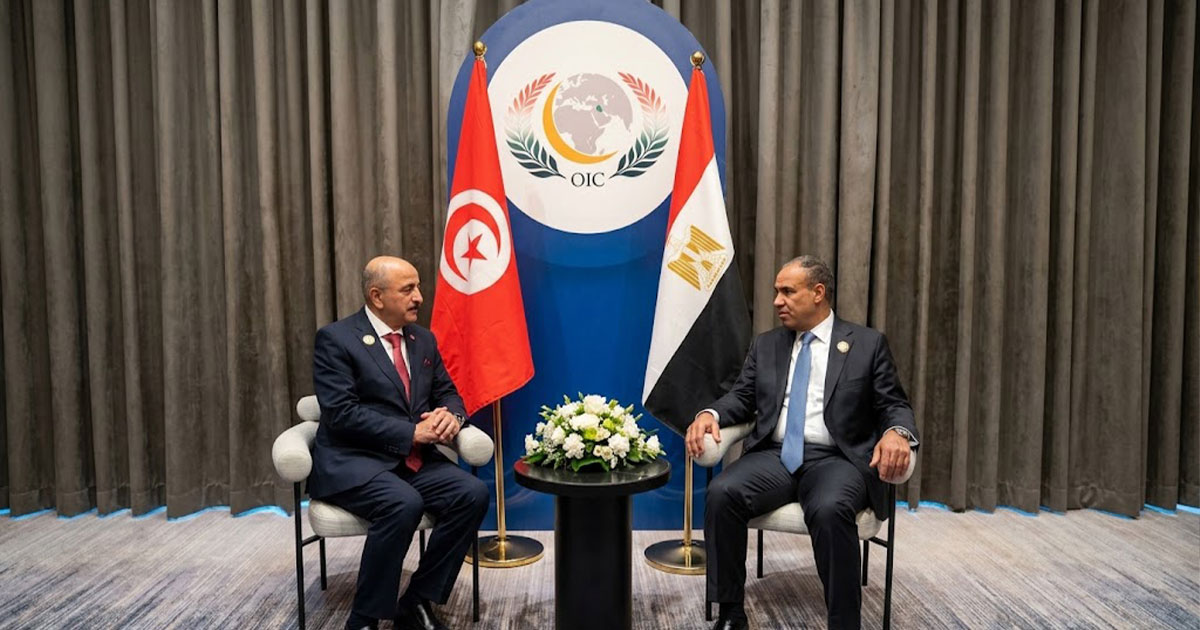
Based on those historical Egyptian-Tunisian relations, this was the meeting between Dr. Badr Abdel-Aty, Minister of Foreign Affairs and International Cooperation And Egyptians Abroad,” with Mr. Muhammad Ali Al-Nafti, “Minister of Foreign Affairs, Immigration, and Tunisians Abroad,” in the Iraqi capital, Baghdad, on the sidelines of the fifty-second session of the Council of Foreign Ministers of the Organization of Islamic Cooperation.

There, the two ministers stressed – according to what was stated by Ambassador Nader Zaki, the official spokesman for the Egyptian Foreign Ministry – the specificity of the historical relations and ties between Egypt and Tunisia, and they agreed to continue advancing economic, trade and investment cooperation, and to follow up on the outcomes of the eighteenth session of the Joint Higher Committee in Cairo.
All of this is in addition to coordinating international positions on developments in Gaza, Libya and Sudan, and supporting stability throughout the region. Therefore, the two ministers stressed the intensification of coordination efforts, and work to support the settlement of crises in Africa and the Middle East, as well as to preserve The unity and sovereignty of the Arab countries in accordance with international law.
Diplomacy Soft Power
The official channels between Egypt and Tunisia operate according to parallel paths, which are:
- Political and economic
- Security and Consular
- as well as cultural
This movement and these parallel paths coincide with the seventieth anniversary of the establishment of diplomatic relations between Cairo and Tunisia, in light of the sustainable development goals, which call for achieving the economy and enhancing the well-being of societies.
In conclusion, the Egyptian-Tunisian relationship is based on shared economic potential, and the most important challenge facing Cairo and Tunisia remains for joint production to become present. In addition to increasing the exchange of goods, the exchange markets become a space for developing the industrial and technological capabilities of the two countries.
Accordingly, The Earth Guards Foundation reads this path from an economic angle, an angle that places the quality of growth on a level equal to its size. Because high terms of trade alone are not sufficient to judge the success of the partnership unless it is accompanied by a diversity of products, a greater balance of opportunities, and investments that raise productivity and support sustainable employment.


