

A severe heat wave hits the growing season in Austria… losses that threaten crops and pastures

A severe heat wave hits the growing season in Austria… losses threaten crops and pastures
The repercussions of the heat wave have increased in Europe, including rising temperatures and increasing pressure on cities. It has also begun to clearly extend to the agricultural sector, even in countries that enjoy a relative abundance of water, such as Austria. Weeks of drought and high temperatures have weakened crop growth, reduced water and grass in mountain pastures, and prompted some farmers to bring their livestock back early from the Alps.
In some areas, the crisis has gone beyond pasture shortages to rising feed costs, prompting farmers to send part of their livestock to slaughterhouses earlier than usual. At the same time, authorities concerned with food production expect a decline in grain yields in…Austria by 19% this year, an indication of the expanding impact of the heat wave in Europe, from livestock to basic crops.
Pastures under stress
At an altitude of approximately 1,300 meters above sea level, Alpine farmers in northern Austria used to send their livestock to mountain pastures during the summer months, taking advantage of the natural grass and water available there.
But the situation changed this year. Johann Wessel, a dairy farmer who heads an association for pasture-based livestock breeders in the state of Upper Austria, said that the region had gone weeks without rain, while high temperatures continued for an unusual period.

This combination of heat and lack of rain has reduced the water and grass available for livestock, forcing…Some farmers are returning cows to the barns earlier than usual.
The problem is that the return of animals to farms means that feed stocks begin to be consumed early, including hay that was saved from last year for the winter season.

Towards slaughterhouses
Every additional day that animals spend inside barns increases the farmer’s feed needs, and if current stocks are not sufficient, purchasing additional quantities becomes necessary, which raises production costs.
As the pressures of the heat wave continue in Europe, some farmers are faced with a difficult economic choice: keep livestock and bear the cost of additional feed, or reduce their numbers and send part of them to slaughter early.
Wessel points out that some pastures no longer containAlready on livestock, while the scale of the problem varies from one mountainous region to another depending on the availability of water and grass.
The matter has reached the point where some farmers are talking about cases of emergency slaughter, at a time when waiting lists at slaughterhouses have become long, which reflects that the pressure is extending to a larger number of producers on a larger number of farms.
Cereals are declining
Livestock were not the only ones affected. AgrarMarkt Austria, the authority responsible for supervising food production in the country, announced that it expects the grain harvest in Austria to decline by 19% during the current year.
This ratio reveals the extent of the impact of heat and drought on agricultural production, and explains how a few weeks of severe weather can change the outlook for an entire season.
This directly intersects with the second goal ofThe Sustainable Development Goals (SDGs), on Zero Hunger, specifically target 2.4 which calls for ensuring sustainable food production systems and agricultural practices that are resilient to climate change, drought and extreme weather events.
What the heat wave in Austria shows relates to the amount of grain produced, in addition to the ability of the agricultural sector to maintain stable production when heat waves and drought become more stressful on farms and natural resources.

Corn pays the price
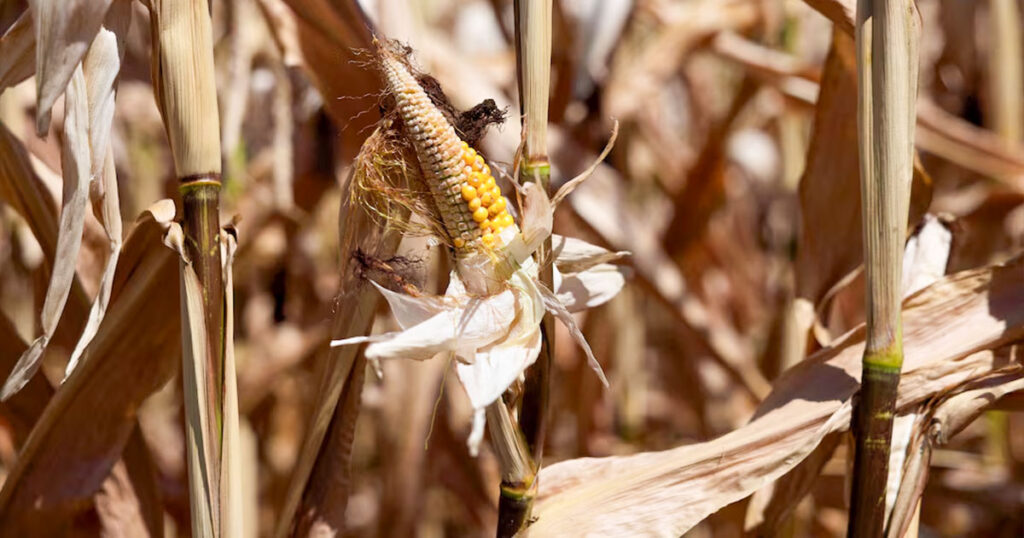
The crisis appears most clearly in crops that need large amounts of water, most notably corn. One farmer was forced to cut most of his crop early after the expected yield became very weak, while the stalks that remained in the fields turned to a dry yellow color instead of the usual green color.
These scenes illustrate how water shortages translate into direct production losses, especially in crops that are difficult to withstand long periods of heat stress.
With the decline in production, the cost is not borne by the farmer alone, as the repercussions could extend to feed, food chains and prices if the same conditions persist or are repeated in subsequent seasons.
Tomatoes lose their value
In the farmhouses in the Leonding area near the city of Linz, a different picture of the losses emerged.
A couple grows about 30 types of tomatoes there, but the high temperatures have stopped the growth of part of the crop and led to the appearance of gray and brown dry spots on some of the fruits.
According to farmers, quantities of tomatoes were infected with what is known as blossom end rot duringVery hot weeks. Although the fruits remain edible after removing the damaged parts, they are no longer suitable for sale in the usual commercial form.
Here, the losses of the heat wave in Europe shift from a decline in the quantity of the crop only to a decline in its quality and marketing value, which adds a new burden to farmers’ income.

Not all crops are loss-making
Despite the widespread damage, not all crops were affected in the same way. On the same farm, the carrot crop performed exceptionally well this year, benefiting from the high temperatures.
This paradox shows that the impact of extreme weather is not uniform, as the response of crops varies according to their water needs, the nature of their growth, and their ability to withstand heat.
But this disparity does not diminish the scale of the broader challenge facing agriculture, especially when losses in grains, maize and tomatoes coincide with increasing pressures on livestock farming.
This is linked to the thirteenth goal of the Sustainable Development Goals (SDGs), especially target 13.1, which calls for strengthening resilience and adaptation to climate-related risks and natural disasters.
The Earth Guards Foundation indicates that what the heat wave in Europe reveals within Austria reflects the need for the agricultural sector to adapt to more volatile climatic conditions, through managing water and pastures more efficiently, and improving the ability of crops and livestock to withstand periods of heat and drought.
The problem is related to the ability of the food system itself to continue when climate shocks arriveSame time to fields, pastures and production costs.


