

EU-Egypt Summit: €7.4 Billion in Agreements and Historic Strategic Partnership
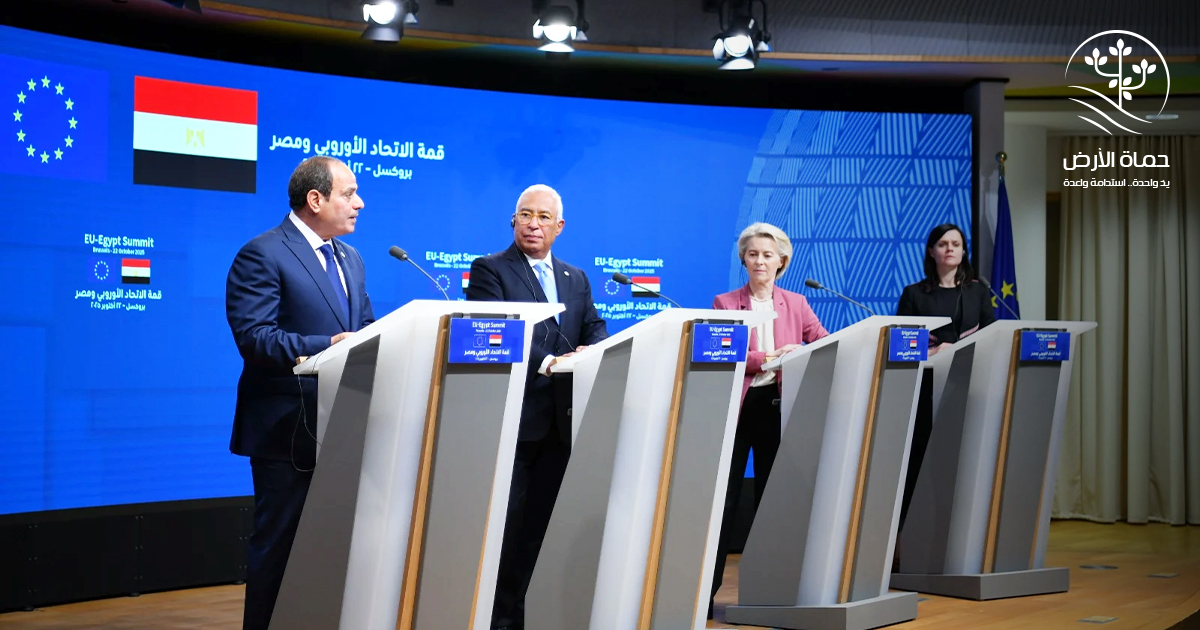
The European Union and Egypt summit… agreements worth 7.4 billion euros and a historic strategic partnership
The European Union and Egypt Summit represents a pivotal station in the path of relations between the two sides, in light of the rapid global transformations and the growing economic and climate challenges that force countries to search for effective regional partnerships that redraw the map of international cooperation on the basis of integration and common interests.
TheSummit of the European Union and Egyptcomes as the culmination of a long path of political dialogue and economic cooperation, and the embodiment of a mutual awareness thatSustainable development cannot be achieved in isolation from regional stability and economic integration. So you addressinstitutionEarth Guards In the following lines, the most prominent topics of this summit and its most important outcomes: So keep reading.
Brussels Summit Strategic Partnership
TheSummit of the European Union and Egypt was held inthe Belgian capital, Brussels, where President Abdel Fattah El-Sisi headed the Egyptian delegation participating in theSummit, which is considered a historic event that establishes a new phase of cooperation between Egypt and the European Union, within the framework of the comprehensive strategic partnership that was officially launched in March. 2024.
This summit, which was chaired on the European side by Mr. Antonio Costa, “President of the European Council,” and Mrs. Ursula von der Leyen, “President of the European Commission,” came to confirm that relations between Egypt and Europe have gone beyond the stage of traditional cooperation toThe level of integrated partnership in the fieldssustainable development, energy, economy, climate and regional security.
There, President Abdel Fattah El-Sisi stressed that theEuropean Union and Egypt Summitrepresentsan embodimentof the commitment of both parties to promotingdevelopment and peace, noting that Egypt is waging a comprehensive construction and development battle that puts people at the heart of the development process, in parallel with… Its efforts to combat illegal immigration, as well as its efforts to protect the environment and other sustainable development challenges.

Signing agreements to support the Egyptian economy
TheThe European Union-Egypt summit witnessed the signing of a number of important economic agreements between EgyptAnd the European Union, at the forefront of whichThe second phase of the macroeconomic support and budget deficit support mechanism(MFA), and there, Dr. Rania Al-Mashat, “Minister of Planning, Economic Development and International Cooperation,” signed on behalf of the Egyptian side, while Mr. Valdis Dombrovskis signed on the European side.
In this regard, the Minister confirmed that this mechanism is part of a comprehensive support system for the Egyptian economy, aiming to enhance its stability and flexibility, increase its competitiveness, and shift towards a green economy, noting that the agreed-upon reforms include 87 structural reforms within the national program for economic reforms.
Dr. Rania Al-Mashat added that the agreement contributes to prolonging the terms of the public debt, enhancing its sustainability, and bridging the financing gap, as well as supporting reforms.Structural development in the fields of renewable energy, and the protection of ecosystems such as the Red Sea; Which makes the agreement one of the financial pillarsfor sustainable development in Egypt.
New grant to support social reforms
Duringthe European Union and Egypt Summit, the Minister of Planning, Economic Development and International Cooperation also signed a new financing agreement with the European Union entitled:Supporting the implementation of social and economic reforms at the local level. This is valued at75one million euros in the form of a grant, and jointly funded by Germany.
This project aims to improve the quality of basic services in low-income areas, and enhance livelihoods and care.Health, education and water, with a special focus on women and youth, in a step consistent with the sixth pillar of the strategic partnership related to human capital.
Dr. Rania Al-Mashat explained that the new agreement embodies the Egyptian government’s commitment to achievingcomprehensive developmentLeave no one behind, in accordance with the United Nations Sustainable Development Goals (SDGs), including the third goal (good health), the fourth (quality education), and the eighth (decent work and economic growth).

From politics to development
During the closed sessions at theEuropean Union and Egypt Summit, the two sides discussed developments in the regional situations in Gaza, Libya, Sudan, Syria, and the Horn of Africa, as well as the war in Ukraine, and related files.On migration, terrorism, and energy security.
In his speech, President Sisi stressed that achieving development is the first line of defense for security and stability, noting that Egypt continues its responsible role in resolving regional conflicts, and that hosting the Sharm El-Sheikh summit comes within its established vision to achieve just peace and sustainable development in the region.
The President added that Egypt does not view the partnership with Europe as merely financing or technical support, but ratherasa system of civilizational and strategic cooperation to build a more sustainable and just common future, especially in issues of climate, green transformation, and clean energy.
The green economy is the focus of the new phase
Then he affirmed the joint final statement at theEuropean Union and Egypt summit,The two parties agree to accelerate the green transition, enhance investments in renewable energy and green hydrogen, and develop electrical interconnection projects between Egypt and Europe.
The statement also welcomed Egypt’s efforts to implement its national green hydrogen strategy, and expand water desalination, solar, and wind projects, as a successful model for sustainable development in Africa and the Middle East.
Egypt’s Vision for Sustainable Development 2030
Therefore, the Brussels Summit comes to confirm thatEgypt Vision 2030 clearly intersects withThe European Green Development Agenda, as the two sides aim to enhance the balance between economic growth, environmental protection, and improving the quality of life; Because Egypt has becomeToday, it is an indispensable regional partner inenergy security, food, climate, migration and human development; This is what made the European Union describe it in an official statement as a “strategic partner for the twenty-first century.”
Egypt’s new future
The Brussels summit highlights that Egypt is entering a new phase of international relations based on mutual trust, common interests, and sustainable development, as it is no longer just a recipient of aid, but has become a key partner in shaping a more stable future for the entire region.
The agreements witnessed in theEuropean Union and Egypt Summit – from macroeconomic support to financing social reforms – represent a direct investment in the Egyptian human being and sustainable infrastructure, and put Egypt on the mapGlobal green transition.
From the above,Earth Defenders Foundation confirms that development and stability are two sides of the same coin, and that the Egyptian leadership is steadily moving towards building a modern state and a new republic capable of facing regional and international challenges through balanced partnerships that promote peace and development at the same time.


