

Earth Guards Foundation Empowers Youth Through Environmental Essay Competition
المستقبل الأخضر بين سطورك
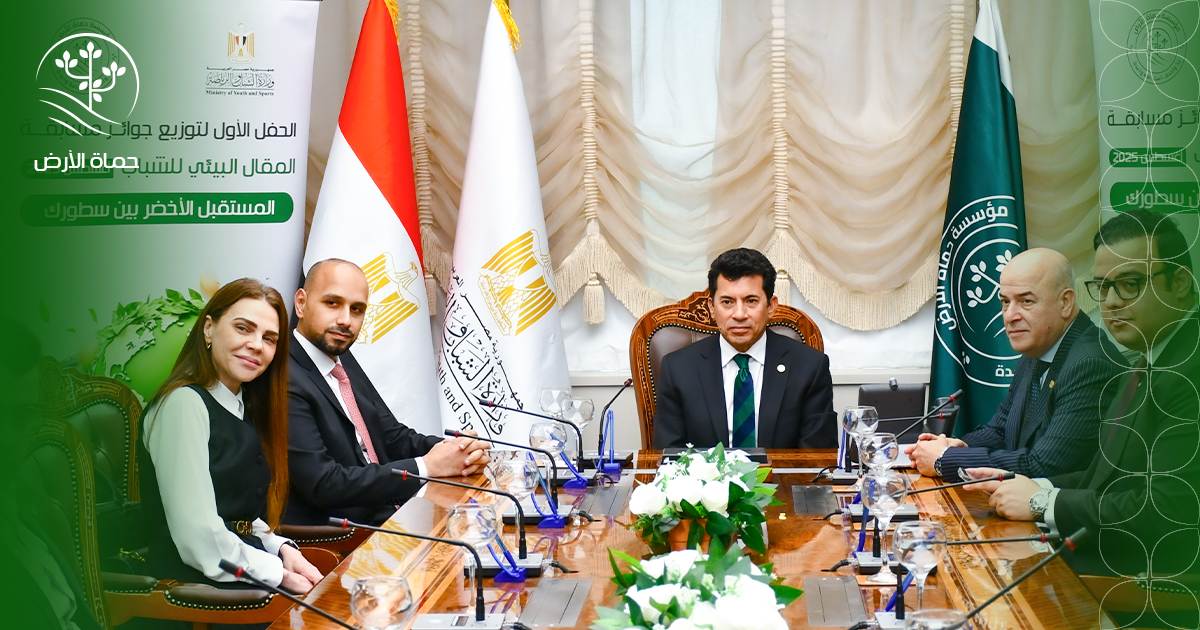
The Earth Guards Foundation works to empower youth with the environmental essay competition
TheSustainable Development Goals (SDGs)are an essential focal point in shaping the future of societies in a just and prosperous manner. It – and all its objectives – is a global road map for achieving a balance between signs of social development and rates of economic development. This is because sustainable development is the irreplaceable path to eradicating poverty, enhancing education, improving health, achieving gender equality, and ensuring comprehensive sustainability between current and future generations, especially the youth group. Empowering youth is the essence of this comprehensive sustainability.
From this standpoint, the Sustainable Development Goals (SDGs) become a reference for all policies and initiatives. Because it motivates governmentsinstitutions and civil society to work together, in order to find innovative and sustainable solutions to the complex challenges facing the world today; Therefore,Earth Guards spares no effort in the field of youth empowerment and support, which prompted it – as the leading Egyptian institution in the field of achieving Sustainable Development Goals (SDGs) – to cooperate with the Ministry of Youth and Sports to launch the environmental essay competition for youth under the title: The Green Future Between Your Lines.
Earth Guards Partnerships
Since its founding,Earth Guardshas consolidated its strategic partnerships – Arab and regional – at all levels, and among these partnerships is the cooperation protocol between it and the Ministry of Youth and Sports, which aims to empower Egyptian youth and enhance their role in issuesSustainable development, as well as working to prepare youth cadres capable of facing current challenges, and spreading awareness of Sustainable Development Goals (SDGs) among all segments of society.
This is in addition to launching joint media campaigns and expanding youth participation in international events; Which made the protocol a practical framework that combines sports, society and the environment, and a path through which the position of young people can be strengthened as a driving force towards a more sustainable future.
Empowering youth with education
As an extension of the provisions of this protocol signed betweenThe Earth Guards Foundationand the Ministry of Youth and Sports, the environmental essay competition was launched earlier last July before the submission period closed after receiving a large number of articles written by Egyptian youth.Conscious.
To honor the winners among them, the Ministry of Youth and Sports, at its headquarters in the New Administrative Capital, witnessed yesterday – Tuesday, September 2nd – the competition’s awards ceremony, which came under the title: The Green Future Between Your Lines, where Dr. Ashraf Sobhi, “Minister of Youth and Sports,” and Dr. Muhammad Zeyada, “Chairman of the Board of Trustees ofHama Foundation “Earth” by honoring the winners with cash and in-kind prizes.

Jury examines sustainability
To ensure that the judging of these articles is fair and transparent, these articles were evaluated according to precise criteria, based on the jury’s approval that the idea of the article be clear, with depth and analysis, and the importance of using evidence and statistics, in addition to the creative style.And the logical structure of the article, taking into account the ability to influence the reader and suggest practical solutions for implementing development ideas on the ground.
Names of winners
Therefore, the jury announced the names of the first two winners in the competition, which are:
- Mohamed Noubi, and this is about his article: Living The Change.
- Ahmed Bassem Abdel Rahman Muhammad, and this is about his article: Youth and their role in the transition to a green economy.
Building ideas and awareness
The large turnout for this competition – the Environmental Essay Competition for Youth – was an expression of the extent of the youth segment’s interest in green urbanization, and the pursuit of implementing Sustainable Development Goals (SDGs) and achieving them in the land.In fact, this turnout included young people between the ages of 16 and 30, emphasizing with their constructive words that achieving sustainable development begins with science and through innovative ideas.
With the Environmental Essay Competition for Youth,The Earth Guards Foundation seeks to enhance young people’s writing and analytical skills, and encourage them to think critically and creatively; This allows them to contribute effectively to shaping a more sustainable future. Therefore, Dr. Muhammad Zeyada – Chairman of the Board of Trustees of theThe Earth Guards Foundation– indicated that the competition had achieved its desired goals in its first edition, the most important of which was working to empower young people and stimulate their creative thinking.
A vital platform for youth empowerment
Dr. Muhammad Ziadeh also stated that this competition is a competitionQuarterly, and it is a vital platform for youth empowerment; تشجيعًا منمؤسسة Earth Guards على دعم الشباب في التعبير عن آرائهم ومبادراتهم، ومنحهم الفرصة الكاملة للتميز من أجل بلدنا الحبيب؛ Egypt, whose national agenda – Egypt Vision 2030 – is based on improving the quality of life and shifting to sustainability in all sectors.
Efforts of future Earth Guards
Perhaps one of the most prominent features of this competition is its focus on supporting young people as innovators and actors capable of providing practical solutions to pressing environmental problems. Therefore,The Foundation is working to expand the scope of this initiative in the future, to include more young people, and to provide them with the opportunity to interact with environmental experts and policy makers. Which enhances the chances of their positive influence onالمجتمع.
At a time when the results of the competition reflect the high level of creativity and passion among the participants,Earth Defenders Foundation confirms that such initiatives are part of a long-term strategy to empower youth, create a generation aware of sustainable development issues, and capable of providing innovative and future solutions.
In conclusion, what theThe Earth Guards Foundation offers through the Youth Environmental Essay Competition goes beyond simply organizing a competition; Because this is a living example of the link between youth empowerment and achieving Sustainable Development Goals (SDGs). The participating youth did not limit themselves to presenting ideas, but rather, through their articles, they embodied the ability of an entire generation to confront social, economic and environmental challenges in an innovative and realistic way. The experience here also highlights the ability of institutionsSociety aims to create effective platforms for learning and initiative, where youth creativity becomes a tool for achieving positive change in society.


