

The Library of Alexandria.. How did knowledge cross two thousand years of glory and extinction?

The Library of Alexandria.. How did knowledge cross two thousand years of glory and extinction?
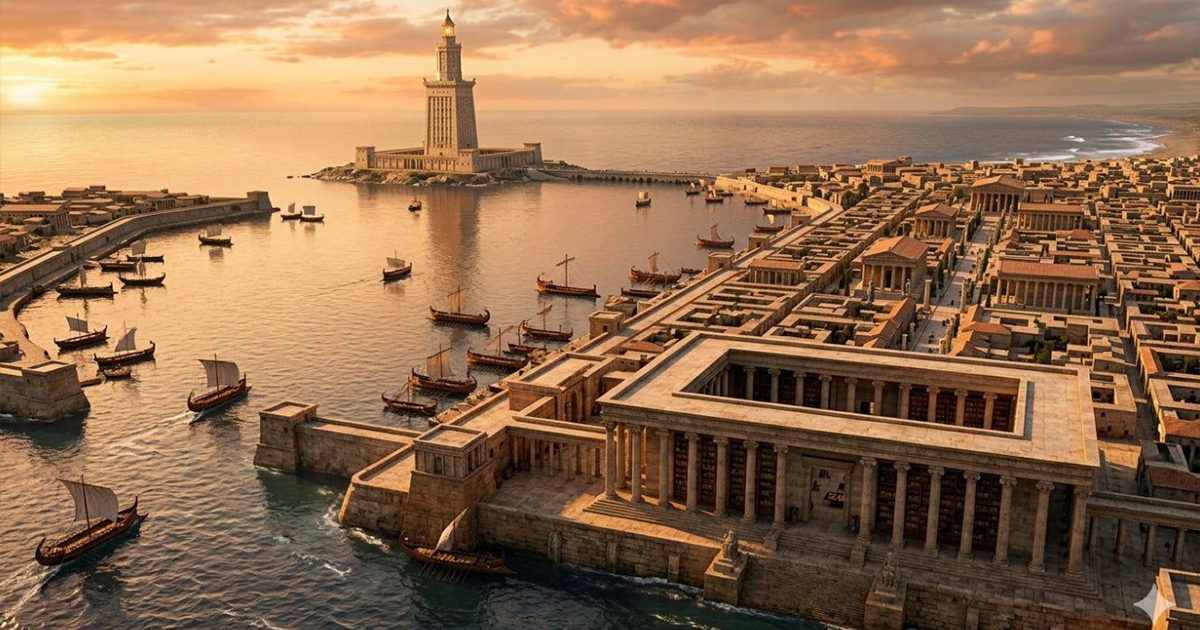
On the banks of the Mediterranean Sea, where ships carried to Alexandria the goods of the East and the West, an ambitious project arose more than two thousand years ago that wanted to bring together the knowledge of the ancient world in one city. Papyrus scrolls were crossing the ports carrying poetry, philosophy, medicine, and mathematics, while the Ptolemaic kings of Egypt aspired to make their capital a center where the minds of scholars would converge, and where the boundaries of human knowledge would expand.
And from that ambition I was born Library of Alexandria, which became one of the most famous scientific institutions in ancient history, and witnessed an intellectual prosperity associated with names that left their impact on human understanding of the earth, nature, and science.
With the successive centuries, the scientific institution declined, and its idea remained present in human memory until the opening of the modern Library of Alexandria in 2002. Between the papyrus scrolls and digital books, there extends a story that reveals how cultural institutions are able to create and preserve knowledge, and how its transmission between generations becomes part of the ability of civilizations to build their future.
Knowledge in the Ptolemaic court
The story began after the death of Alexander the Great in 323 BC, when Egypt passed to Ptolemy I, who founded the Ptolemaic dynasty and sought to establish Alexandria as the political and cultural capital of his kingdom.
Historical sources suggest that the idea of establishing the library arose during his reign, and then took its institutional form during the rule of his son Ptolemy II, between 282 and 246 BC, with the expansion of efforts to collect literature and attract scholars.
Egypt at that time possessed elements that helped achieve this ambition. Its agricultural wealth provided significant financial resources, while the production of papyrus gave it a prominent position in the manufacture of writing materials on which the Greek and Roman world relied.
In the Royal District of Alexandria, the Library of Alexandria was linked to a scientific institution known as: ""The Museists"It allowed scholars to reside, research, and teach under the patronage of the Ptolemaic court.

The sources tell of a broad book acquisition policy, which included sending agents to search for manuscripts in Mediterranean cities. Some accounts state that books arriving on ships were copied in Alexandria, and their originals were kept within the royal collection.
Behind this activity was a clear cultural and political ambition; Owning books and attracting scholars became ways to enhance the status of the capital and demonstrate its ability to compete with the intellectual centers of the ancient world.
Scientists draw the boundaries of knowledge
The library flourished during the rule of the early Ptolemies, and its scientific environment became an incubator for research that extended from literature and language to geography, mathematics, and medicine.
An experience is revealed Eratosthenes, one of the most prominent librarians, on the scientific ambition of Alexandria; He was able to estimate the Earth's circumference using the sun's shadows, distances, and geometric calculations, an achievement that preceded modern means of measurement by many centuries.
In another field, he excelled Callimachus of Cyrene, whose name was associated with the development of one of the most famous indexing systems in ancient history.
He created a huge work known as: "Pinax", included lists of authors and their works distributed over fields of knowledge, in an attempt to organize the large collection of texts and facilitate reference to them.
This experience gains its importance from a question that has accompanied libraries throughout the ages: How can the researcher access the knowledge he needs in the midst of thousands of works?

Organization here was an extension of the book collecting process; Indexing gives texts clear positions within written memory, and allows them to be reused and built upon.
And through Eratosthenes and Callimachus Two complementary images of scientific life become clear: a researcher produces new knowledge, and another develops means that help circulate existing knowledge.
From this angle, it stands out Target 9.5 of SDG 9, on industry, innovation and infrastructure, which calls for strengthening scientific research and technological capabilities and encouraging innovation.
Scientific progress requires an environment that gives researchers resources, time, and opportunities to exchange knowledge. These are ingredients that were evident early in the experience of the Library of Alexandria, even if its methods and goals differed from modern research institutions.
Between the glory of the library and the fluctuations of power
The library's prosperity was linked to the patronage of the rulers, and this same patronage was one of the factors that determined its course when political circumstances changed.
In 145 BC, political conflicts during the reign of Ptolemy VIII led to the expulsion of a number of scholars, including the chief librarian. Aristarchus of Samothraki, known for studying and investigating Greek texts.
With the departure of scholars and the decline in the level of royal patronage, the scientific standing of the institution gradually began to suffer, while research works and methods continued to spread through copying and circulation in other centers of the ancient world.
The transformations continued with Egypt's transition to Roman rule in 30 BC, and then Alexandria was subjected to military and religious turmoil during the following centuries.
What is noteworthy is that the story of its end has become more famous than the details of its decline. The literature transmitted accounts of the fire of Julius Caesar in 48 BC, the events of the Roman era, and the destruction of the Temple of Serapis in 391 AD.

These facts vary in nature and dates, and the available evidence makes determining the fate of the original royal group a complex historical issue. A broader reading of this stage indicates a long decline that was intertwined with political conflicts, weak patronage, and a change in intellectual institutions.
This experience also reveals the importance of stability and continued support for scientific institutions. The accumulation of knowledge is the result of efforts extending over generations, and its prosperity remains dependent on the ability of societies to nurture scholars and protect their writings from the effects of political fluctuations.
From papyrus to the digital age.. The return of the Library of Alexandria
After many centuries, the modern Library of Alexandria was opened in 2002, restoring the city to a cultural project inspired by its history of collecting knowledge and promoting research and communication between cultures.
The modern library overlooks the Mediterranean Sea with its distinctive circular building, which has become one of the city's contemporary landmarks. Behind this architectural presence, there is a cultural message based on preserving heritage, encouraging scientific research, and expanding opportunities to access sources of knowledge.
The Foundation's activities are distributed among its collections, research and cultural centres, the fields of studying manuscripts and heritage, and developing digital means that help preserve, organize and make available knowledge materials. A comparison between the two eras reveals to us a profound transformation in the human relationship with the library.

Papyrus scrolls in the ancient world required physical copying and transportation between cities, and the ability of scholars to benefit from them was affected by their presence near centers of science. Digital technologies provide broader possibilities for preserving copies of heritage materials, and facilitating searching and accessing them across distances.
Thus, the issue of preserving knowledge moves from interest in the manuscript as a material artifact to also interest in the ideas it contains that can be studied and re-presented to new generations.
At the same time, the societal function of contemporary cultural institutions expands to include public dialogue and issues related to people's lives.
Examples of this are what I discussed The Earth Guards Foundation In her report on The Library of Alexandria organizes Women’s Week for Sustainable EnvironmentIn a model of the library’s presence within cultural activities concerned with women’s participation and community issues.
Memory of future generations
The ancient and modern Library of Alexandria brings together a timeless human idea: that the knowledge produced by one generation can become a starting point for subsequent generations.
The Ptolemaic Library was linked to royal patronage, which allowed scholars to devote themselves to research, while modern technologies opened broader horizons for preserving knowledge and making it available, giving new generations greater opportunities to learn, research, and benefit from human heritage.
This historical journey gives contemporary meaning to the protection of cultural heritage. Each manuscript carries a trace of human experiences, questions and discoveries, and its preservation allows subsequent generations the opportunity to complete what the predecessors began.
Here it is Target 11.4 of Sustainable Development Goal 11, on sustainable cities and communities, its importance; Calling for the strengthening of efforts aimed at preserving cultural and natural heritage.

Between the past and the present, the responsibility of cultural institutions is renewed in protecting what has reached us, and adding what can benefit those who will come after us.
In this stretch between the memory of the past and the horizons of the future, the importance of the cognitive message it adopts emerges The Earth Guards Foundation; It believes that spreading awareness and making knowledge available is a way to enable people to understand the challenges surrounding them, and to participate in building a more aware, sustainable, and resilient future.
The knowledge preserved in papyrus scrolls Library of Alexandria Centuries ago, today it became part of a vast human memory, and the protection and availability that libraries provide to this memory allows new generations to benefit from the legacy of their predecessors, build on their scientific and intellectual achievements, and open new horizons for the future.


