

When Islamic architecture quenched Cairo’s thirst… the story of the watersheds immortalized in history
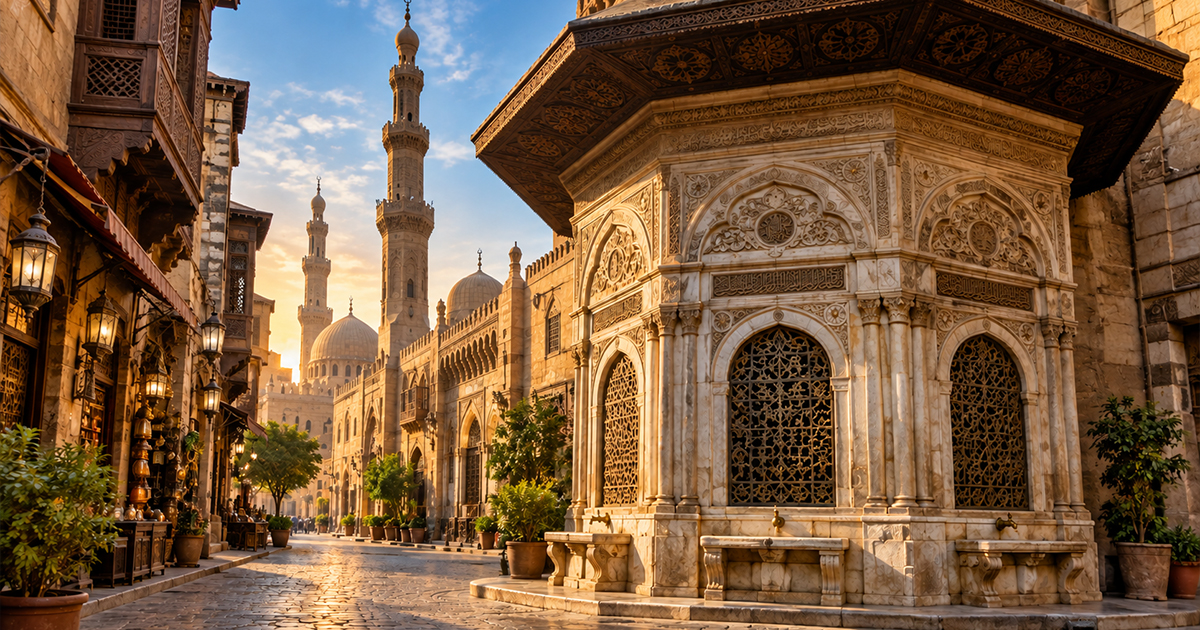

When Islamic architecture quenched Cairo's thirst… the story of the watersheds immortalized in history
Between the alleys of ancient Cairo and its narrow alleys, where minarets and domes are adjacent and the roads leading to the markets are intertwined, fingerprints are evident. Islamic architecture In installations that carry heritage stories within their walls, beyond the beauty of stone and decorations.
There, along Al-Mu'izz Street and the Al-Gamaliyya and Al-Ghuriya neighborhoods, Cairo's fountains stand as testimony to a time when water was provided to passers-by from behind ornate copper windows, while some of them were surmounted by libraries where boys received lessons in reading, writing, and memorizing the Qur’an.
Behind those facades hides the story of a city that made architecture a means of giving. The cisterns that were designated for storing water, the dressing rooms that received passers-by, and the columns that rose above each other reveal how people’s daily needs combined with the arts of construction.
From the path of Khosrow Pasha to the path of Abd al-Rahman Katkhuda and the path of Muhammad Ali, a historical story extends that illuminates an aspect of the relationship of Islamic architecture to social life, and opens a window to read the roots of sustainability and the arts in Cairo over the centuries.
Cairo quenches thirst
Before water reached homes through modern networks, obtaining drinking water was part of daily life in Cairo. And in this city, which was crowded with its markets and streets, it appeared The panicles As charitable facilities designated to supply passers-by with water, sultans, princes, and the wealthy competed to establish them.
These buildings spread in populated neighborhoods and commercial areas, from Al-Muizz Street to Al-Saliba and Sayyida Zeinab, becoming part of the urban and social landscape. However, waterers continued their role in transporting water to homes far from the stables, which reveals that the provision of water was dependent on a system of facilities, workers, and integrated services.
The avenues were not just drinking places; Its establishment carried the meaning of ongoing charity, and embodied the presence of charitable work in public life. Through this function, an aspect of the history of Islamic architecture can be read, when the construction of buildings was linked to serving the population and meeting their daily needs.
Did Cairo's floodwaters provide an early answer to a question that still preoccupies cities today: How does drinking water reach all residents in an equitable manner? Centuries after the creation of these avenues, this challenge has become a part of… From target 6.1 of Sustainable Development Goal 6, on clean water and sanitation, which aims to make safe drinking water available to everyone.
Although the tools of the past and water safety standards differ from those of the present, the roads reveal that providing water to passersby was a social matter that was reflected in the urbanization of Cairo.
Giving Architecture
The water's journey along the path began from the ground; The tanks were designated for storing water, and above them were drinking rooms from which drink was served to passers-by through windows overlooking the streets.
These rooms combined the requirements of function with the precision of industry. Marble shelves appeared to hold drinking utensils, and copper windows separated the interior from the road, in addition to the use of marble, porcelain, and decorated wood.
Thus, details are revealed Water storage Its distribution is that the beauty of the building was linked to its function, and that the architectural elements participated in organizing the service for which it was created.
It is the most prominent evidence of this stage The path of Khosrow PashaIt was established by the Ottoman governor of Egypt during the period extending from 1535 AD to 1537 AD, on Al-Muizz Street in front of the Sultan Qalawun Collection.

It is considered the oldest surviving Ottoman fountain in Cairo, and its design has retained a local architectural character despite its construction in the Ottoman era. Its facades overlook the road with two drainage windows covered with copper grilles, and in front of each of them is a marble shelf supported by three stone pedestals.
As for The dressing room It is distinguished by its marble cladding and ornate wooden ceiling, and it included a marble element known as a salsabil, which was used to cool water. With these details, the path shows an example of employing available materials and construction methods to provide an everyday service in the heart of the city.
Water is irrigated and knowledge is recited
As the centuries passed, some fountains began to combine watering passersby and educating children, so the scribes rose above the watering chamber, so that the building performed two social functions in one urban space.
And it is embodied Sabeel Abdul Rahman Katkhuda This picture clearly. It was established by Prince Abdul Rahman Katkhuda in 1744 AD, at the intersection of Al-Muizz Street and Al-Tambakshia Street, in a place that made it present in the city’s movement and markets.
The path is distinguished by three facades with windows serving water, and it is decorated with marble columns, architectural arches, and geometric and floral decorations. Inside the hymn chamber, the walls are covered with blue ceramic tiles, including a painting depicting the Holy Kaaba and its surrounding buildings.

Above this room stands the kuttab, which was prepared to teach children reading, writing, arithmetic, and memorizing the Qur’an, and its wooden windows overlook the surrounding streets.
In this construction, one of the striking features becomes clear Islamic architecture In Cairo; Water, which quenches the thirst of passersby, has met with science, which opens the doors of knowledge for children, while decorations, mashrabiyas, and columns have given each function its own space.
Centuries later, access to learning opportunities for all has become one of the issues he addresses The fourth goal of the sustainable development goalsConcerned with quality education. The experience of the Asabila and Katateeb reveals how interest in education has taken different forms over the ages, even if the nature of institutions, curricula, and ways of providing education differed.
The era of Muhammad Ali
With the entry of the nineteenth century, the fountains witnessed another transformation in their architectural features, reflecting the artistic influences that Egypt experienced at that stage.
In 1820, Muhammad Ali Pasha ordered the establishment of… The way of Muhammad Ali In the Al-Aqqadin area on Al-Muizz Street, as an ongoing charity for the soul of his son, Prince Ahmed Toson Pasha, who died in 1816.
The building had a distinctive style with its semicircular facade, which included five metal windows to serve water, surrounded by marble decorations and Ottoman Turkish inscriptions. Its design was influenced by architectural styles that appeared in Istanbul, along with decorative elements from the Baroque and Rococo arts.

Beneath the chamber of the sabil extended a large cistern, covered with nine stone domes, and waterproofing materials were used in its walls. The Cairo Governorate Portal indicates that its capacity reached about 445 thousand litres, a volume that demonstrates the importance of water storage facilities in serving passers-by before the advent of modern supply systems.
The educational function was not lost on the complex, as the path was linked to a book to teach children, so that this type of establishment continues to combine financial and cognitive giving.
Thus the transformations were not in Islamic architecture Just a transition between decorative styles; Providing water remained an essential function, while the shapes, materials, and styles of buildings changed with changing times.
A legacy beyond stone
Centuries after the construction of these fountains, Cairo changed and expanded, and the means of supplying water to the population changed, while the historical buildings remained witness to a social and urban system that played an important role in the life of the city.
وتكشف هذه الآثار أن قيمة التراث المعماري تتجاوز الجدران والنقوش؛ It also preserves the memory of the services that cities provided, and the methods that communities used to provide their basic needs.
While the avenues tell pages of Cairo's history, preserving them poses a responsibility that extends to the present. It is a responsibility that you reflect Target 11.4 of Sustainable Development Goal 11, on sustainable cities and communities, which calls for strengthening efforts to protect the world's cultural and natural heritage.
There is something in the streets of Cairo that reveals the human meaning of this goal. Preserving its copper windows, cisterns, and educational halls also preserves the memory of a city that knew how to make its urban facilities a means of serving its people.
This idea finds a contemporary extension in heritage preservation and highlighting projects, including: The Grand Egyptian Museum as a model of the intersection of cultural memory and cultural sustainabilityThe relationship between preserving traces of the past and using heritage to enrich the cultural life of society is renewed.
And from perspective The Earth Guards FoundationReading the history of Asabila provides an opportunity to understand the relationship between building and man. The facilities that served the population with water and education are a reminder that the prosperity of cities is also linked to their ability to meet social needs and preserve their heritage for future generations.
Benefiting from these experiences remains linked to understanding their historical context, not transferring the solutions of the past as they are to the present. Modern water networks, safety standards, and population needs are radically different from what Old Cairo knew.
When the visitor contemplates the windows of the fountains, its cisterns, and its eaves, he reads pages from the history of a city that shaped its construction according to the needs of its people. In ancient Cairo, stone had its beauty, water had its place, and science had its place. When these elements came together, architecture left an impact that remained after times changed.


