How water pollution turned El Salvador’s largest lake into a mass fish grave?
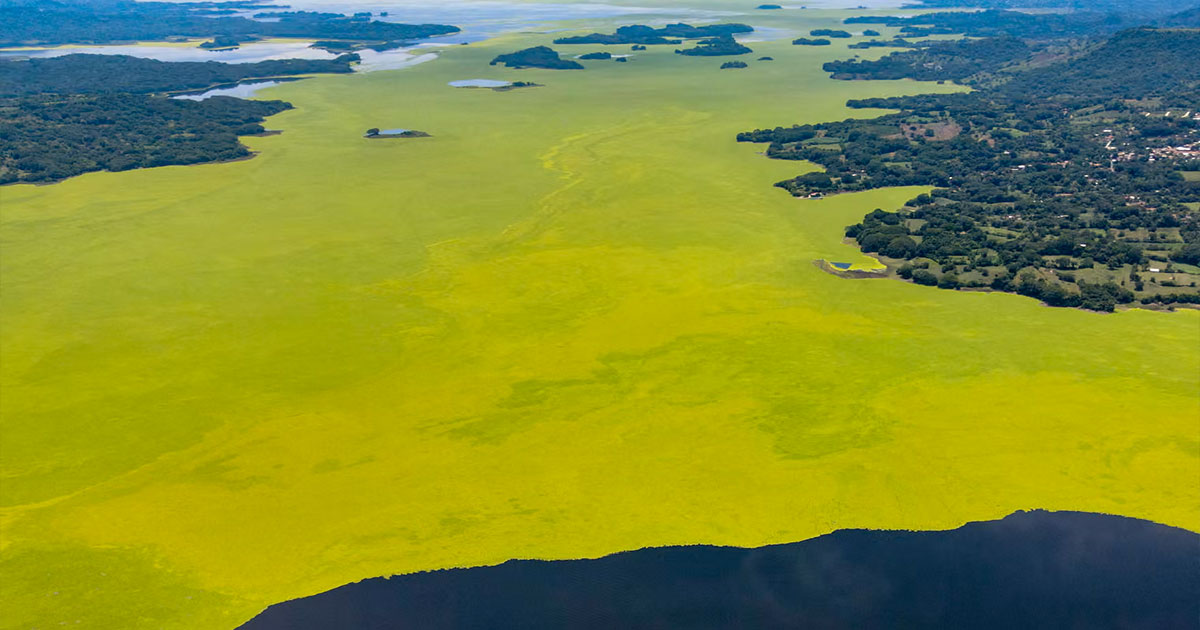
The crisis began with the death of thousands of fish on the shore of Lake Suchitlan in El Salvador. Within months, invasive aquatic plants spread, plastic waste accumulated, and fishing and tourism activities declined. Then, by August 2025, water lettuce covered about 70% of the lake’s surface, while residents were left facing an extremely dangerous environmental scene without a clear official explanation.
Despite the return of the fish after nearly a year and the disappearance of the plants that covered the surface of the lake, the sources of water pollution are still present, and no answers have emerged to the questions related to the death of fish and other problems that struck the lake!
Before the problem began, environmental organizations and researchers had warned for many years that the lake was under constant pressure. Due to untreated wastewater (the most prominent source of water pollution in El Salvador), agricultural runoff laden with fertilizers, and poor enforcement of water quality standards.
Then large quantities of nutrients reached the lake through the Lemba River, especially nitrogen and sulfate from fertilizers and agricultural activities; This causes a phenomenon known as eutrophication, which is a high concentration of nutrients that causes plants and algae to grow excessively.
Regarding this, biologist Gabriel Cerin said: “ The abundance of nutrients provided suitable conditions for the spread of water lettuce. With the expansion of vegetation coverDecreased oxygen available to fish and other organisms; Which contributed to the deterioration of the ecosystem ».
From fish deaths to lake suffocation
Then this problem appeared in its clearest form when residents found thousands of dead fish, washed ashore during one night, and in the following weeks water lettuce – an invasive aquatic species – spread over large parts of the lake, which has an area of about 135 square kilometers, and then the color of the lake’s water turned dark, in addition to other environmental effects.
Late tests increase ambiguity
After the fish died, the toxicology laboratory at the University of El Salvador was asked to analyze samplesOf the water, the tests focused on measuring nitrogen and phosphorus, and monitoring cyanobacteria that grow in nutrient-rich water. These are organisms that may produce harmful toxins.
However, the laboratory did not conduct tests for some pesticides and herbicides, including the highly toxic substance paraquat, known commercially as “ Gramoxone”. When samples were taken several weeks after the accident, they did not show abnormal nutrient levels or obvious cyanobacterial activity.
There, researchers warned against relying on these results to determine the causes of death; Because the tests were conducted after a long time had passed, and because the density of plants during the crisis severely prevented some measurement points from being reached; Thus, this time gap demonstrated the importance of rapid action when any environmental change or indicators of water pollution appear. So he hasWater properties change, and evidence disappears before analyzes begin.
Water pollution puts public health under pressure
Based on this crisis, worrying health indicators and serious environmental impacts have emerged, including: an increase in mosquito numbers after fish deaths, and some visitors complaining of skin rashes after swimming. Public health reports also indicate that gastrointestinal disorders and respiratory infections are common among members of the communities surrounding the lake.
Lake Food, Energy and Biodiversity
To realize the seriousness of this environmental crisis, we must know that Lake Suchitlán – known as the Ceron Grande Reservoir – is the largest body of fresh water in all of El Salvador, and it is located at the heart of a water and economic system on which large local communities depend.It is a wetland site protected under the International Ramsar Convention.
Of the 14 native fish species, the Salvadoran lake contains 12, with wild species at risk of extinction in the surrounding areas, including mountain lions and American wild cats.
The lake feeds the Ceron Grande Dam, which provides about 28% of El Salvador’s hydroelectric power; Therefore, its environmental degradation has a severe impact on nearby communities, the electricity and food sectors, and biodiversity protection.
This multiple role played by the Salvadoran lake places the water pollution crisis at the heart of development issues. Because damage to a water system of this size may put pressure on household income, raise health risks, and threaten an important source of renewable energy, all of which hinders the achievement ofA number of Sustainable Development Goals (SDGs), most notably good health, decent work, and clean energy that should be available to everyone, as well as life under water.
Fishing and tourism people pay the price
In detail, many of the residents surrounding the lake depend to earn a large amount of their livelihood from fishing, and while the fisherman was earning about $15 every day, the water pollution crisis prompted some of them to join teams to remove plants and waste, while others relied on the agricultural crop sector or even the support of relatives! Many families continued to eat the fish they caught despite concerns about its safety. Because there is no protein available other than fish protein.
The losses of the crisis also extended to tourism, which is a rare alternative to working around the lake.As demand for restaurants overlooking the water declined, and demand for the hobby of bird watching weakened. This is all due to the spread of vegetation and unpleasant odors. Boat cruise workers were forced to look for temporary jobs, when the income of some of them fell to about 30% of its previous level.
A recurring crisis in Central American lakes
Suchitlan does not represent a separate case; There are other lakes in Central America that face similar problems resulting from a combination of water pollution, high temperatures, urban expansion, and land use change. Lake Coatepeque in El Salvador has witnessed a widespread spread of cyanobacteria, and environmental authorities attributed the phenomenon to high temperature, strong solar radiation, and an increase in nutrients.
In Guatemala Lake Atitlan suffers from frequent blooms of cyanobacteria; Due to wastewater and urban expansion. Lake Yojoa in Honduras is also facing declining water quality and fish kills, amid the impacts of agricultural runoff, deforestation, and industrial activities.
These examples reveal that water pollution has become a regional challenge that requires cross-border cooperation, especially since rivers and water basins connect agricultural activities, cities and lakes. Reducing these environmental risks requires continuous monitoring of water and fish, disclosing the results to local residents, and providing food alternatives when indicators of water pollution appear in the area. Thus, the third goal of the Sustainable Development Goals (SDGs), which calls for achieving good health and well-being, is achieved, as well as the sixth goal onWith clean water.
In conclusion, the Lake Suchitlán crisis reveals that water pollution is an environmental landscape that is established by years of neglect, through silent pollution, weak oversight, and delayed response, until the ecosystem reaches a point where collapse becomes the natural result.
What happened in the largest lake in El Salvador shows that aquatic systems may seem able to recover on the surface, but the disappearance of invasive plants and the return of fish do not mean that the causes of the crisis have disappeared as long as the sources of pollution flow into the lake. Therefore, The Earth Guards Foundation believes that protecting water resources depends on early monitoring, integrated management of water basins, and reducing the discharge of pollutants, and then the goals of sustainable development are achieved.