

Egypt and Montenegro…the first diplomatic mission and economic partnerships between Africa and Europe

Egypt and Montenegro…the first diplomatic mission and economic partnerships between Africa and Europe
Egypt represents a strategic gateway to the African continent, with its distinguished geographical location, a wide network of economic and trade relations, and a pivotal role in enhancing cooperation between Africa and various regions of the world. In this context, the visit of the President of the Republic of Montenegro to Cairo, and the accompanying announcement of the opening of his country’s first diplomatic mission on the African continent, comes to support opportunities for building new economic partnerships between the two countries, and opens promising horizons for cooperation in various fields.
This visit represents a trend towards expanding the horizons of Egyptian cooperation with European countries, by activating new economic and investment partnerships, and supporting areas such as tourism and maritime services.Logistics and renewable energy, which contributes to exchanging experiences and maximizing the use of the capabilities available to both sides, within the framework of efforts aimed at achieving Sustainable Development Goals (SDGs), especially Goal 17 of the Sustainable Development Goals (SDGs), which calls for establishing partnerships to achieve the goals, which emphasizes the importance of building effective international partnerships based on cooperation and exchange of experiences, which contributes to supporting development paths and enhancing integration between countries.
Egyptian-Montenegrin discussions to enhance cooperation
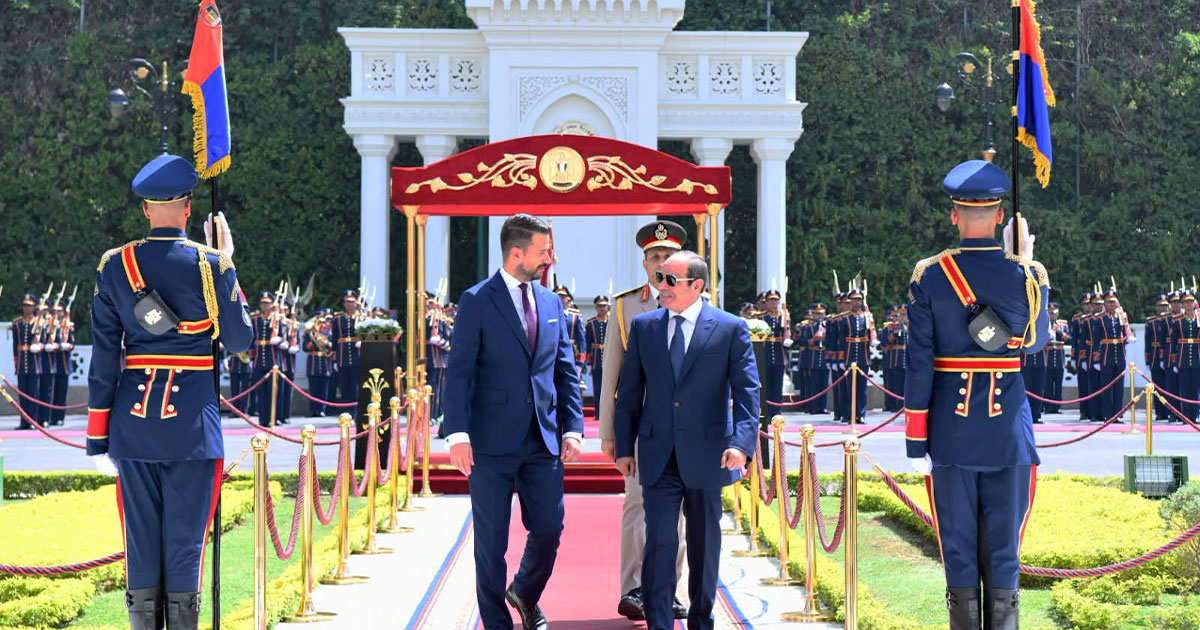
President Abdel Fattah El-Sisi received President Jakov Milatovic, President of the Republic of Montenegro, during his first official visit to Egypt at the presidential level since the establishment of diplomatic relations between the two countries in 2006, in a step that reflects the keenness of both sides to strengthen paths of joint cooperation.

The discussions dealt with ways to develop bilateral relations, especially in the economic and trade fields, and diversify areas of cooperation in order to achieve mutual benefit from the opportunities available to the two countries. President Milatovic also stressed his country’s aspiration to benefit from Egyptian expertise in the tourism, energy and infrastructure sectors, and to expand the scope of joint investments, pointing to the successes achieved by Egyptian investments in Montenegro.
The meeting witnessed consensus on the importance of continuing political coordination and enhancing cooperation in various fields, in a way that supports the building of new economic partnerships, and reflects the two countries’ orientation towards expanding the horizons of bilateral relations during the next stage.
Investment table to enhance economic partnerships
Within the framework of enhancing the economic aspects of the visit, the Ministry hostedInvestment and Foreign Trade An expanded round table chaired by Dr. Mohamed Farid Saleh, Minister of Investment and Foreign Trade, and in the presence of President Jakov Milatović and a high-level delegation from both sides, along with a number of representatives of the business community and major companies.
The table discussed opportunities to enhance economic and investment cooperation between Egypt and Montenegro, and reviewed the promising areas of partnership between the private sector in the two countries, especially in the sectors of tourism, maritime and logistical services, renewable energy, and agricultural industries, in a way that supports increasing the volume of trade exchange and transforming available capabilities into joint projects and investments.
The event also witnessed the signing of a memorandum of understanding between the General Authority for the Port of Alexandria and the Montenegro Ports Authority, with the aim of enhancing cooperation in the fields of maritime transport and logistics services, thus opening the way for the development ofTrade movement and connectivity between the two countries.

This cooperation is in line with the eighth goal of the Sustainable Development Goals (SDGs), which is concerned with achieving economic growth and providing job opportunities, by supporting joint investments in advancing the path of sustainable development. Cooperation in the fields of transportation and logistics services also supports the directions of the ninth goal of the Sustainable Development Goals (SDGs), which aims to develop infrastructure, enhance innovation, and build more efficient economic systems.
Economic partnerships to open new investment horizons
The Minister stressed that holding the round table represents an important milestone in the path of Egyptian relations with Montenegro, and reflects the common will to advance economic and investment cooperation, noting that the two countries are linked by friendly relations, which are witnessed during the current stage.There is increasing momentum to deepen political and economic cooperation, especially in light of the agreement to complete the economic cooperation agreement and strengthen bilateral relations.
He explained that there is great economic potential that is still untapped between the two countries, stressing that the goal of this meeting is to translate this potential into practical cooperation, joint investments, and sustainable economic partnerships between the private sectors in the two countries.
He added: Today, Egypt has become a strategic gateway to access a market that includes more than 3 billion consumers, benefiting from one of the largest networks of free trade agreements in the world, providing investors with an integrated platform to access African, Arab, European and international markets.
The Minister concluded his speech by emphasizing that relations between countries, like successful investments, are built on trust before they are built.On the numbers, he expressed his aspiration for this round table to represent a starting point for a new phase of the economic partnership between Egypt and Montenegro, based on mutual respect, common prosperity, and maximizing investment opportunities available to both sides.
Deepening economic cooperation between the two countries
For his part, President Jakov Milatović, President of the Republic of Montenegro, stressed that business community meetings represent an essential foundation for transforming political relations between countries into economic and investment partnerships that achieve common interests, explaining that his visit to Cairo comes at the head of a high-level delegation that includes representatives of the government, parliament, and the private sector, with the aim of deepening economic cooperation between the two countries.
He pointed out that Egypt represents an important political and economic partner for his country, in light of its regional status and strategic location,Announcing the opening of Montenegro’s first diplomatic mission on the African continent from Cairo, which will enhance cooperation with Egypt and support his country’s openness to Arab and African countries.
He added that the two sides agreed to expedite the completion of the economic cooperation agreement, which provides a more stable institutional and legal framework for investors, and opens the way for companies in the two countries to establish joint projects.
Egyptian investments and enhancing tourism cooperation
The President praised the investments of Egyptian companies in Montenegro, stressing that they represent one of the most prominent models of successful foreign investment in his country, especially through its tourism and real estate project in Lusztica Bay, whose investments exceeded 1.3 billion euros, indicating the confidence of the Egyptian investor in the Montenegrin economy, expressing his aspiration that this experience will represent an incentive.For more Egyptian companies to explore investment opportunities in Montenegro.
He pointed out that Montenegro is considered the most advanced among the countries nominated to join the European Union, which opens new horizons for enhancing economic and trade cooperation with Egypt, noting that the tourism sector represents one of the promising areas of cooperation between the two countries, in light of the launch of direct charter flights between Cairo and the capital, Podgorica, which supports tourism movement and enhances rapprochement between the two sides.
Visit the Grand Egyptian Museum
Within the framework of enhancing tourism cooperation between Egypt and the Republic of Montenegro, President Jakov Milatović and his wife were keen to visit the Grand Egyptian Museum. They were received by Dr. Ahmed Ghoneim, CEO of the Grand Egyptian Museum Authority, who welcomed them and gave them an overview of the museum and its most important features.He also took them on a tour inside the museum that included the outer courtyard, the main lobby, the great staircase, the main halls, and the halls of King Tutankhamun.

President Jakov Milatović and his accompanying delegation expressed their great admiration for the distinguished architectural design of the museum and its display scenario, and the unique archaeological treasures it contains that reflect the greatness of ancient Egyptian civilization, appreciating the efforts made to complete this global cultural and civilizational edifice.
In conclusion, in light of these movements, the economic partnerships between Egypt and Montenegro represent a step towards expanding areas of cooperation between Africa and Europe, and maximizing the benefit of common potentials in various sectors, in a way that supports sustainable development paths and enhances the role of international partnerships in achieving a more prosperous future.
For its part, the Earth Defenders Foundation appreciates the path of growing cooperation between Egypt and Montenegro, as a model of international partnerships based on exchanging experiences and maximizing the benefit of joint capabilities, which contributes to supporting areas of sustainable development, and opening new horizons for economic and tourism cooperation between the two countries, in a way that achieves added value to the development paths in Africa and Europe.


