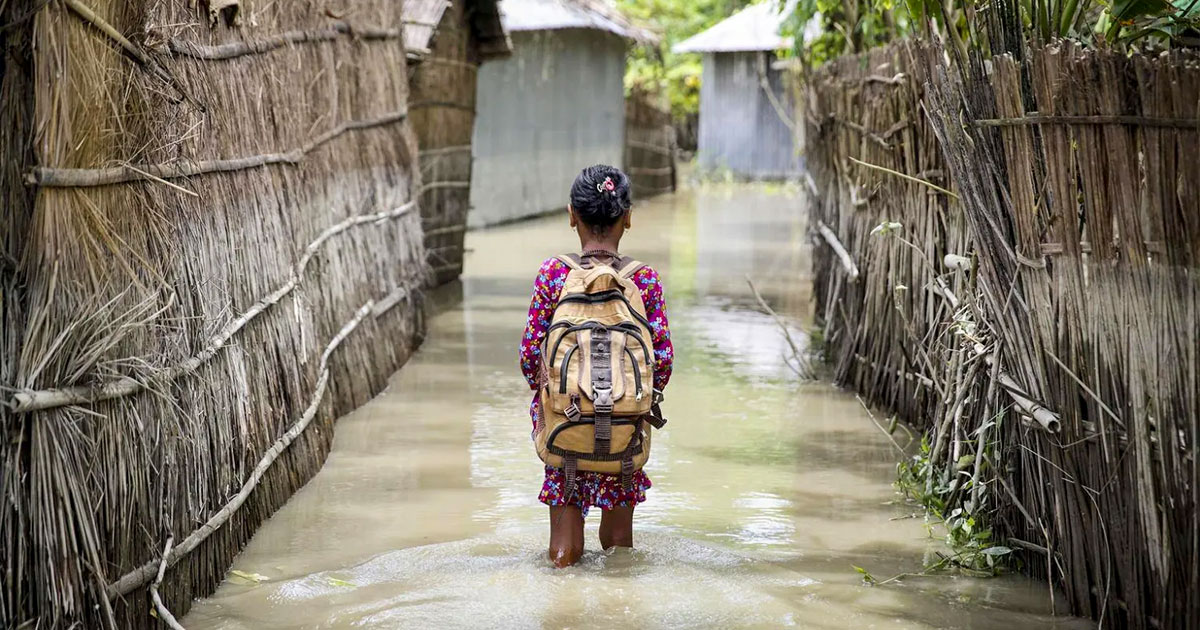
UN report: Climate risks threaten more than a billion children around the world
Climate risks are intensifying day after day in many countries of the world, which we see evident in high temperature rates and the recurrence of extreme weather phenomena, which affects the lives of individuals, especially groups that need special attention, such as children, their health, and their education.
What are the most prominent climate risks affecting children and their lives, and how can we reduce the impact of climate change on these children? This is what The Earth Guards Foundation answers in the following lines: So keep reading.
Data from the Children’s Climate report indicatesRisk Report issued by UNICEF indicates that children are exposed to a wide range of climate risks, the effects of which overlap in many regions around the world, which increases the amount of pressure on communities and service systems. The most prominent of these risks are:
Heat waves
Drought
River floods
Coastal floods
Forest fires
Sand and dust storms
The danger of these phenomena increases when they are repeated at close times in time. Which hinders efforts to achieve the Sustainable Development Goals (SDGs), most notably the third goal on good health and well-being, and the fourth goal on quality education.
For the children of the world
In more detail, the Climate Risks to Children report says: More than a billion children around the world face three climate risks – perhaps more – including:
Heat waves
Floods
Storms
The same report indicates that 123,000 children face more than six different climate hazards throughout their lives; Thus, it appears to us that the scope of these climate impacts is expanding, and is affecting multiple aspects of children’s lives, from health and education, to food security, infrastructure, and basic services.
WhereAre the most severe climate risks concentrated?
The report shows a map of the concentration of overlapping climate crises around the world as follows:
The Sahel region of Africa: It is one of the most affected regions, where more than 4 million children face a dangerous combination of heat waves, and constant sand and dust storms.
Asian countries (Bangladesh, Myanmar, Pakistan): These are countries that are classified as the regions most exposed to climate risks; Due to the interaction of river floods with tropical cyclones.
High-income countries (Italy as an example): The report proves that the crisis is global and does not exclude anyone; More than 6 million children in Italy live under the burden of…Severe droughts and prolonged heat waves affect their water and environmental security.
Why children specifically?
Children are one of the groups most affected by climate change. Because of the nature of their needs, they need basic services, as well as public facilities, such as schools, health centers, water networks, and other vital sectors.
One of the most prominent examples cited by the UNICEF report is the country of Papua New Guinea (located in the southwestern Pacific Ocean), where some of its children are forced to cross a river full of crocodiles to reach their schools after heavy rains washed away one of the vital bridges in the region. The collapse of the bridge dates back to 2012, and local communities are still facing difficulties in providing the necessary funding to rebuild it.Amidst climatic conditions that increase the complexity of the situation year after year.
How do climate risks affect children?
The effects of climate risks extend to many aspects of children’s lives. In the health field, heat waves, water pollution, and the increased spread of some diseases – for example – are linked to the increased health risks that these children may be exposed to, especially in areas that suffer from weak basic services.
These risks also affect the education sector when they prevent students from reaching their schools, or when floods and storms cause severe damage to the educational infrastructure. In some cases, climate disasters lead to interruption of school for many weeks. Which is reflected in educational attainment and widens educational gaps.
The impacts also include the roads, bridges, water networks, and public facilities that children depend on every day, highlighting the close relationship between climate risks, the quality of basic services, and the stability of communities.
Protecting children from climate risks
Therefore, UNICEF called on governments and private sector institutions to strengthen efforts to reduce carbon emissions and develop climate adaptation programs, with a focus on the basic services that children depend on in their daily lives.
The report also focused on investing in health and education systems that are more resilient to climate challenges, in addition to developing infrastructure, and improving water, sanitation, and transportation services, to ensure the continued provision of basic services in the country.During crises and natural disasters.
In conclusion, we conclude from the Climate Risks to Children report issued by UNICEF that climate risks are an influential factor in the future of millions of children around the world, and that dealing with them requires long-term investments in infrastructure, basic services, and effective climate policies.
Accordingly, The Earth Guards Foundation indicates that protecting children from the repercussions of climate change is a strategic issue, and every delay in building systems more capable of adapting to climate changes doubles the inequality gap and threatens the right of future generations to health, education and food security, as we must leave no one behind. The knees.