Egypt Strengthens Public Health Plan to Combat Addiction Through National Strategy and International Partnership
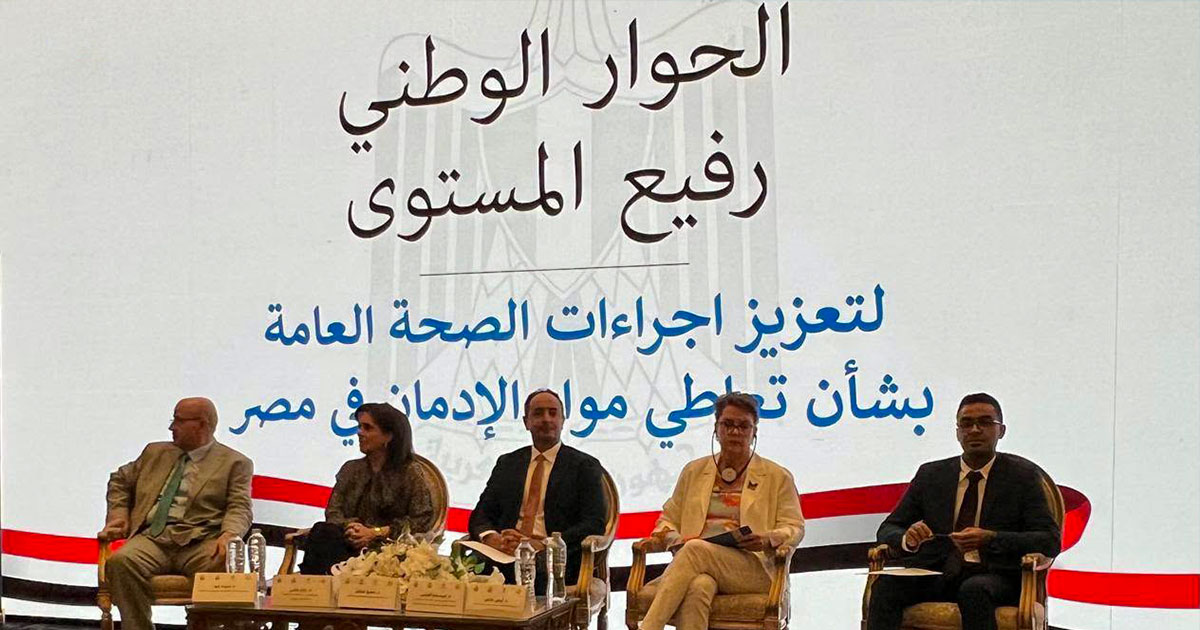

Egypt strengthens its public health plan to confront addiction with a national strategyAnd an international partnership
Public health is the indicator that measures the ability of countries to protect people and enhance their quality of life; Its roles extend beyond providing medical services, to include preventing behaviors and practices that threaten the safety of individuals and society.
In this context, efforts to combat the phenomenon of drug abuse and addiction are gaining increasing importance, as it is a health and development issue that requires the integration of the efforts of national institutions and international organizations, ensuring the construction of policies based on early prevention, effective treatment, and rehabilitation, and the consolidation of a safer and more stable community environment.
From this standpointDr. Amr Othman, “Director of the Fund for Combating and Treating Addiction and Abuse,” participated in the work of the“High-Level Policy Dialogue to Strengthen Public Health Actions on Confronting Abuse and Addiction“.
It is a conference hosted by Cairo within the World Health Organization’s regional initiative for the Eastern Mediterranean, with the support of the United Nations Office on Drugs and Crime, within the framework of supporting the implementation of the national strategy to combat drugs and reduce the dangers of abuse and addiction, which was launched under the patronage of President Abdel Fattah El-Sisi.
Ways to combat addiction
The opening session witnessed the participation of Dr. Hanan Balkhi, “Regional Director of the World Health Organization for the Eastern Mediterranean,” and Christina Albertin, “Regional Representative of the United Nations Office concerned.”on drugs and crime,” along with Dr. Nima Abdel, “representative of the World Health Organization in Egypt,” and Dr. Ayman Abbas, “head of the central administration of the General Secretariat of Mental Health,” as well as experts from the World Health Organization and the United Nations, leaders of the Fund for Combating and Treating Addiction, and representatives of relevant ministries and authorities.

The dialogue aimed to develop a unified national vision to enhance the public health system’s response to the problem of abuse and addiction, through the preparation of a flexible and sustainable action plan based on the national strategy and consistent with the regional initiative of the World Health Organization.
This is a desire to expand prevention, treatment and rehabilitation services, and to update relevant policies and legislation in accordance with international standards, and to enhance coordination between governmental institutions, international organizations and community institutions.Civil.
National Strategy Axes
In his participation, Dr. Amr Othman reviewed the most prominent axes of the national strategy, explaining that it relies on an integrated vision that begins with primary prevention within schools, universities, and youth centers, while moving from traditional awareness campaigns to preventive programs.
Stressing that these programs aim to build life skills among youth and youth, and enable families to early detect indicators of abuse, in addition to strengthening the role of religious institutions in correcting misconceptions, and expanding the definition of free treatment services, especially in governorates that are less popular with these services.
The Director of the Fund for Combating and Treating Addiction and Abuse also indicated that the strategy includes programs for early detection and building the capabilities of staff working inThe field of prevention and treatment, and the expansion of therapeutic services, rehabilitation, and community and economic integration for those recovering.
In addition to the above, the strategy includes working to confront social stigma, and including dramatic treatments that contribute to correcting the mental image of addiction and recovery, while strengthening regional and international cooperation in the field of reducing the demand for drugs, and creating integrated databases that support planning and decision-making.
Dr. Amr Othman confirmed that the Fund has achieved a number of achievements in the past years within the framework of implementing the strategy, including:
- Developing the Volunteer Association to include more than 35 thousand volunteers.
- Creating ten volunteer homes within Egyptian universities, benefiting about 250,000 students.
- Preparing 10,000 specialized staffReligious scholars and doctors to support prevention programs.
Dr. Amr Othman, “Director of the Fund for Combating and Treating Addiction and Abuse,” also indicated the inclusion of scientific content specialized in drug prevention within the “Community Issues” curriculum, and this is in cooperation with the Supreme Council of Universities.
Work was also done to launch the first bachelor’s program specializing in “Addiction Psychology and Therapeutic Methods” at Benha University, starting from the academic year 2025/2026, with the continued implementation of the professional diploma for reducing the demand for drugs in cooperation with the Faculty of Arts at Cairo University, in order to achieve the goals of public health and quality education.

Village Without Addiction Initiative
As part of community awareness efforts, the Fund Director explained that prevention programs had been implemented withinMore than 15,000 schools, 26 public universities, and 1,000 Azhari institutes, in addition to launching the “Prevention Clubs” initiative within youth centers and sports clubs, and building the capabilities of thousands of volunteer leaders to use digital media and visual content to spread awareness messages.
In the same context, Dr. Amr Othman added that the “Village Without Addiction” initiative expanded within the villages of the “Decent Life” presidential initiative, where thousands of awareness-raising activities were implemented in hundreds of villages, in addition to organizing convoys and volunteer camps, in a way that enhances the reach of prevention messages to various societal groups.
And all of this before Dr. Amr Othman addressed the Fund’s efforts within the developed areas as an alternative to slums, explaining that treatment clinics had been established within those areas, and nearly 20,000 residents benefited from them, with frequent home visits being carried out to raise awareness, and organizing family festivals,Launching media campaigns under the slogan “You are stronger than drugs” with the participation of international sports star Mohamed Salah.

From the above it becomes clear to us that the cost of prevention remains much lower than the cost of treatment, and that societies that invest in building human awareness are at the same time establishing a more productive economy, a more cohesive social fabric, and a state more capable of facing the challenges of the future.
In the estimation ofThe Earth Guards Foundationit appears that the deeper impact of such strategies is evident in their ability to change the structure that may produce danger! This raises the concept of prevention as a developmental act equivalent to building roads and factories, because a healthy, conscious and healthy person is the foundation upon which all forms of progress are built, and he is the asset by whose ability the state’s efficiency in maintaining its present is determined.And anticipating its future.