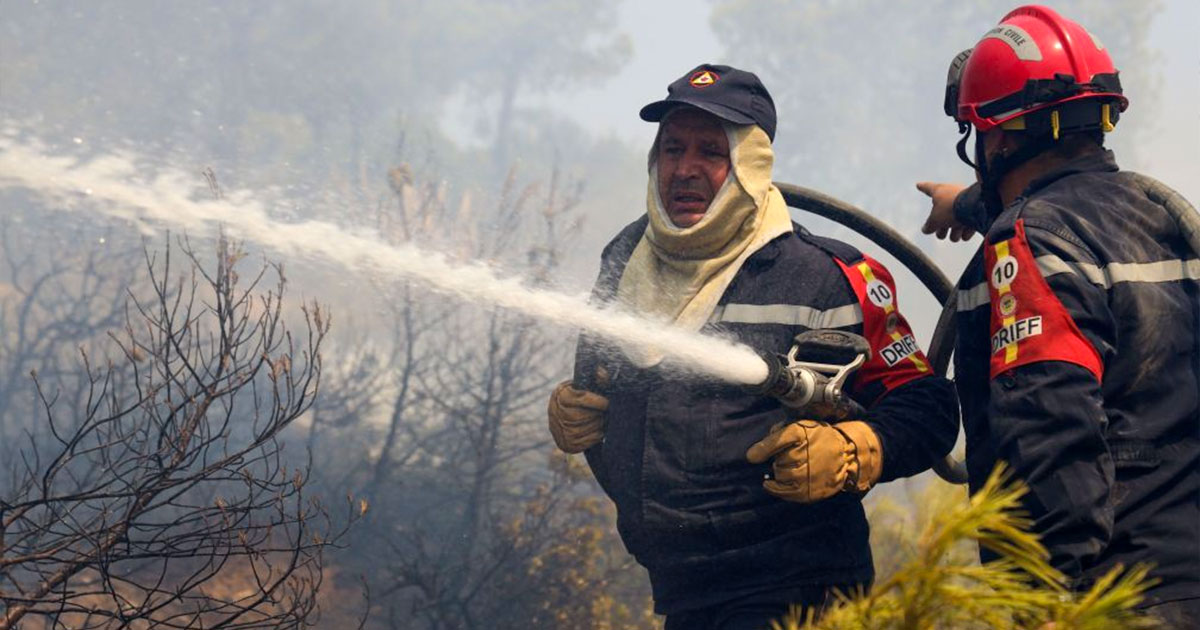
Forest fires devour large areas in Algeria and claim the lives of 6 people
In just 24 hours, firefighting teams moved between dozens of burning spots in various parts of Algeria, while the fires approached homes and health facilities, prompting the authorities to carry out preventive evacuations in a number of states. With 154 fires recorded and six deaths, forest fires have returned to the forefront as a crisis that threatens the population and vegetation simultaneously.
The emergency reached its peak on 18 July 2026, when fires were recorded in forests, bush and agricultural lands across the northern, northeastern, central and western regions. Emergency teams were able to extinguish 138 fires, while control operations continued to control 16 other hotspots at the time the data was issued.
It reveals the breadth of the geographical scopeThe fires affected the extent of the pressure faced by civil protection teams, as the fires were distributed among the states of Annaba, Souk Ahras, Skikda, Guelma, Bouira, Medea, Mila, Mascara, Al-Tarf, Jijel, Setif, Bejaia and Tlemcen, in addition to other states.
Forest fires in Algeria spread across a large number of locations within a short period of time, forcing emergency teams to distribute personnel, equipment, and machinery to distant areas, and increasing the difficulty of quickly surrounding and controlling the fires.
The multiplicity of burning spots increases the complexity of extinguishing operations. Every fire requires continuous monitoring even after it is under control, especially with the continued heat, drying of plants, and the possibility of renewed ignition. Therefore, the response did not end once most of the fires were extinguished, as teams continued cooling and monitoring operations to avoid the fire returningAreas that have been secured.
The speed of the movement reflected the scale of the official alert, as the Algerian government led a coordinated response in which civil protection, the army, the General Directorate of Forests, local authorities and relevant institutions participated, along with volunteers.
Forest fires approach homes and hospitals
The crisis turned from a threat to vegetation cover into a direct danger to the population, after the Ministry of the Interior, Local Communities and Transport confirmed the death of six people as a result of the fires.
In the Saraidi area of Annaba state, more than 100 patients were evacuated from a rehabilitation hospital, as fire approached the perimeter of the facility. About 150 homes were also damaged or threatened, necessitating the implementation of evacuations to protect residents before the fire reached the area.Residential areas.
Preventive evacuations included areas in Al-Tarf, Bejaia, Guelma and Bouira, in an indication of the widening circle of danger. The spread of fires to the vicinity of hospitals and villages shows how forest fires can affect basic services, and force the authorities to simultaneously deal with firefighting, evacuation and relief operations.
In addition to emergency teams, the Algerian Red Crescent has mobilized its local committees, volunteers and logistical resources since the beginning of the crisis, providing first aid, drinking water, food aid, psychological support and basic humanitarian needs to residents and response teams.
3,719 fires since the beginning of May
The cumulative numbers reveal that what happened on July 18 is not an isolated incident. It came within a season that witnessed a sharp increase in the number of fires. Since the beginningIn July, Algeria recorded 1,460 fires across the country, while the number since the beginning of May rose to 3,719 fires. On the other hand, the number of fires during the same period in 2025 reached about 1,501 fires.
This means that the number of fires has more than doubled compared to last year, putting greater pressure on civil protection agencies, forests and local authorities. This escalation also raises the need to continuously monitor areas prone to flammability, especially during periods of high temperature.
According to the Sub-Director of Media at the Civil Defense Directorate, Nasim Barnawi, the response teams were able to contain between 85% and 90% of the fires through joint operations in which state agencies and volunteers participated, while efforts continued to extinguish the remaining hotspots and prevent their spread.
Burned areas exceed three times that yearPast
The area of damaged vegetation increased in parallel with the increase in the number of fires. According to data from the General Directorate of Forests, the fire destroyed more than 3,967 acres of vegetation, forests, and damaged lands, compared to about 1,112 acres during the same period in 2025.
These numbers indicate that the burned area exceeded three times the area recorded during the previous year, with environmental and economic impacts that may extend beyond the fire season. Forests and natural plants contribute to protecting soil, preserving organisms’ habitats, and supporting agricultural activities and the livelihoods of local communities.
This deterioration is directly linked to the fifteenth goal of the Sustainable Development Goals (SDGs), concerned with protecting terrestrial ecosystems, and is also related to the thirteenth goal on climate action, in light of heat waves and drought impose increasing pressure on vegetation.
The loss of this cover may increase the exposure of the soil to degradation, and weaken the ability of the affected areas to cope with subsequent heat waves and drought, which expands the need for rehabilitation, monitoring, and restoration of ecosystems after the end of the extinction phase.
Heat wave fuels fires
The escalation of forest fires coincided with an extended heat wave that struck northern Algeria, and contributed to providing conditions conducive to the spread of fires. As temperatures rise, grasses and trees lose a large portion of their moisture, becoming more flammable.
In addition to this, the dryness of vegetation and the difficult terrain in a number of mountainous areas, which impedes the access of fire brigades and heavy machinery to some hotspots.The risk of renewed fire also remains even after initial control, especially if tree trunks and soil maintain high temperatures.
These factors indicate that dealing with fires requires continued monitoring, cooling, and securing the surrounding areas, while maintaining the readiness of intervention teams throughout periods of danger.
Prevention precedes the fire season
The significant increase in the number of forest fires and the areas affected reveals the importance of combining rapid response and preventive measures that begin before the peak of summer. These measures include monitoring high-risk areas, removing accumulated dry vegetation, maintaining the routes used by fire engines, strengthening early warning systems, in addition to preparing clear evacuation plans for hospitals and villages near forests.
The participation of local communities is also an important element in reducing losses, through early reporting of smoke spots, adherence to safety guidelines, and supporting emergency teams with information related to roads and residential areas at risk.
The more the fire is discovered in its early stages, the greater the chances of containing it before it spreads to large areas, which relieves pressure on the fire brigades and reduces the possibility of the fire spreading to homes and basic facilities.
Forest fires threaten development path
Forest fires are directly linked to Sustainable Development Goal 13, on climate action, and Goal 15, on protecting terrestrial ecosystems. Its impacts also extend to Goal 3, related to health, and Goal 11, concerned with building safer communitiesAbility to confront disasters.
Loss of vegetation cover does not represent an isolated environmental issue, as it is related to the health of residents, the safety of homes, the stability of agricultural activity, and the ability of emergency services to protect basic services. Fires also consume significant human and logistical resources, and impose additional costs on affected communities.
In conclusion, the forest fires that Algeria witnessed during the current season reveal a clear escalation in the severity of climate risks and the expansion of their effects on humans and natural resources at the same time. The increase in the number of fires and affected areas within a short period of time puts forest management and disaster prevention facing increasing challenges, and underscores the importance of investing in early warning systems, managing vegetation, and raising the readiness of local communities to deal with hot and dry seasons.
and confirms The Earth Guards Foundation Protecting forests is closely linked to maintaining environmental balance and the sustainability of natural resources, and represents an essential pillar for enhancing the ability to adapt to climate change. Preventive policies, along with cooperation between local institutions and communities, contribute to reducing human and environmental losses and supporting the path of sustainable development in the face of extreme climate phenomena.