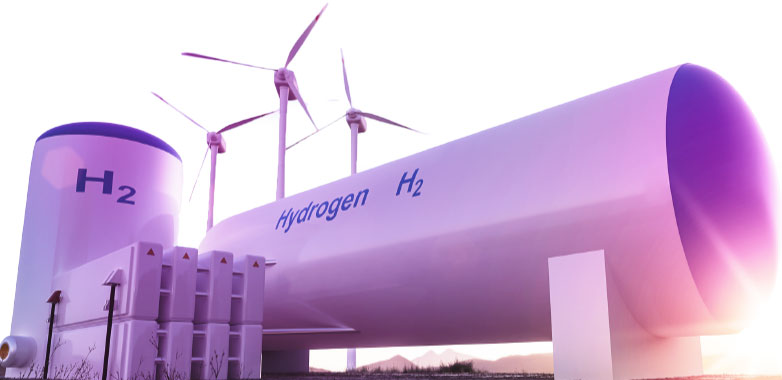
We highlight the most prominent competitor to green hydrogen
There is no doubt that recent years have witnessed great momentum and growing popularity for clean alternatives to fossil fuels. This is due to the global warming that the planet is suffering from, which has led to many environmental disasters, as a result of climate change and the destruction of natural environments in many regions. The most prominent type of clean fuel is green hydrogen.
Hydrogen, as we know, is the most abundant element in the universe, and it has a relatively high heat content. Add to this its clean combustion, as it produces nothing but water vapor; Therefore, it represents a promising option in meeting energy needs in the future, and so we tried in this article to highlightHighlights on one of the most promising types of hydrogen: Pink Hydrogen.
The traditional method of producing hydrogen depends on fossil fuels as a source of methane (natural gas), from which this gas is extracted; Then pass it through a process known as methane steam reforming. To produce hydrogen by cracking methane molecules. This process is characterized by its significant carbon footprint.
The previous method is the most common and reliable in producing hydrogen, but the large emissions it emits have made it an unsustainable method that we must get rid of.
On the other hand, we find that the production processHydrogen by electrolysis is a process with much lower emissions and eliminates dependence on fossil fuels as the raw material for hydrogen production.
Green hydrogen – as the name suggests – is produced by electrolysis of water, and using renewable sources to provide the electrolysis cells with the necessary energy. To produce green hydrogen, which can then be used in various applications, including fuel cells and energy production.
Barriers to green hydrogen
Despite what we have reviewed, the percentage of green hydrogen production is still small in the global hydrogen market, as it did not exceed – according to the International Energy Agency “IEA” – 1% of the total production in 2021; Due to high production costs.
The obstacles facing green hydrogen at the present time lie in the fact that its production process requires large amounts of energy, in addition to the limited production capacity of the electrolysis cells used in its production, and the high cost as a result of its reliance onRenewable energy sources.
So, the idea was put forward to meet the energy needs of the electrolysis process used to produce hydrogen – with nuclear energy, rather than renewable energy sources. Hence the term “pink hydrogen” arose, to differentiate it from green hydrogen.
Pink hydrogen and how to produce it
The main difference between pink hydrogen and other types of hydrogen is that it depends on nuclear energy, as a source of generating the necessary electricity.For electrolysis cells used to produce hydrogen from water.
As we reviewed previously in the pages of the magazine, nuclear energy – in the eyes of many – can represent a reliable solution to meet our energy needs with the lowest possible emissions. Hence the idea of using nuclear energy to produce hydrogen.
The big advantage of pink hydrogen is that it reduces dependence on fossil fuels in hydrogen production on the one hand, and provides practical solutions to the problems currently facing green hydrogen production on the other hand.
For those who do not know, the importance of hydrogen is not only that it is a promising source of energy, but rather that it is a key element in the processes of processing and refining crude oil and producing transportation fuels, in addition to being the main raw material in a number of industries, such asPetrochemicals, iron and steel industry, and others.
Pink hydrogen is currently seen as the tip of the scale in producing hydrogen from non-fossil sources, and at the same time its cost is acceptable and its efficiency is better, while maintaining low emissions.
Pink hydrogen preference
A 3-gigawatt nuclear plant could, according to a paper in the British Journal of Hydrogen and Fuel Cells, produce enough pink hydrogen to heat a million homes or power 40,000 hydrogen buses, all with net-Net Zero Emissions.
While some may say: nuclear energy is a completely unclean energy source, and depends on the extraction of many rare radioactive elements to operate reactors, not to mention the resulting radioactive waste – exceptAdvances in nuclear technology and waste management have made nuclear power safer and more sustainable over time.
To illustrate the advantage of nuclear energy, a 100 megawatt production station can produce 63% more pink hydrogen than a green hydrogen production station, and this can significantly reduce the cost of production and increase the competitiveness of hydrogen-powered fuel cells in various industries.
In conclusion, we say: Pink hydrogen represents a solution to the difficult balance between producing hydrogen at an acceptable cost and high efficiency, while maintaining a low emissions rate. Despite this, pink hydrogen – like any emerging technology – is still in the early stages of its development, and yet all the results indicate enormous potential for this type of hydrogen.
So, it is expectedWe will see the rise of pink hydrogen in the coming years, as projects to produce hydrogen from non-fossil sources can become environmentally and economically feasible thanks to nuclear energy, which means that governments will seek to strengthen their capabilities in the field of nuclear energy to move towards a green future, or pink, if you will.